
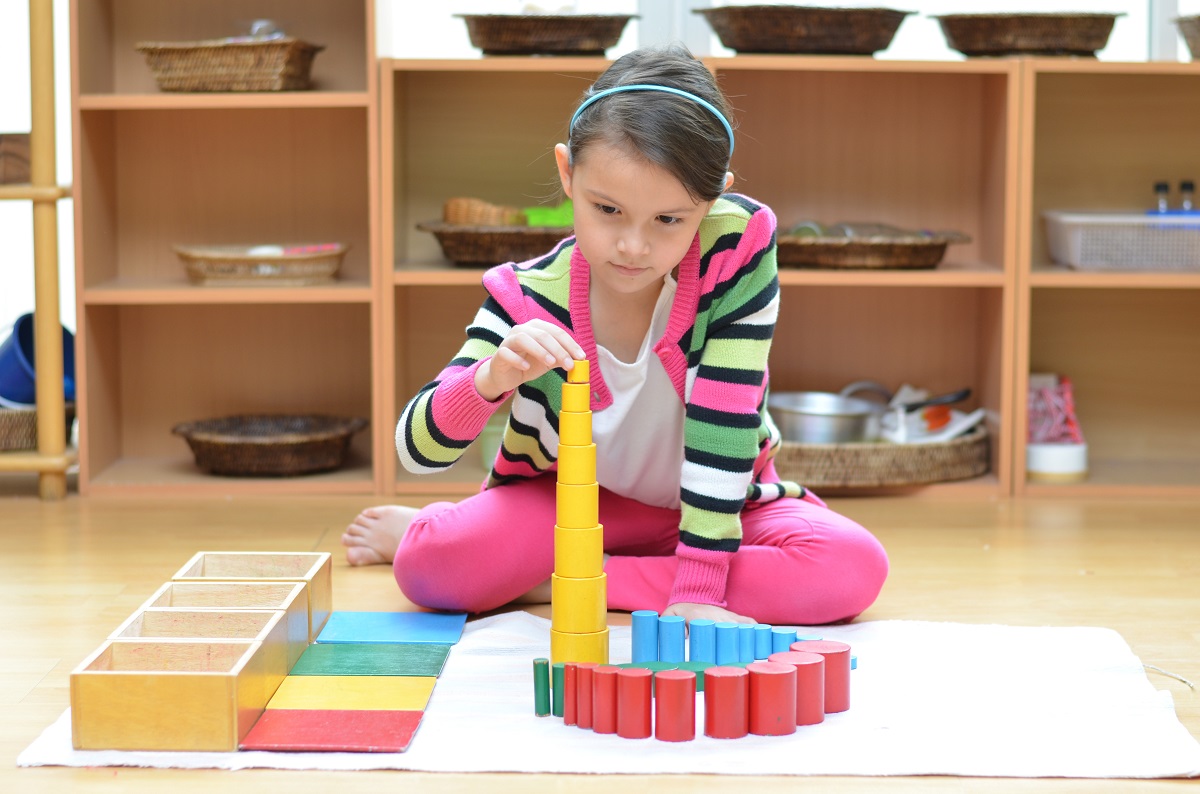
The most common complaint about a playroom is that children don't use it, or that they use it by dumping everything out and walking away. This is almost always an environment problem, not a child problem. A room where the toys are in bins, where everything is visible but nothing is organized, and where there is no defined sense of where things belong, produces exactly the behavior parents find frustrating: random extraction, brief engagement, and mess. The Montessori approach solves this not by buying different toys but by organizing the space differently.
The core principles applied to the playroom
Less is more
The single most impactful change in any playroom is reduction. Most children's play spaces contain significantly more than the child can engage with meaningfully. The result is overstimulation, shallow engagement, and the paradox of too many choices producing less enjoyment than fewer choices.
A Montessori playroom displays a small number of items, typically between eight and fifteen for a primary-age child, each one visible, accessible, and ready to use. The rest is stored out of sight, rotated in periodically as interest changes. Children who experience this reduction consistently show deeper, more sustained engagement with what remains. The toy that was ignored in a room of thirty toys becomes absorbing when it is one of eight.
Open shelves, not toy boxes
Toy boxes and bins make individual items invisible. Open, low shelves, with each item displayed clearly, make selection possible. When a child can survey the room with a glance and see exactly what is available, they choose deliberately. When everything is in a bin, they dump the bin. The storage format drives the behavior.
Everything has a place
In a Montessori playroom, each item has a designated spot and returns to that spot when the activity is complete, one of the clearest expressions of the prepared environment at home. This is not about tidiness as a value in itself. It is about maintaining the shelf as a functional menu. An item that is missing or displaced is an item the child cannot choose next time. Teaching the habit of returning materials to their spot is part of the work of the playroom, not a chore done after the work is over.
Setting up the Montessori playroom: room by room
The main activity shelf
The central feature of the playroom is a low, open shelf at child height. The items on it should represent a variety of activity types: something for fine motor work, something for sensorial exploration, something for creative expression, something for constructive play. They should be complete (everything needed is there), organized (each on its own tray or in its own basket), and limited (a child can see across the entire shelf without being overwhelmed).
A movement area
Young children need to move. A Montessori playroom should include a cleared floor space large enough for a mat or rug where the child can work on the floor, roll, tumble, and move freely. This area should be kept clear of materials when not in use. A low climbing structure, a balance board, or a simple ramp appropriate to the child's age provides the large movement challenge that supports gross motor development. It is not a substitute for time spent on outdoor activities, but it keeps large-motor work available on a rainy afternoon.
A defined art area
A small table with art materials organized on an adjacent shelf, accessible to the child without adult involvement, makes creative work possible independently. The materials should be appropriate for the child's age and ability: crayons, paper, child-safe scissors, and glue for toddlers; a broader palette including paint, clay, and construction materials for primary-age children. The key is that the child can select, use, and return materials without needing an adult to get things out or put them away.
A reading corner
A quiet corner with a floor cushion or small chair, good light, and accessible books creates a reading space that children will actually use. Books should be displayed covers-forward on a low shelf or in a small bin, showing the covers rather than the spines, limited to fifteen to twenty at a time and rotated regularly. Children who can see the covers of their books choose them with far more intention than children who see only a spine.
What to include at each age
Under 2 years
The infant and young toddler playroom is sparse by design. A few grasping and mouthing objects, a simple shape sorter, a stacking toy, and a push toy cover most of the curriculum, and the guide to the best Montessori toys by age goes into more detail month by month. Everything should be made of natural materials where possible, large enough not to be a choking hazard, and simple enough for the child to engage with independently. Avoid battery-operated toys that produce sounds and lights on their own: they provide passive stimulation that does not require the child to do anything.
2 to 3 years
Pouring and transferring trays belong on the toddler shelf alongside simple puzzles, matching activities, and a few construction materials like unit blocks. A dressing frame or a busy board with real fasteners provides fine motor challenge. A small art area with crayons and paper works well at this age. The number of items should remain small and rotate frequently as interest changes.
3 to 6 years
The primary-age playroom can include a wider range: simple Montessori materials such as Sandpaper Letters, a Movable Alphabet, and matching materials alongside creative materials, construction sets, and imaginative play props. Art materials can be more varied. Puzzles, sorting activities, and science exploration trays work well. The organizing principle remains the same: a limited, curated selection, each item complete and accessible.
6 to 12 years
The elementary playroom supports research projects, creative construction, art, music, and reading. Dedicated zones for each major activity type work better than mixed storage at this age. A project table for work in progress, a library corner, an art station, and a maker corner for building and constructing cover most of the elementary play curriculum.
Maintaining the Montessori playroom
The playroom requires two kinds of maintenance: daily tidying and periodic rotation. Daily tidying, done ideally with the child's involvement, returns each item to its designated spot. This takes five to ten minutes when the setup is right, because everything has a clear home. When the setup is not right, tidying takes longer because there are too many things and not enough clear designated spots.
Periodic rotation, every two to four weeks, refreshes the shelf by removing items that are no longer producing engagement and introducing stored or new items. The rotation is worth doing thoughtfully: pay attention to what is being used deeply and what is being ignored, and let that guide what stays and what comes out of storage.
The bin audit
If you want to see the Montessori principle in action immediately, try this: take everything out of the toy boxes in your current playroom. Lay everything on the floor. Look at what is there. Now, select eight to ten items that represent a variety of activity types. Put those on a low shelf. Put everything else in closed storage. Observe your child in the newly curated space for one week. Most families who do this report a noticeable shift in how long and how deeply their child engages. The transformation is not about what you bought. It is about what you removed.