
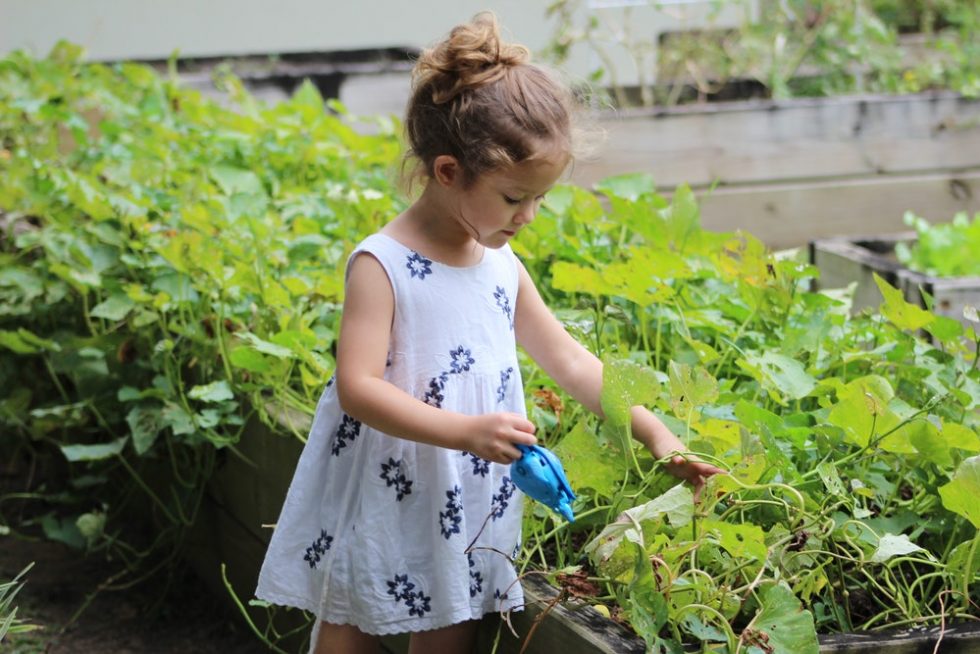
Maria Montessori was an early and consistent advocate for outdoor education and direct connection to the natural world. Her original Casa dei Bambini in Rome included a garden space where children worked alongside adults in real agricultural tasks. She believed that children who grow food, tend animals, and work with soil develop a fundamentally different relationship to the natural world than children who only encounter it through books and screens. A hundred years later, the research on children and nature largely validates this intuition.
Why gardening fits the Montessori framework
Gardening aligns with Montessori principles in ways that few other activities match:
- Real work with real consequences: a plant that is not watered dies. A seed planted too shallow does not germinate. These are not simulations. The child's actions have outcomes in the real world, and those outcomes matter.
- Control of error built in: the garden itself corrects. If a child over-waters, they observe the consequences. If they plant in shade when the seed packet said full sun, the stunted growth teaches what the instruction intended. The plant is the teacher.
- Long attention spans are required: a garden does not produce results in one session. The child must return, day after day, to water, observe, weed, and wait. This develops exactly the quality of sustained, purposeful attention that Montessori called "the polarization of attention."
- Concrete learning that abstractions can later attach to: the child who has grown a radish understands what a root vegetable is in a way that no vocabulary card can provide. The child who has watched an apple tree bloom in spring and fruit in fall understands seasons and life cycles with their whole body.
Gardening by age
Ages 18 months to 3 years
Toddlers can participate in gardening in limited but genuine ways. At this age, the focus is on sensory experience and simple repetitive tasks:
- Watering with a small watering can, the most satisfying task for this age, and one that teaches the connection between water and growth when observed consistently
- Pressing large seeds (beans, sunflower seeds) into soil, the motor coordination required is appropriate for this age, and the seeds are easy to handle
- Rinsing harvested vegetables with a small brush under running water
- Pulling easily-removed weeds in a designated area
At this age, do not expect sustained engagement. Two to five minutes of genuine participation is meaningful. The goal is establishing gardening as a normal part of daily life, not teaching botanical concepts.
Ages 3 to 6 years
The primary-age child can take on significantly more responsibility and begin to connect their garden work to science concepts:
- Planting from seed: reading seed packets (with help), preparing the soil, measuring planting depth, spacing seeds, labeling rows
- Transplanting seedlings: learning to handle delicate roots, understanding why plants need space
- Composting: collecting kitchen scraps, turning the pile, observing decomposition over weeks
- Harvesting and preparing produce: connecting directly to the food preparation curriculum: harvesting what you grew, washing it, cutting and eating it
- Drawing plants at different growth stages: observation drawing as a science and art activity combined
Ages 6 to 12 years
Elementary children can manage a garden plot with genuine independence, and their work can connect to formal science inquiry:
- Season-long garden planning: choosing what to grow based on climate and season, succession planting (planting new seeds as others are harvested), companion planting
- Science experiments in the garden: growing the same plant in different conditions (shade vs. sun, different soil types, different watering schedules) and recording results
- Seed saving: selecting the best specimens from which to collect seeds for next season, understanding the principles of selection
- Research projects: investigating the botany, history, or ecology of a particular plant; connecting to the Great Lesson of the Coming of Life
- Community contribution: growing produce for a food pantry, school lunch program, or community garden donation
What to grow: practical recommendations
The best plants for children's gardens are those that germinate quickly, grow visibly, and produce something edible or beautiful that the child can harvest. Slow or finicky plants are discouraging.
| Plant | Germination | Why it works for children |
|---|---|---|
| Radishes | 3 to 5 days | Fastest germination of any common vegetable; ready to harvest in 3 to 4 weeks |
| Sunflowers | 5 to 10 days | Large seeds (easy to plant), dramatic visible growth, edible seeds at harvest |
| Bush beans | 7 to 10 days | Vigorous growers, abundant harvest, clear connection between flower and bean |
| Cherry tomatoes | 5 to 10 days | Immediate edible reward throughout the season; children harvest snacks daily |
| Nasturtiums | 7 to 10 days | Entire plant is edible (leaves, flowers), beautiful, extremely forgiving |
| Lettuce | 4 to 8 days | "Cut and come again", children can harvest outer leaves repeatedly for weeks |
Setting up a garden space without a yard
A backyard is ideal but not required. Many of the most successful Montessori-aligned garden setups involve containers:
- A single large container (12 inches or deeper) on a balcony or windowsill is enough for tomatoes, herbs, or lettuce
- A windowsill herb garden: basil, chives, and parsley in individual pots, gives children a living thing to water daily and harvest for cooking
- Indoor seed-starting trays in a sunny window allow the germination and early growth stages to be observed closely, even in apartments
- Community garden plots: many cities have waiting lists, but many also have children's sections that prioritize families with young children
Gardening connects everything
One of the reasons Montessori educators value gardening so highly is that it refuses to stay in one subject box. A single tomato plant connects to botany (what plants need to grow), chemistry (soil composition, photosynthesis), practical life (watering, weeding, harvesting), food preparation (cooking what you grew), geography (where tomatoes originally came from), and history (how plants moved across continents as trade developed). This kind of natural interdisciplinary learning, emerging from a real activity rather than designed by a curriculum, is exactly what Montessori meant by cosmic education.