
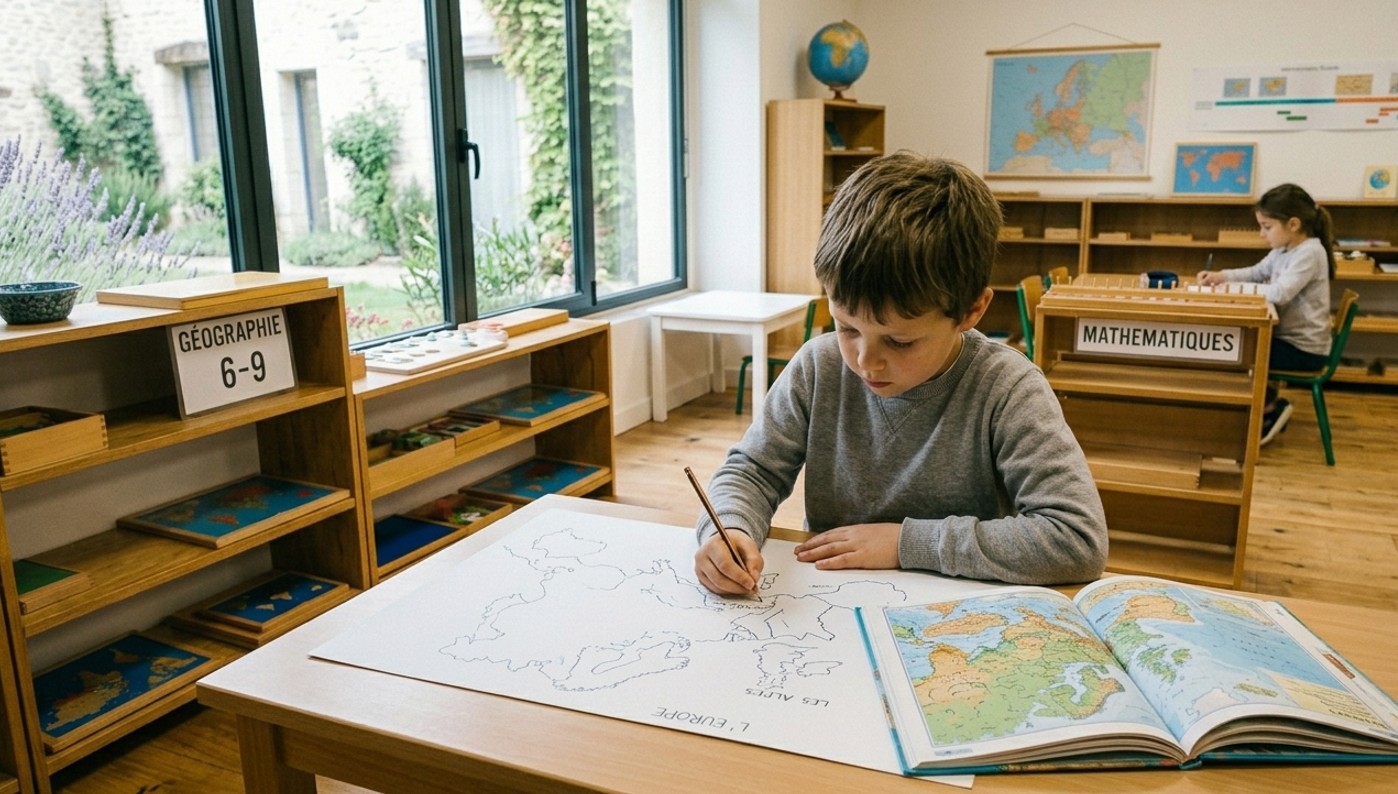
At age six, children move out of the Absorbent Mind period and into a new developmental phase defined by abstract reasoning, intense social interest, and a hunger for the "big picture", why things are the way they are, how the world works, and where humans fit in the larger story of life and the universe. Montessori activities for this age respond to all of these hungers.
The Great Lessons: starting with the whole
The signature activity of the Montessori elementary program is the Great Lesson, a dramatic narrative presentation, usually given at the start of a new school year, that opens an entire domain of inquiry. There are five Great Lessons: the Coming of the Universe and Earth, the Coming of Life, the Coming of Human Beings, the Story of Communication in Signs, and the Story of Numbers.
These are not lectures. They are told with props, experiments, and genuine drama, the guide might darken the room, light a candle, and tell the story of the Big Bang before demonstrating a chemical reaction that represents the early formation of the Earth's crust. From each Great Lesson, dozens of follow-up "research works" branch out: books, timelines, models, experiments, and writing projects that the child chooses based on their own curiosity.
Math activities
The Montessori elementary math curriculum continues the concrete-to-abstract progression from the primary years, building on tools like the Bead Frame and now working with much larger numbers and more complex operations.
- The checkerboard: a large geometric board used for multiplying multi-digit numbers by multi-digit numbers. Physical, beads placed on squares according to place value rules, before symbolic.
- Bead chains: long chains of 100 or 1,000 beads, used for skip counting, understanding multiples, and developing number sense at larger scales
- Fraction materials: physical fraction circles and bars used to explore equivalence, addition, subtraction, multiplication, and division of fractions, all concretely, before a single abstract equation is introduced
- Geometry cabinet: introduction to the formal properties of geometric shapes, leading eventually to calculation of area and volume using physical materials
Language and writing activities
Elementary language work shifts from decoding to composition, and from composition to analysis.
- Grammar analysis with symbols: Montessori grammar uses color-coded symbols to label parts of speech. A noun is a black triangle (solid, like a stone). A verb is a red circle (dynamic, like a wheel). This visual system makes the structure of language tangible.
- Research writing: follow-up work from the Great Lessons often involves writing factual reports, reading multiple sources, taking notes, and composing original text. By age 8 or 9, Montessori children are typically writing with genuine analytical structure.
- Story writing: creative writing is developed through structured prompts, peer sharing, and revision, not just free writing
Science and nature activities
Science in the elementary years connects directly to the Great Lessons, botany, zoology, physics, and chemistry are all explored as branches of the cosmic story, not as isolated disciplines.
- Growing and studying plants across the life cycle, with botanical drawings and written observations
- Dissection of simple organisms (flowers, vegetables) to study internal structure
- Simple physics experiments (levers, pulleys, inclined planes) that develop intuitive understanding of force and work
- Timeline of life on Earth, a very long paper timeline that makes the relative ages of different forms of life viscerally clear
At-home activities for this age
Elementary-age Montessori children at home benefit most from:
- Real projects with real outcomes: cooking a complete meal for the family, building something functional from wood or fabric, planning and executing a small garden
- Deep-dive research on a topic they choose: give them access to books, let them own the question, and resist the urge to direct the outcome
- Community contributions: volunteering, caring for a younger sibling, managing a household responsibility over time
- Time outdoors: nature observation, sketching, keeping a nature journal, all consistent with Montessori's emphasis on direct connection to the natural world