
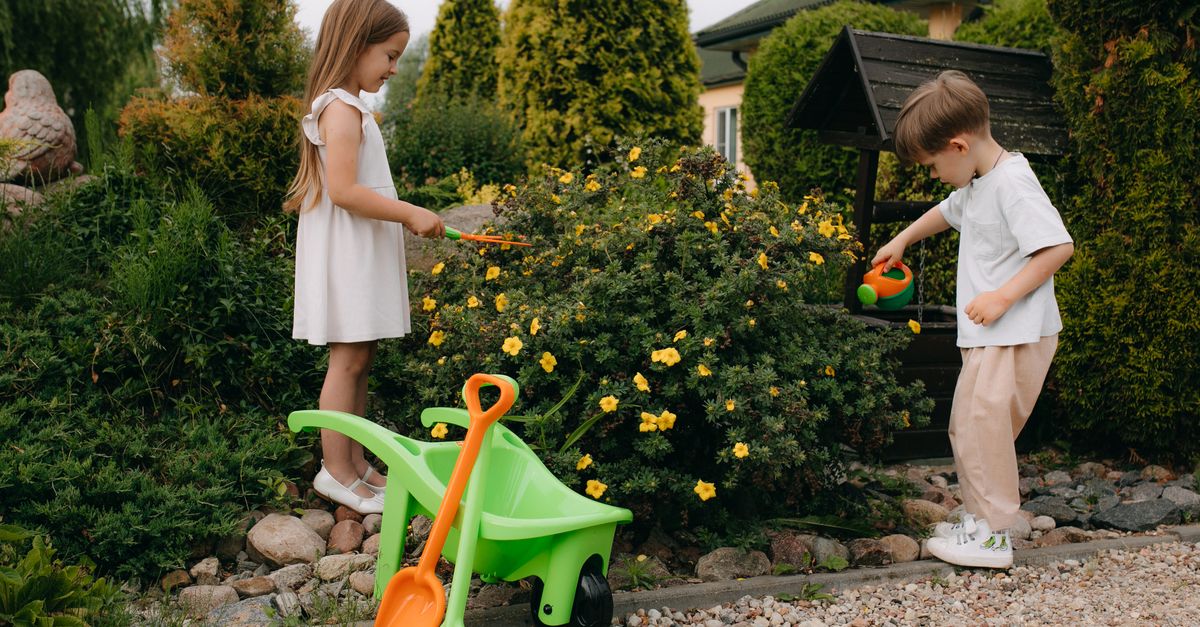
In Montessori's original work, she insisted that children spend significant time outdoors, working in gardens, observing animals, and engaging directly with natural materials. Her Casa dei Bambini in Rome had an outdoor courtyard that the children worked in daily. This was not incidental. She saw the natural world as the ultimate source of the concrete, hands-on, self-correcting experience that her entire pedagogy was built around. A seed that grows or fails to grow, a bug that hides or runs, a weather change that arrives unexpectedly: nature is full of the unscripted reality that Montessori considered essential to genuine learning.
The outdoors as prepared environment
The concept of the prepared environment is usually associated with the classroom: the low shelves, the orderly materials, the accessible tools. But Montessori extended this concept to the outdoor space. A well-prepared outdoor Montessori environment:
- Has areas for physical movement, both open space and challenging terrain
- Contains living things: a garden, trees, grass, insects, possibly animals
- Provides real tools appropriate to the child's size: child-sized rakes, trowels, watering cans, buckets
- Offers natural materials for exploration: soil, water, sand, stones, leaves, wood
- Has a designated space for observation and quiet work: a log to sit on, a table for nature journaling, a shaded area
Not all outdoor spaces meet this description, and not all families have access to large gardens. But the principle scales: even a balcony with two pots of soil and a small watering can provides more Montessori outdoor experience than a perfectly manicured space that children are asked to keep pristine.
Outdoor activities by age
Infants and young toddlers
At this age, outdoor time is primarily about sensory experience in fresh air. The infant or young toddler taken outside benefits from:
- Lying on a mat in the shade: watching leaves move in the wind, tracking light and shadow, listening to outdoor sounds. This is not passive. For a young infant, this is intense sensory work.
- Tummy time on natural surfaces: grass, a blanket on uneven ground. The slightly unstable surface challenges motor development differently than a flat indoor floor.
- Supervised contact with natural materials: being held near plants to touch leaves, feeling the texture of bark, listening to birdsong pointed out by an adult
Toddlers
The mobile toddler is a natural explorer. Outdoor Montessori activities at this age center on real, hands-on work:
- Watering plants with a child-sized watering can. The results are immediate and visible. The can needs refilling. There is a real feedback loop.
- Collecting natural objects: stones, sticks, leaves, pinecones. Sorting them, arranging them, carrying them. No instructions needed.
- Digging in soil with a real small trowel. What is in the soil? Worms? Roots? The discovery is the activity.
- Raking leaves with a child-sized rake. The physical work of raking is satisfying at this age; the pile is its own reward.
- Puddle play and sand: water and sand are among the most absorbing materials in the Montessori sensorial world. Outdoor puddles and sandboxes provide both with no setup required.
Primary
The primary-age child can take on more complex outdoor projects and begin developing the habit of careful observation:
- Nature journaling: a small blank notebook and a pencil. The child draws what they see: a leaf, an insect, a flower, a cloud. No artistic standard is applied. The habit of looking carefully and recording what you see is the goal. See the section below for guidance.
- Gardening with real responsibility: growing something from seed, with real care required for real results. The child who is responsible for a specific plant, checking it daily, watering it when needed, learns that their actions have consequences over time. See our complete gardening guide for specific crops and approaches by age.
- Insect and animal observation: using a magnifying glass to look at insects closely, observing bird behavior, watching a spider build a web. The Montessori approach is to look, not to capture and keep. Observation in the animal's natural context develops a different kind of attention than a captured specimen in a jar.
- Weather tracking: a simple weather chart kept outdoors or at a window. What does the sky look like? What did it look like yesterday? What changed? Simple daily observation over weeks or months is early science.
- Leaf and bark rubbings: placing paper over a textured natural surface and rubbing it with a crayon or soft pencil reveals the structure underneath. A simple activity that produces beautiful results and develops close observation.
Elementary
The elementary child can take outdoor learning into more extended, inquiry-based territory:
- Ecosystem observation projects: choosing a specific spot outdoors and visiting it weekly for a month, recording changes in plants, animals, weather, and light. The time span is the point: change becomes visible only over time.
- Plant identification: using a field guide to identify local trees, wildflowers, or birds. Matching what you find to a classification system is early taxonomy, and it applies the Montessori biology curriculum to the real world.
- Outdoor research questions: "Why does this side of the path have more moss than that side?" "Where do the worms go when it hasn't rained?" The elementary child's question-driven curiosity makes the outdoors an inexhaustible research environment.
- Measuring and mapping: creating a simple map of a garden or outdoor space, measuring distances and recording them. Geography and mathematics outdoors, without worksheets.
Nature journaling
Nature journaling deserves particular attention because it is one of the most versatile, accessible, and developmentally rich outdoor activities across the full age range. A nature journal is simply a blank book used for recording observations of the natural world: drawings, notes, collected specimens (pressed flowers, taped leaves), and questions.
The Montessori principle that applies here is the same as for all material: isolation of quality. The nature journal focuses on one thing at a time. Today we are looking at this leaf. Not all the leaves, not the whole tree, not the whole garden. This leaf, its shape, its texture, the pattern of its veins, what it looks like when held to the light.
A good nature journal session:
- Begins with looking, before any drawing or writing. Spend two or three minutes just observing.
- Draws what you see, not what you think a leaf looks like. The difference is significant: drawing from observation develops different visual acuity than drawing from memory.
- Labels parts, if the vocabulary is known: blade, midrib, petiole, margin. If not known, they can be looked up after drawing.
- Records the date, the location, and the conditions: "Tuesday. Garden. Overcast. About 15°C."
- Ends with a question: "Why is this one a different color than the one next to it?"
Montessori's view on the natural world
In her later work, particularly in Education for a New World and To Educate the Human Potential, Montessori argued that the child's connection to the living world was not a supplement to their education but a foundation of it. A child who understands their place in the natural order, who has felt the weight of soil, watched a plant grow from seed, and observed the community of a garden, has something that no classroom curriculum can fully provide: a sense of proportion, of patience, and of belonging to something larger than themselves.