
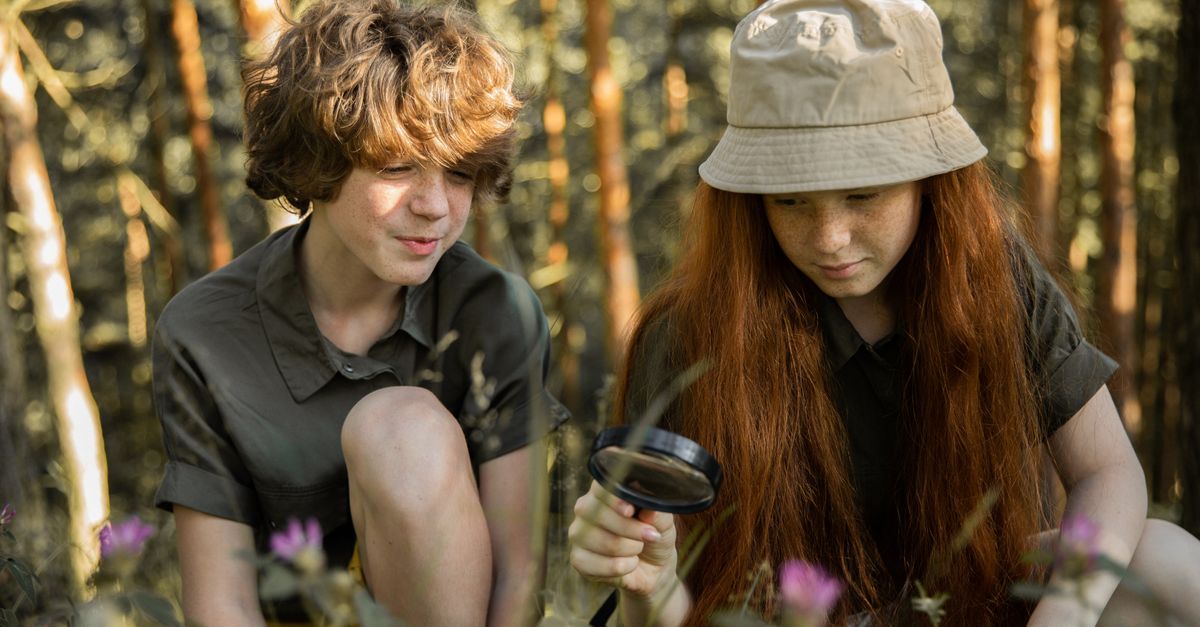
In a conventional school, science is a period on a schedule. In a Montessori environment, science is woven into everything: the naming of leaves brought in from outside, the careful observation of a caterpillar in a jar, the question a child asks about why ice melts, the drawing of a flower's internal parts before they know what any of those parts are called. Science begins in wonder. The Montessori environment protects that wonder while gradually building the vocabulary and frameworks to think more precisely about it.
The foundation: direct observation
Before any classification system is taught, before any vocabulary card is introduced, Montessori science begins with looking. Really looking. A child who spends ten minutes drawing a leaf, noting where the veins go, how the edges are shaped, whether the surface is smooth or textured, knows that leaf in a way that no label card can replicate. Montessori teachers call this "going to nature first, then to books."
This is not merely a pedagogical preference. It reflects a developmental truth: young children learn through their senses, through direct contact with the world. Abstract classification systems are meaningless until the child has encountered the living things being classified. You introduce the word "deciduous" after the child has watched leaves fall. You introduce "photosynthesis" after the child has grown a plant in two different light conditions and observed what happened.
Botany activities
Botany is one of the richest areas of the primary and elementary Montessori curriculum, and it is also one of the most accessible for home educators.
Leaf collection and classification
Children collect leaves from their environment, press and dry them, and then work to classify them by shape, edge type, and venation. The Montessori Botany Cabinet provides wooden puzzle pieces for the most common leaf shapes (linear, elliptical, ovate, lanceolate, orbiculate), which children match and name. At home, a collected leaf can be compared to illustrations in a good field guide, the same cognitive operation, without the formal material.
Parts of a plant
Classified cards (three-part cards with a picture-only card, a label-only card, and a combined control card) introduce the vocabulary of plant anatomy: root, stem, leaf, flower, seed, fruit. Children match the labels to the pictures without guidance, then check their work against the control card. This self-correcting structure is characteristic of Montessori science materials across all ages.
Growing from seed
One of the most complete science activities available to any age group: plant a seed, observe it daily, draw what you see, record how much it grows. At the primary level, this is about observation and wonder, the same terrain covered in more depth in our guide to Montessori gardening activities. At the elementary level, it becomes a genuine scientific inquiry, varying light, water, or soil and comparing outcomes. The fact that the plant grows (or fails to grow) is the child's real teacher.
Zoology activities
The Montessori zoology curriculum introduces animal classification systematically, moving from the broadest categories (vertebrates vs. invertebrates) to the most specific (the distinction between amphibians and reptiles).
Vertebrate and invertebrate classification
Classified cards, puzzle figures, and model collections introduce the five vertebrate groups: fish, amphibians, reptiles, birds, and mammals. For each group, children learn the defining characteristics, not as facts to memorize but as attributes they can verify by observation. Does this animal have fur? Does it lay eggs? Is it warm-blooded? The classification becomes meaningful because the child can apply it.
Animal observation journals
One of the most valuable zoology activities requires nothing more than time and attention: watching a real animal and drawing what you see. A bird at a feeder. A caterpillar on a branch. A goldfish in a tank. Children who observe and draw animals develop a quality of attention that no nature documentary can produce, because looking and drawing require you to notice things that watching alone lets you miss.
Life cycle activities
Montessori life cycle activities, raising butterflies from caterpillars, observing tadpoles become frogs, tracking a plant from seed to fruit, provide a continuous experience that no single lesson can replicate. The child experiences time passing, change occurring, death as part of a cycle. These activities are among the most memorable of the entire primary experience.
Physical science activities
Physical science in the primary years (ages 3 to 6) is largely exploratory: sink and float, mixing colors, observing states of matter. In the elementary years, it becomes more structured and experimental.
Simple machines (ages 6 to 12)
Elementary students explore the six classic simple machines, lever, wheel and axle, pulley, inclined plane, wedge, and screw, through hands-on experiment. They discover, rather than are told, that a long lever allows them to lift a heavier weight. They discover that a wheel reduces friction. The concept arrives through experience, not through definition. When the formula comes later, it describes something they already know in their bodies.
States of matter exploration
Water is the most accessible material for exploring states of matter with young children. Observing ice melt into water and water evaporate from a dish left in the sun requires only a refrigerator and a window, but the observations a child makes, when guided to look closely and describe what they see, are genuine scientific observations. "The water disappeared. Where did it go?" is the beginning of a conversation about evaporation that will come back meaningfully when the vocabulary is introduced years later.
Science journals
Starting around age 6, Montessori children keep science observation journals, notebooks in which they draw and describe what they observe. These are not worksheets. There are no blanks to fill in, no correct answers to match. They are records of the child's own observation and thinking. Over years, a science journal becomes one of the most remarkable documents a child produces: genuine scientific observation, in their own words and drawings, across many topics and many years.
Science activities without classroom materials
- Nature walk with a purpose: before the walk, choose one question: what kinds of seeds can we find? what colors appear on leaves in fall? how many different textures can we find in bark? The focused question transforms a walk into an inquiry.
- Observation drawing: give your child a real object (a feather, a pinecone, a shell, a vegetable) and ask them to draw it as accurately as they can. No instruction about how to draw. Just look and draw. The quality of attention this develops is remarkable.
- Weather journal: record the weather every day for a month. Temperature, cloud cover, precipitation, wind. Graph the results. Ask: what patterns do you notice?
- Simple experiments: sink and float (what predicts which?), which surfaces are rough and which are smooth, what happens to sugar in cold water vs. hot water. Ask the question before you do the experiment. Write down what you think will happen. Find out. Write down what actually happened.
Science and the Great Lessons
In the Montessori elementary program, all science is connected to the Great Lessons, five dramatic narrative presentations that tell the story of the universe, life, human beings, language, and mathematics. Botany connects to the Coming of Life, later traced concretely through the timeline materials. Physical science connects to the Coming of the Universe and Earth. This cosmic framing means that no science topic is taught in isolation: everything is part of a larger story that the child is learning to understand piece by piece. See our guide to elementary activities for more on the Great Lessons.