
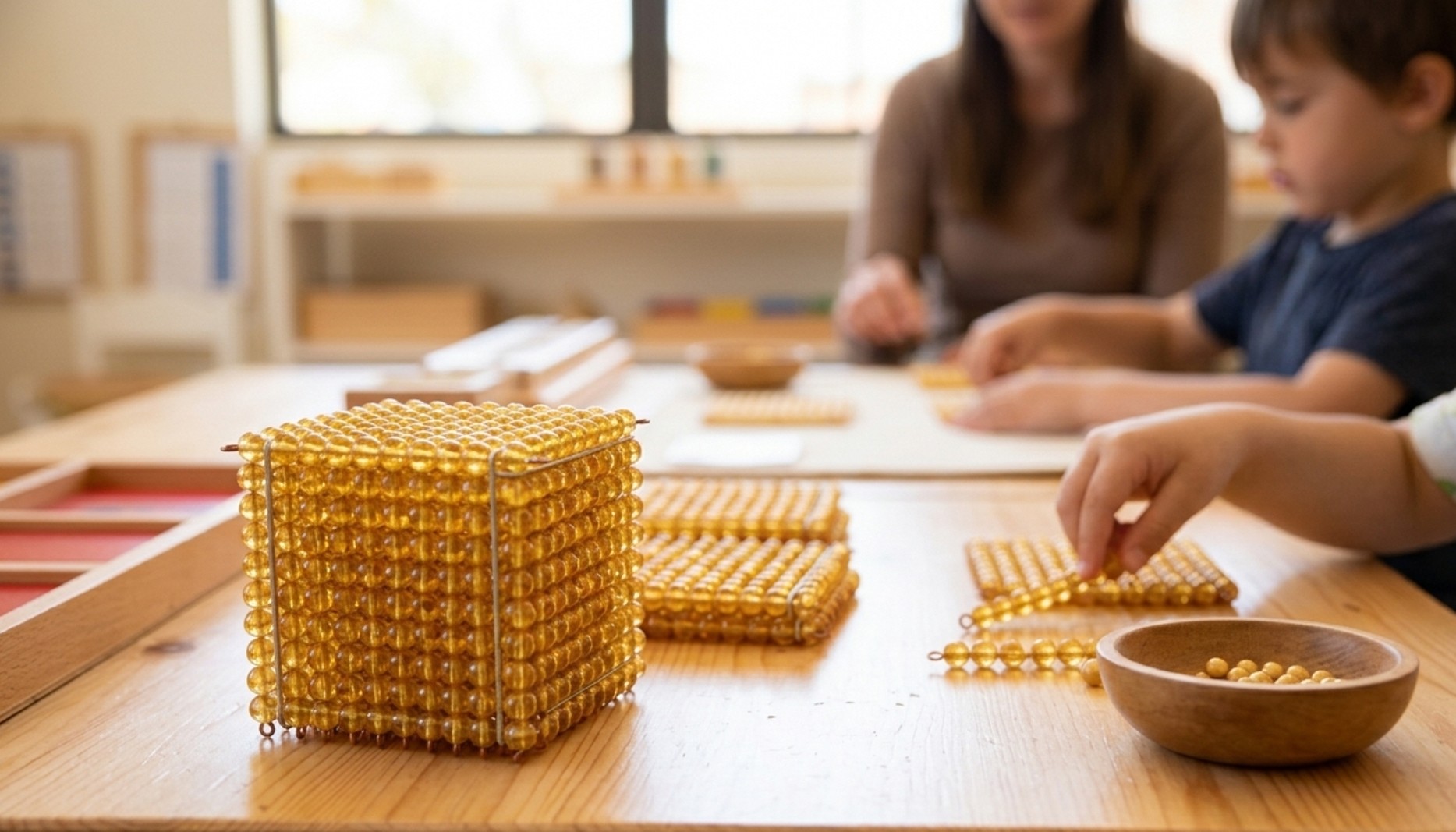
The Golden Bead material consists of golden-colored glass or acrylic beads in four forms: individual unit beads, bars of ten beads strung together, squares of ten bars (100 beads in a flat grid), and cubes of ten squares (1,000 beads in a solid three-dimensional form). These four forms represent the four categories of the decimal system, units, tens, hundreds, and thousands, in a physical, sensory form that the child can handle, count, carry, and exchange.
The physical representation of place value
Place value is one of the most abstract, and most commonly misunderstood, concepts in elementary mathematics. Most children who can "do" place value in the conventional sense (circle the "tens digit," add in columns) cannot explain what that tens digit actually represents. They have learned a procedure for which the underlying concept is opaque.
The Golden Bead material makes this concept physical and therefore accessible to young children. One unit bead is literally one. A ten-bar is ten unit beads joined together in a line, the child can count all ten. A hundred square is ten ten-bars joined in a flat grid, the child can count all 100, or count ten groups of ten. A thousand cube is ten hundred squares stacked into a solid, the child can feel its weight, see its size relative to the unit bead, and understand viscerally that it represents something much larger.
The relationship between categories is not told to the child, it is discovered through handling. The child who has carried a thousand cube and a unit bead in the same trip across the classroom knows, in their body, that these represent different magnitudes. No abstract symbol system can convey this.
The Bank Game
The Golden Beads' most important early exercise is called the Bank Game. The teacher sets up a "bank", a mat with quantities of all four bead types. Number cards (1–9 for units, 10–90 for tens, 100–900 for hundreds, 1000–9000 for thousands) are laid out nearby. The child selects a number card or receives a number from the teacher, goes to the bank, and retrieves the correct quantity of beads: for "3,452," they bring back 3 thousand cubes, 4 hundred squares, 5 ten-bars, and 2 unit beads.
This exercise contains everything important about place value: the idea that numbers have distinct categories (each category represented by a different bead form), that the categories are powers of ten, that any number in the system is an assembly of these categories, and that changing a digit in one column does not change the digits in other columns. Children who play the Bank Game extensively develop a place value intuition that later supports all four arithmetic operations and, eventually, algebra.
The four operations with Golden Beads
Once the child can work confidently in the Bank Game, the Golden Beads are used to explore all four arithmetic operations concretely.
Addition
Two or more children each retrieve a quantity from the bank, bring their bead collections to the mat, and combine them. The teacher then counts the total, demonstrates any carrying (ten unit beads exchanged for one ten-bar), and writes the corresponding equation. The child sees what "carrying" actually means: when you have accumulated ten units, you exchange them for one ten, and the equation's carry mark represents that physical exchange.
Subtraction
A large quantity is retrieved from the bank. A smaller quantity is then "taken away" physically. If the subtraction requires borrowing (you need to take 7 units but only have 3), the child exchanges one ten-bar for ten unit beads at the bank, then continues. Borrowing, too, has a concrete meaning: you are exchanging one of a larger category for ten of the smaller category. The abstract notation represents a real exchange.
Multiplication
Multiplication is introduced as repeated addition of equal groups. Three children each retrieve the same quantity ("each person gets 2,342 beads"). They bring their beads to the mat and combine them. The teacher writes the equation: 3 × 2,342 = 7,026. The concept of multiplication as equal groups added together is physically inescapable.
Division
A large quantity is retrieved and divided equally among several children. The sharing process, placing one bead at a time in front of each child in turn, produces equal piles. The remainders (if any) go back to the bank. Division as equal sharing is experienced concretely, and the concept of remainder has a physical reality: the beads that were left over when everyone already had an equal share.
From Golden Beads to abstract symbols
The Golden Beads are only the beginning of the Montessori math materials sequence. After extensive work with the physical beads, children move to more abstract representations in a carefully designed progression:
- The Stamp Game: colored tiles representing units, tens, hundreds, and thousands, used for the same operations as the beads but without the physical bulk. The child records operations on paper while still using physical tiles.
- Bead Chains: long chains of beads for counting, skip counting, and exploring multiplication patterns
- Dot Game: a paper-based representation of the bead operations, further abstracting toward written arithmetic
- Abstract operations on paper: when the child can perform operations on paper correctly and explain why the algorithm works, they have completed the concrete-to-abstract progression for that operation
This entire progression, from physical beads to abstract paper calculation, typically unfolds over two to three years in the primary program. By the time a Montessori child reaches elementary age and encounters the Bead Frame and multi-digit operations in a more formal context, they have a deep conceptual understanding that conventionally educated children rarely possess.
Why the Golden Beads matter so much
Research on Montessori mathematics consistently finds that Montessori children outperform conventionally educated peers on measures of number sense, place value understanding, and flexible problem-solving. The 2006 study by Lillard and Else-Quest in the journal Science found that Montessori children at age 5 demonstrated significantly stronger numeracy skills than peers in conventional programs. The same study found advantages in literacy, cognitive flexibility, and social development.
The Golden Beads are central to this mathematics advantage. A child who understands what the symbols in a place value system actually represent, because they have counted and exchanged physical beads, is better equipped to handle any subsequent mathematical challenge than one who has only ever seen the symbols.
Buying the Golden Beads
A complete Golden Bead set from a quality Montessori supplier (Nienhuis, Albanesi, Montessori Outlet) costs between $80 and $200, depending on quantity and material quality. Glass beads are more beautiful and more durable than acrylic but also more expensive and heavier. For home environments, a smaller set (45 units, 45 ten-bars, 9 hundred squares, 1 thousand cube) is sufficient for most activities. See our complete buying guide for details.
The Golden Beads are introduced after the child has worked with the Number Rods and Sandpaper Numbers, which build quantity understanding and numeral recognition for the numbers 1 through 10. The Golden Beads then extend that concrete understanding into the decimal system, using the same principle of physical experience before symbolic representation that runs through the entire Montessori math sequence.