
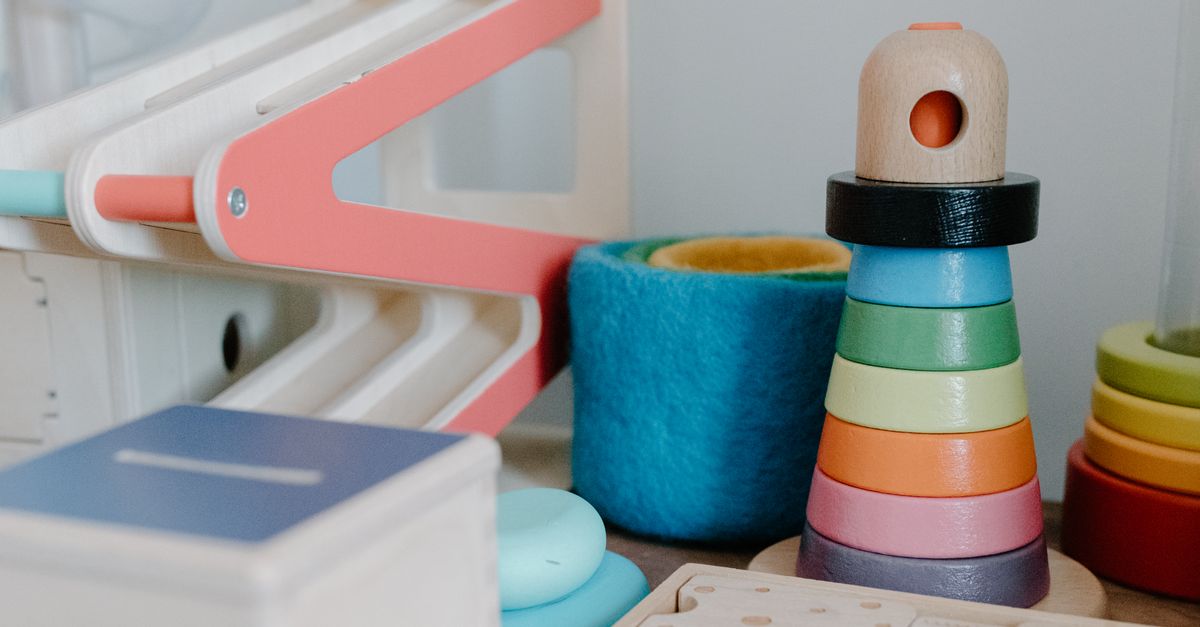
Before any age-specific recommendations, the criteria: a Montessori-aligned toy or material serves one developmental purpose at a time, is made of real materials (wood, metal, natural fabric, glass), requires the child's active engagement rather than producing entertainment on its own, and is scaled to the child's actual physical and cognitive capacity at the time of introduction, not months or years ahead. By these criteria, the vast majority of what fills toy store shelves does not qualify. What does qualify tends to be simpler, more beautiful, more expensive, and far more effective.
What makes a toy Montessori-aligned
- Real materials: wood, metal, fabric, natural rubber. Not plastic that flashes and beeps.
- Single purpose: each item does one thing, develops one skill, or explores one concept at a time. Multi-function toys split the child's attention; single-purpose materials focus it.
- Active participation required: the child must do something to use it. It does not produce outcomes (sounds, lights, movement) without the child's engagement.
- Appropriate for the current stage: not six months ahead of where the child is. A toy that is too advanced is as useless as one that is too simple.
- Control of error built in: ideally, the material gives the child feedback when it's used incorrectly, without an adult needing to correct them.
- Aesthetic quality: beautiful objects are treated more carefully and engaged with more attentively. This is not a luxury preference; it is a developmental observation with a long Montessori tradition behind it.
Birth to 3 months
- Munari mobile: high-contrast black and white geometric shapes. The most developmentally appropriate thing you can offer a newborn.
- Octahedron mobile: three colored geometric solids. Introduced around 5 to 6 weeks, as color vision emerges.
- A simple floor mat or gym mat, a firm surface at floor level, where the infant can lie without being enclosed or elevated.
3 to 5 months
- Gobbi mobile: five spheres in graduated shades of one color. Challenges developing color discrimination.
- Dancers mobile: figures that invite early reaching. Introduced as the infant begins to bat at objects intentionally.
- Wooden grasping ring: a simple smooth ring of wood or natural rubber, sized for an infant hand to close around. First grasping object.
- Bell cylinder: a small cylinder that makes a soft sound when shaken. Connects sound production to the infant's own movement.
5 to 12 months
- Object permanence box: a wooden box with a hole in the top and a drawer or slot at the side. The child drops a ball through the hole; it disappears and then reappears in the drawer. Teaches object permanence, the understanding that objects continue to exist when out of sight.
- Shape sorter (wooden, simple): three to four shapes maximum. Look for one where each shape is genuinely different from the others, making it possible to succeed through trial and observation rather than random insertion.
- Nesting cups or graduated rings: stacking and nesting with objects that vary in a single dimension. Develops visual discrimination and spatial reasoning.
- Push-pull toys: as the infant begins to pull to standing and take first steps, a simple wheeled toy to push or pull along provides appropriate motor challenge.
12 months to 2 years
- Knob puzzles: wooden puzzles with large knobs on each piece. Start with three-piece puzzles (animals, shapes, vehicles), progress to five and eight pieces. The knob is critical: it develops the pincer grip that will later support writing.
- Spooning and transferring set: a small tray with two bowls and a spoon. The child transfers dried beans, marbles, or small objects from one bowl to the other. This is a practical life activity and a sensorial and fine motor activity at once.
- Simple wooden building blocks: unit blocks in natural wood, without color or decoration. The best blocks are the ones that can be used in the most ways: standard rectangular units that can be combined to create balanced structures.
- Matching objects to pictures: a basket of real objects (spoon, ball, apple, car) with corresponding picture cards. The child matches the object to its image, developing classification and early language.
- Busy board: a panel of real household fasteners, latches, and locks. A natural next step once knob puzzles are mastered, extending the same fine motor persistence toward more complex mechanisms.
2 to 3 years
- Dressing frames: buttons, snaps, and zippers practiced on frames before being applied to real clothing. One of the most practically valuable materials in the Montessori curriculum.
- Color sorting materials: trays of objects sorted by color, starting with three or four highly distinct colors. Later, graduated shades of a single color.
- Simple wooden puzzles with more pieces: 10 to 20 piece puzzles with distinct, non-overlapping pieces that teach spatial reasoning and planning.
- Practical life materials: a child-sized broom, dustpan, and mop; a watering can; a small pitcher for pouring. These are not toys. They are real tools scaled to the child's hands.
- Playdough or clay: not a craft medium but a sensorial and fine motor material. Provide it with simple tools (a wooden rolling pin, cookie cutters, a small knife for cutting) and no instruction about what to make.
3 to 6 years
- Pink Tower or graduated nesting set, the quintessential sensorial material of the primary years.
- Sandpaper Letters: the bridge from spoken sound to written symbol. Can be DIY'd at home effectively.
- Movable Alphabet: letter tiles for composing words before writing by hand. High value per dollar spent.
- Number rods (or home equivalent): graduated rods for counting and early math. At home, colored tape on dowel rods achieves a reasonable approximation.
- Watercolor set with real brushes: not washable tempera, not crayons. A real set of watercolors and brushes in different sizes, with a jar for water and a palette for mixing.
- Open-ended building materials: wooden unit blocks, Kapla planks, or similar materials that allow complex three-dimensional building without a predetermined outcome.
6 to 12 years
- Real tools for real projects: a basic woodworking set (hammer, nails, saw, sandpaper), sewing kit with real needles and thread, cooking tools. Not toys. Real equipment, introduced with appropriate safety guidance.
- Research materials: quality nonfiction books on topics the child cares about. A nature field guide for their region. An illustrated atlas. A quality children's encyclopedia.
- Musical instruments: a recorder, ukulele, or keyboard for children who show interest in music. Real instruments, not toy versions.
- Golden Bead material or checkerboard: for families who want to support the Montessori math sequence at home, these are the most productive investments for this age range, with the Bead Frame a natural next step once place value with the beads is solid.
- Science observation journal: a blank sketchbook dedicated to nature observation, drawing, and recording. One of the most valuable educational investments available, and it costs under $15.
What to skip
- Anything that plays music, flashes lights, or produces effects without the child's active input
- Toys labeled "educational" without a clear developmental purpose
- Screen-based learning apps for children under 3
- Coloring books (which train the child to fill a predetermined space rather than observe and represent)
- Character merchandise, licensed characters direct children's imagination toward existing narratives rather than their own
- Toys aimed six to twelve months ahead of the child's current developmental stage