
The Montessori classroom works because every element of it has been deliberately designed to support the child's independence, concentration, and development. A Montessori home works the same way, not by mimicking the classroom, but by applying the same thinking to a different context. The question is not "how do I turn my living room into a classroom?" It is "what does my child actually need from this space, and am I making it possible for them to get it on their own?"
What Montessori at home is not
Before going further, it is worth being clear about what Montessori at home does not require:
- It does not require purchasing expensive classroom materials. Many of the most valuable Montessori activities at home use ordinary household objects, real tools, and the genuine work of daily life.
- It does not require a dedicated playroom or significant renovation. The principles apply to any space, large or small, urban or rural, rented or owned.
- It does not require a parent who has read every Montessori book ever published. The core ideas are accessible, and the most important practice is observation, not knowledge.
- It does not require perfection. Montessori at home is a direction, not a standard. Moving incrementally toward a more child-centered environment is worthwhile even if you never arrive at a fully prepared Montessori home.
The four principles that travel from school to home
1. The prepared environment
In a Montessori classroom, the environment is deliberately designed to be accessible, orderly, and beautiful. At home, this means making your child's world navigable independently. Low shelves where toys and materials are stored in order, one item per shelf with space between them, rather than a toy box everything gets dumped into. A low hook for the child's coat. A step stool at the bathroom sink. A drawer in the kitchen with a few child-sized utensils. A small pitcher for pouring their own water.
None of these changes are expensive. All of them shift the child from dependence on an adult to independence in their own environment. That shift is the prepared environment in practice.
2. Freedom within limits
Montessori education offers children real freedom, not unlimited freedom. The child in a Montessori classroom may choose any work on the shelf, work with it as long as they wish, and work where they are most comfortable. But they may not disturb other children, leave materials in disarray, or use materials in ways that damage them. The limits are real and consistently held. The freedom within those limits is also real.
At home, this principle shows up in how choices are offered. Rather than "what do you want to wear today?" (which generates overwhelm and power struggles), a Montessori-influenced approach offers two real options: "the blue shirt or the striped one?" Rather than an open-ended snack situation, a prepared tray with the day's options, accessible to the child, from which they serve themselves. Freedom offered within a structure the child can manage.
3. The child's right to uninterrupted work
One of the most important and least expensive things a parent can do at home is resist interrupting a child who is deeply engaged in an activity. The Montessori classroom protects concentration above almost everything else. No one interrupts a child who is focused, even to give praise. At home, this means noticing when your child is in a state of concentration and choosing not to break it.
This goes against several instincts, the instinct to praise ("Look how good you're doing!"), the instinct to help ("Here, let me show you"), and the instinct to redirect to something you consider more educational. All of these interrupt the concentration the child is already practicing. The child who spends forty minutes carefully filling and pouring rice from one bowl to another is not wasting time. They are building exactly the focused attention that later becomes reading and mathematics.
4. Real work over pretend work
Young children want to participate in real household activities. They want to cook, clean, tend to plants, and care for younger siblings. Montessori at home means matching those instincts to real chores suited to their age, with appropriate tools, appropriate expectations, and without undoing their work afterward. A three-year-old who sweeps the floor imperfectly has done real work. A three-year-old who pushes a toy vacuum across a plastic play kitchen has not.
The practical life activities that are the foundation of the Montessori primary classroom are simply the real activities of daily life, offered to the child at the level of their actual ability. The classroom formalizes something that home can offer more naturally.
Setting up spaces by age
Infant (birth to 12 months)
The infant Montessori space centers on freedom of movement and sensory richness without overstimulation. The key elements:
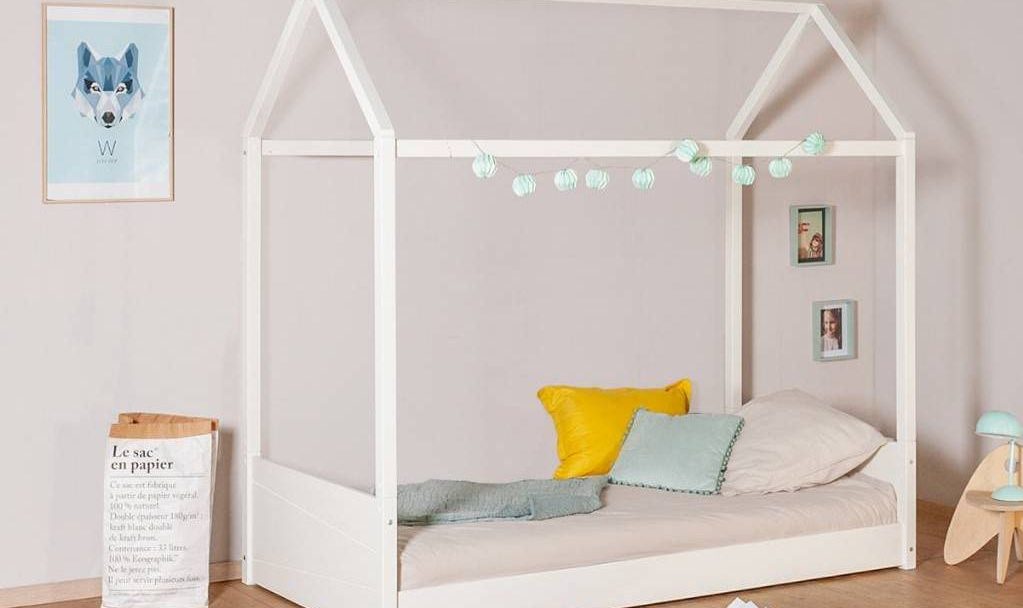
- A low, floor-level sleeping space (the Montessori floor bed) that allows the infant to move freely from the first months
- A low mobile in the visual field, changed as visual development progresses from high-contrast to colored to three-dimensional (see the infant mobiles guide)
- A small mirror at floor level, which provides visual feedback during tummy time
- A low play area with a limited selection of real, simple objects for grasping and mouthing: a wooden rattle, a fabric ball, a metal bell. Not a play gym covered in twenty hanging items in five colors.
Toddler (12 months to 3 years)
The toddler environment is where the prepared environment principle has the most immediate impact. Key elements:
- Low open shelves with three to five activities displayed at a time, rotated as interest wanes. Not a toy box.
- A small table and chair at child height for work activities
- Access to a water source for pouring, washing hands, and practical life activities
- Real child-sized tools for household participation: a child broom, a small dustpan, a sponge for wiping surfaces, a small pitcher
- A limited, orderly selection of books at child height, spines out or covers facing forward, changed periodically
- Child-height hooks and drawers for clothing and personal items, supporting dressing independence
Primary (3 to 6 years)
At this age, the home environment can support the full range of Montessori development: language, mathematics, sensorial, and practical life. Key elements:
- A dedicated workspace: a low table with good light, used consistently for activities, free of the screens covered in the screen time guide
- Art materials stored accessibly and organized so the child can set up and clean up independently
- A section of the kitchen the child can access independently, ideally with a low shelf for snack preparation materials
- Books organized by topic or type rather than piled haphazardly
- A child-accessible kitchen area: a low shelf with a small pitcher, their cup, a snack plate, and simple preparation tools puts real food work within their reach every day
- Selected Montessori materials if budget allows: a set of Sandpaper Letters, a Movable Alphabet, and a Number Rods set cover most of the early language and math curriculum at modest cost
The daily rhythm
Montessori classrooms have a long uninterrupted work period, typically two to three hours in the morning, during which children choose and move between activities without directed group transitions. At home, creating the conditions for sustained work does not require three uninterrupted hours. It requires predictability.
Children who know what is coming next are less anxious and more able to focus on the present activity. A Montessori-influenced home rhythm is not a rigid schedule, it is a predictable sequence: morning routines lead into free work time, which leads into outdoor time, which leads into lunch, and so on. The child knows the shape of the day even if the exact times vary. The Montessori morning routine guide covers how to structure the first hours of the day so the child manages them with as little adult intervention as possible, from waking and dressing to breakfast and departure.
Within that rhythm, protecting a daily block of time where the child chooses their own activity, without adult direction, is one of the highest-value things a home environment can offer.
The parent's role: observer first
The hardest adjustment for most parents implementing Montessori at home is the shift in their own role. The Montessori guide's primary stance is observation, watching what the child is doing, what they are drawn to, where they are struggling, and where they are ready for a new challenge, before intervening.
At home, this means resisting the urge to direct the child's activity, solve their problems before they encounter them, or offer help before it is requested. It means watching your child struggle with a button for two full minutes before reaching over. It means letting them pour their own water even when you know some will spill. It means asking "what do you think?" before giving an answer.
None of this is natural. It is a practice. The parents who find Montessori at home most transformative are usually not the ones who bought the most materials. They are the ones who changed how they watch.
The single most impactful change
If you could make only one change to your home environment today, the research and the practice both point to the same answer: lower the furniture and materials to the child's level, and let them access and replace their own things. This one shift, more than any material, any curriculum, or any philosophical position, puts the child in charge of their own environment. Everything else follows from there.