
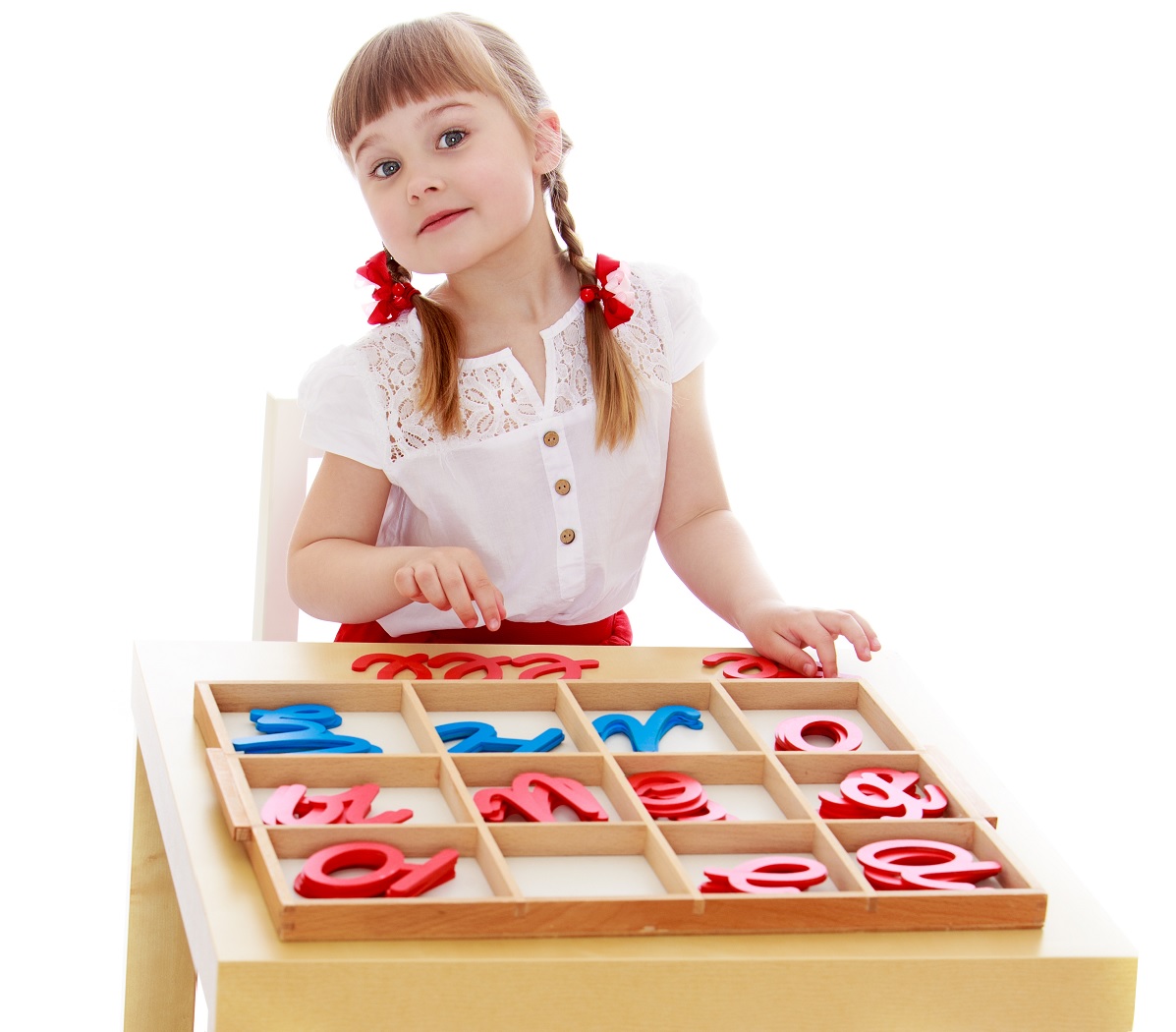
The Movable Alphabet is a large box containing many copies of each letter of the alphabet in individual tiles. In the most common convention, consonants are printed on one color (typically pink or blue) and vowels on a contrasting color (typically red), creating a visual distinction that the child can use independently, without knowing any vocabulary about vowels and consonants. The child selects and arranges tiles on a work mat to form words, sentences, and eventually longer compositions.
The fundamental insight: composition before writing
In conventional literacy instruction, children typically learn to read before they write, or learn both simultaneously. Montessori reverses this sequence in a specific way: composition, the encoding of ideas into written language, comes before handwriting. A child who can push letter tiles together to form the word "dog" is composing. Their hand did not write the word. But their mind performed every cognitive operation that writing requires: identifying the sounds in the word, retrieving the corresponding letter for each sound, sequencing the letters correctly, and producing a readable representation of the word.
This insight, that the cognitive and motor demands of writing can be separated, and that the cognitive operation is developmentally available earlier, is one of Montessori's most significant contributions to literacy education. A child who might wait until age 5 or 6 to begin writing by hand (because their fine motor development hasn't caught up) can begin composing at age 3.5 or 4, because the Movable Alphabet removes the motor barrier.
Color coding: vowels and consonants
The color distinction between vowels and consonants in the Movable Alphabet provides a form of embedded grammar instruction that children absorb without explicit teaching. When a child forms a word like "cat" and sees that the "a" is a different color from the "c" and "t," they are perceiving the vowel-consonant structure of the word visually. When they notice that every word they build contains at least one red tile, they are beginning to understand, concretely, what vowels do. This awareness is indirect preparation for the phonics instruction about vowel patterns that will come later.
The composition sequence
The Movable Alphabet is used in a developmental progression that moves from the simplest encoding to the most complex over months and years:
Stage 1: First phonetic words
After learning the sounds for a handful of letters through the Sandpaper Letters, the child forms their first words. These are typically three-letter consonant-vowel-consonant words (CVC words): "sat," "pin," "mud," "top." The child says the word slowly, listens for each sound, and selects the corresponding tile. There are often one or two errors, a wrong vowel, a reversed letter, which the child may correct independently or with gentle guidance.
At this stage, spelling is phonetic rather than conventional. "Because" might be encoded as "bekuz." This is celebrated, not corrected. The child is demonstrating full phonemic segmentation ability. Conventional spelling is a second skill, built on this foundation, introduced much later.
Stage 2: Expanding to four- and five-letter words
As more letter sounds are mastered, the child begins to encode longer words and words with more complex phonetic structures. Words with blends ("frog," "plant," "stamp"), digraphs ("ship," "chip," "that"), and long vowels begin to appear. The child's compositions grow from single words to multiple words on a mat.
Stage 3: Sentences and early composition
One of the most remarkable transitions in the primary Montessori experience is when a child begins to compose sentences with the Movable Alphabet. The teacher might ask: "Can you write something about what you did this morning?" And the child, a four-year-old, pushes tiles into a sentence: "I woke up and had eggs." The words may be phonetically spelled. The spaces between them may be inconsistent. But the grammar is there. The composition is there. The child is writing, in every sense that matters.
At this stage, teachers often transcribe the child's Movable Alphabet compositions into a notebook, creating the child's first "book", a record of their own ideas in written form that they can reread.
Stage 4: From tiles to pencil
The transition from Movable Alphabet composition to written composition on paper happens gradually and individually. There is no fixed age at which this transition occurs, only individual readiness. For most children in strong Montessori primary environments, it happens between ages 4 and 5, though earlier and later are both common and within the normal range. The transition is supported by Metal Insets work (which builds pencil control) and Sandpaper Letter tracing (which builds motor memory for letter formation).
Large vs. small Movable Alphabet
Two sizes of Movable Alphabet exist in the Montessori tradition: a large size (tiles approximately 2 cm tall) used in the primary years (ages 3 to 6), and a small size (tiles approximately 1 cm tall) used in elementary work. The large size allows the young child's less precise motor movements to manipulate tiles successfully; the small size reflects the improved motor control of older children and allows for longer compositions without requiring enormous workspace.
Most home educators will want only the large size. The small size is primarily useful in a classroom context where elementary students are working with more complex sentence-level and paragraph-level composition tasks.
DIY Movable Alphabet
A quality commercial Movable Alphabet costs between $60 and $200. An effective DIY version can be made for a few dollars:
- Use two colors of index cards (or cardstock cut to uniform size), one color for consonants, one for vowels
- Write lowercase letters clearly on each card. Make multiple copies of frequently used letters: 4 to 6 copies of "a," "e," "s," "t"; 2 to 3 copies of less frequent letters
- For a more durable version, print letters on cardstock and laminate, or write in permanent marker and cover with clear contact paper
- Store in a divided box or tray with each letter in its own compartment, so the child can find and replace letters independently
The most important feature of any Movable Alphabet, commercial or DIY, is that there are enough copies of common letters to compose full sentences. A set with only one "e" tile makes composition frustrating. Aim for a minimum of four copies of every vowel and at least two to three copies of every common consonant.
The Movable Alphabet and the explosion of writing
Maria Montessori observed something striking in her first Casa dei Bambini: children who had spent significant time composing with the Movable Alphabet often experienced a sudden, dramatic emergence of handwriting, what she called the "explosion of writing." Having encoded language cognitively for months through tile manipulation, the moment their hand was ready, they began writing with extraordinary fluency and confidence. The Movable Alphabet did not teach handwriting. It ensured that when handwriting was possible, everything else was already in place. Read more in our complete writing activities guide.