
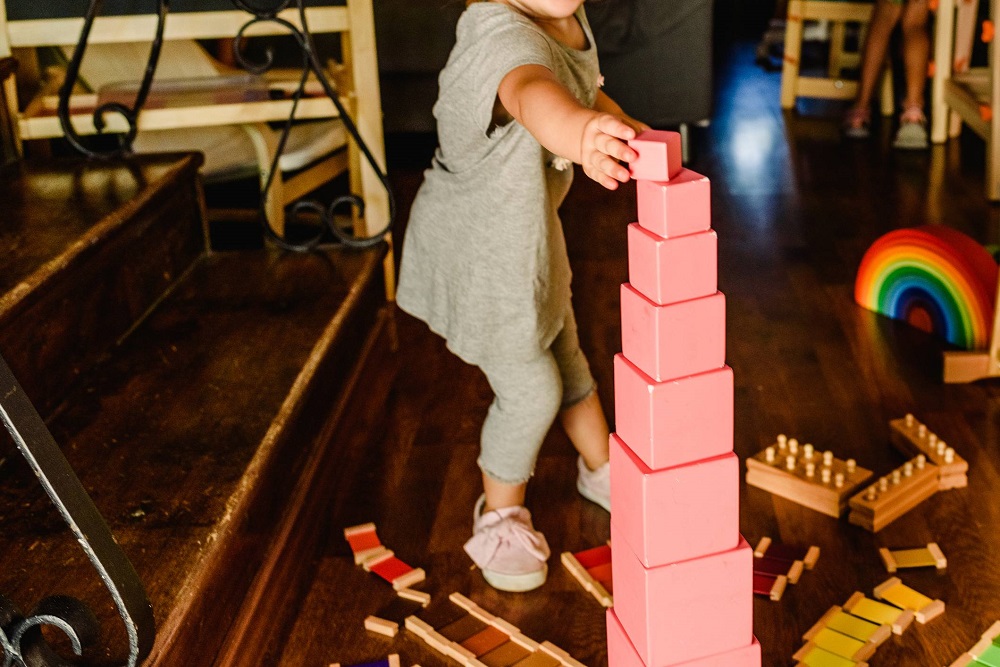
The Pink Tower consists of ten wooden cubes, each painted a uniform rose pink, ranging in size from 1 cm on each side to 10 cm on each side. The cubes increase in size by 1 cm in each dimension, meaning the largest cube is 1,000 times the volume of the smallest. The child stacks them on a floor mat, always working from largest to smallest, to build the tower. This is the work as it is first presented. What the child is actually doing is far more complex.
What the Pink Tower teaches
Visual discrimination of dimension
The primary purpose of the Pink Tower is to develop the child's ability to perceive differences in three-dimensional size, to see that this cube is larger than that one, and to rank them accurately from largest to smallest. This seems straightforward, but the precision required by the material is not. At 10 cubes, the differences between adjacent cubes are small enough to challenge most three-year-olds. The child must look carefully, hold multiple comparisons in mind simultaneously, and make decisions based on direct perception rather than labeling or memory.
This is exactly the kind of visual precision that the sensorial curriculum is designed to develop: not the gross perception of "big" and "small" that any child already possesses, but the refined discrimination that can distinguish, with confidence, a difference of 1 centimeter in three-dimensional space.
Mathematical preparation
The Pink Tower introduces three fundamental mathematical concepts before a single number is named:
- The concept of the cube: every piece is a cube, and the child handles ten different cubes in the course of normal Pink Tower work. The concept of a three-dimensional shape with equal sides is learned in the hands before it appears in any geometry lesson.
- Cubic volume progression: the cubes increase by 1 cm in each dimension. The volume increase is therefore cubic: 1³, 2³, 3³ ... 10³. The child does not know this consciously, but they experience the progression of cubic growth, how rapidly volume increases relative to linear measurement, as a sensory fact. When cubic numbers appear in the elementary math curriculum, they will feel familiar.
- Decimal relationships: the largest cube (10 cm) is precisely ten times the side length of the smallest (1 cm). This mirrors the base-ten structure of the number system, and the Pink Tower is understood in Montessori to be indirect preparation for the decimal system work that will follow with materials like the Golden Beads.
Concentration and order
Building the Pink Tower correctly takes sustained attention. The child must carry each cube separately from its storage location to the floor mat, the mat is placed at a distance from the shelf specifically to require this repeated walking and carrying. They must choose the correct cube each time. They must correct their errors when the tower looks wrong. And when they are done, they must return each cube to the shelf, one at a time, in the correct order.
This complete cycle of preparation, work, and restoration of order is a feature of every Montessori activity, and it is part of what makes the Pink Tower more than a stacking exercise. The beginning and end of the work are as important as the building itself.
Control of error
The Pink Tower contains its own control of error. When a cube is placed out of order, when a larger cube is placed above a smaller one, the tower looks and feels wrong. The visual impression of the staircase pattern is disrupted. A careful child notices this immediately. A child who does not notice it at first will notice when the tower is complete and the profile is uneven, or when the tower topples.
The control of error is important because it means the teacher does not need to correct the child during the work. The material corrects the child. This protects the child's concentration (adult interruption during focused work is one of the most damaging things that can happen in a Montessori environment), and it develops the internal monitor, the child's own awareness of when something is right or wrong, that is the foundation of genuine independence.
How the Pink Tower is presented
The presentation of the Pink Tower follows the standard Montessori three-period lesson format, but the initial presentation is almost entirely silent. The teacher:
- Unrolls the floor mat at a distance from the Pink Tower shelf
- Carries each cube to the mat, one at a time, using both hands, placing them randomly on the mat
- Selects the largest cube by comparing several options visually, places it on the mat
- Selects the next largest, places it on top, all without speaking, demonstrating careful looking and deliberate placement
- Completes the tower, admires it briefly
- Dismantles and returns the cubes to the shelf, one at a time, in reverse order
- Rolls up the mat
- Invites the child: "Now it's your turn."
The silence of the presentation is intentional. No verbal instructions compete with the visual information the child is processing. No narration distracts from the child's observation of what the teacher is doing. After the child has worked with the Pink Tower many times, vocabulary (large, larger, largest; small, smaller, smallest) is introduced through the three-period lesson.
Extensions
The Pink Tower is one of the richest materials for extensions, alternative uses that extend the developmental challenge once the basic work is mastered:
- Building horizontal instead of vertical: arranging the cubes in a staircase pattern on the floor rather than a tower, creating a different visual challenge
- Combining with the Brown Stair: the Pink Tower and Brown Stair are designed to be combined; the prisms of the Brown Stair nestle into the staircase steps formed by the Pink Tower cubes
- Pairing with the Cylinder Blocks: the Cylinder Blocks develop the same three-dimensional discrimination applied to cylindrical forms with varying height, diameter, and depth; children who have mastered both materials encounter dimension from multiple angles and build a richer spatial vocabulary
- Blindfolded building: selecting and ordering the cubes by touch alone, without visual guidance, developing the stereognostic sense
- Building with eyes closed and then checking: feeling the height differences to verify order, then looking to confirm
- Measuring with cubes: using the cubes as non-standard measuring units, an early introduction to measurement concepts
Age range and timing
The Pink Tower is typically introduced at age 2.5 to 3, making it one of the earliest sensorial materials presented. Most children work with it intensively for six to twelve months, then move on to the extensions, and then leave it. By age 4 to 4.5, most children have extracted everything the basic Pink Tower offers and have moved to more complex sensorial and academic work. If a child at age 4 is still working daily with the basic Pink Tower presentation, it may indicate that the teacher has not introduced sufficient extension work, or that the child needs more time in the sensorial curriculum before moving to academic work.
DIY options for home
An authentic Pink Tower costs between $60 and $150 and requires significant storage space. For families working with a tighter materials budget, or who simply prefer not to purchase the material, several alternatives develop similar visual discrimination skills:
- Nesting cups that vary only in size (not color, not pattern, uniformity is key to the isolation of quality principle)
- Graduated stacking rings on a post, if the colors vary, cover them with a solid-color sock or wrap to isolate the size variable
- A collection of progressively sized containers, boxes, or blocks of similar material and color
None of these substitutes perfectly replicate the Pink Tower's mathematical properties (the cubic progression, the specific ratio of largest to smallest). But for families whose goal is sensorial development rather than the full mathematical preparation, they are reasonable starting points.