
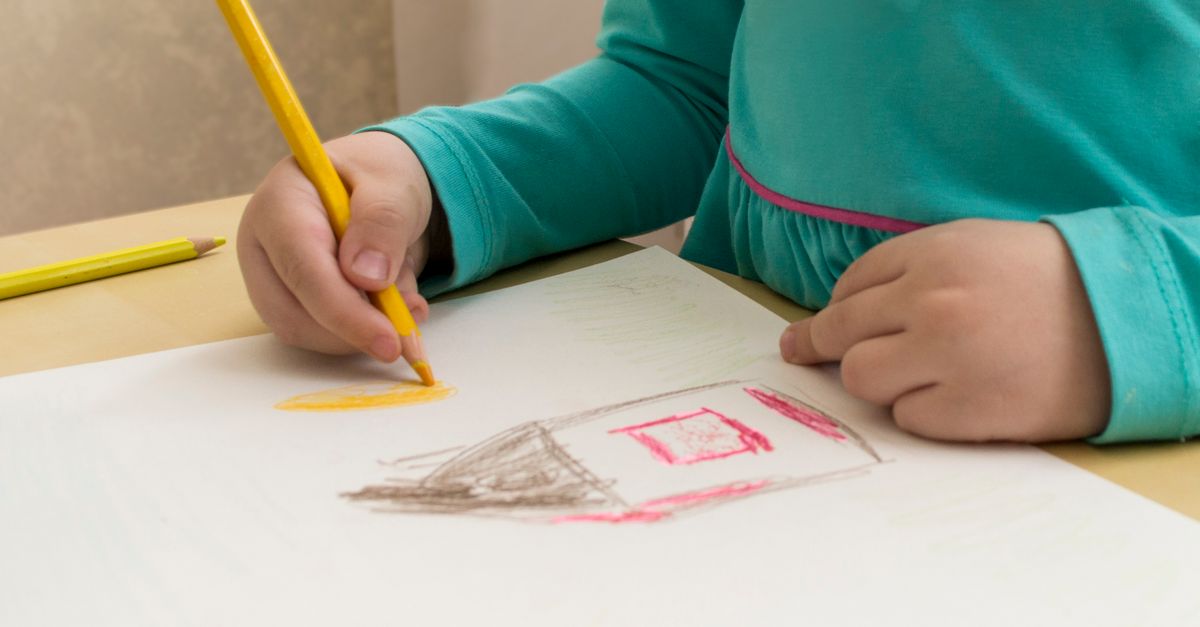
The Metal Insets are a set of ten metal frames and their corresponding inset shapes, each frame containing a different geometric form: a circle, an oval, a triangle, a square, a pentagon, a curvilinear triangle, a quatrefoil, a rectangle, a trapezoid, and a right-angled scalene triangle. Each frame and inset has a small knob for handling. The child uses colored pencils to trace both the frame and the inset onto paper, then fills in the resulting shape with parallel lines. This process, seemingly simple, develops precisely the motor control and pencil grip that a child needs to write letters.
Why geometry teaches handwriting
Handwriting is a motor skill. Like all motor skills, it develops through repetition of the underlying movements, not through repeated attempts at the final product. The movements required for writing, holding a pencil correctly, maintaining consistent pressure, controlling line direction, staying within defined limits, are exactly the movements developed through Metal Inset work.
When a child traces the curved edge of the oval inset, they are practicing the controlled, smooth curves that appear in letters like "c," "e," "o," and "a." When they trace the straight sides of the square frame, they practice the controlled straight strokes of "l," "t," and "i." When they fill in the shape with parallel horizontal lines, they practice the muscle control that keeping letters on a baseline requires. The geometry is the scaffolding. The letters come after.
The three tools
Metal Inset work always uses three pencils, typically in contrasting colors. This is not arbitrary:
- Three pencil changes within a single tracing break the activity into smaller motor demands, each of which the child manages independently. Selecting a pencil, placing it in the correct grip, and beginning to draw is itself a preparation for the motor sequence of writing.
- Color contrast makes the traced outline (from the frame or inset) visually distinct from the fill lines, helping the child see the structure of their work and self-correct when lines drift outside the boundary.
- Multiple fill passes allow the child to return to the same shape with increasing precision over many sessions, a built-in progression within the activity.
The progression
Metal Inset work follows a progression from the simplest to the most demanding:
- Tracing the inset only: the child places the inset on paper and traces around its outside edge. This produces the smallest shape and the simplest tracing path.
- Tracing the frame only: the child places the frame on paper and traces the inside edge. This requires more control because the pencil must stay inside the frame's opening.
- Tracing both inset and frame: the child traces the frame, then places the inset inside it and traces that too, creating a geometric design within a frame.
- Filling in with parallel lines: using a second pencil, the child fills the traced shape with lines that run parallel to each other, evenly spaced. This is the most demanding step and develops the most direct handwriting preparation.
- Overlapping designs: two or more insets traced over each other, creating geometric patterns. This is advanced Metal Inset work, typically done by children who are already writing.
When Metal Insets are introduced
Metal Insets are typically introduced between ages 3 and 4, concurrently with or slightly after the first Sandpaper Letter presentations. The readiness indicators are physical rather than academic: the child should be able to hold a pencil (even imperfectly), complete simple practical life tasks that require fine motor control, and sustain attention for five to ten minutes of focused work.
In the Montessori sequence, Metal Insets develop the hand for writing while the Sandpaper Letters develop the memory for letter formation. The two lines of preparation converge when the child begins to write. By that point, both the motor skill and the letter-form knowledge are already in place. The first real letters the child writes are not labored attempts; they are the deployment of already-encoded skills.
Connection to the writing sequence
The full Montessori writing sequence involves three streams of preparation, all running simultaneously:
- Phonological preparation: the Sound Game and oral language activities build awareness of the sounds that letters represent
- Letter-form preparation: Sandpaper Letter tracing encodes the shape and direction of each letter in motor memory
- Motor preparation: Metal Insets develop the pencil control and hand stability that handwriting demands
When all three streams are adequately developed, handwriting emerges, in Montessori's observation, suddenly and with great confidence. She called it the "explosion of writing": children who had been working with Sandpaper Letters and Metal Insets for months would one day simply begin writing, often producing long pieces in a single sitting. The preparation had been building; the handwriting was the result, not the practice. See the full writing activities guide for the complete picture.
DIY alternatives
A quality commercial Metal Insets set costs between $60 and $150. For families who want to develop the same skills at home with less investment:
- Geometric stencils: plastic stencils with geometric cutouts work similarly to the Metal Inset frames. The child traces the inside of the stencil opening, which is equivalent to tracing the frame. Commercial stencil sets with simple shapes (circles, triangles, rectangles) are inexpensive and widely available.
- Cardboard frames: cut geometric shapes from cardboard, creating both the frame (the surrounding card with the shape removed) and the inset (the cut-out piece). The tactile experience is less refined than metal, but the tracing activity is identical.
- Any tracing with controlled fill: the essential skill is tracing a defined boundary and then filling the enclosed space with parallel lines. Any defined shape, traced carefully and filled methodically, develops the same motor skills.
The quality difference between commercial Metal Insets and DIY alternatives is real: the weight and precision of metal provides better tactile feedback and the knobs provide the correct grip practice. For a home environment, however, geometric stencils with pencil work achieve most of the developmental purpose.
Three pencils, not crayons
Metal Inset work is always done with pencils, not crayons or markers. Pencils require a controlled, consistent grip and pressure. Crayons are held more loosely and require less precision. Markers produce results regardless of pressure or angle. The pencil is not interchangeable with other writing tools in this context; the grip and pressure control it demands are specifically what the material develops.