
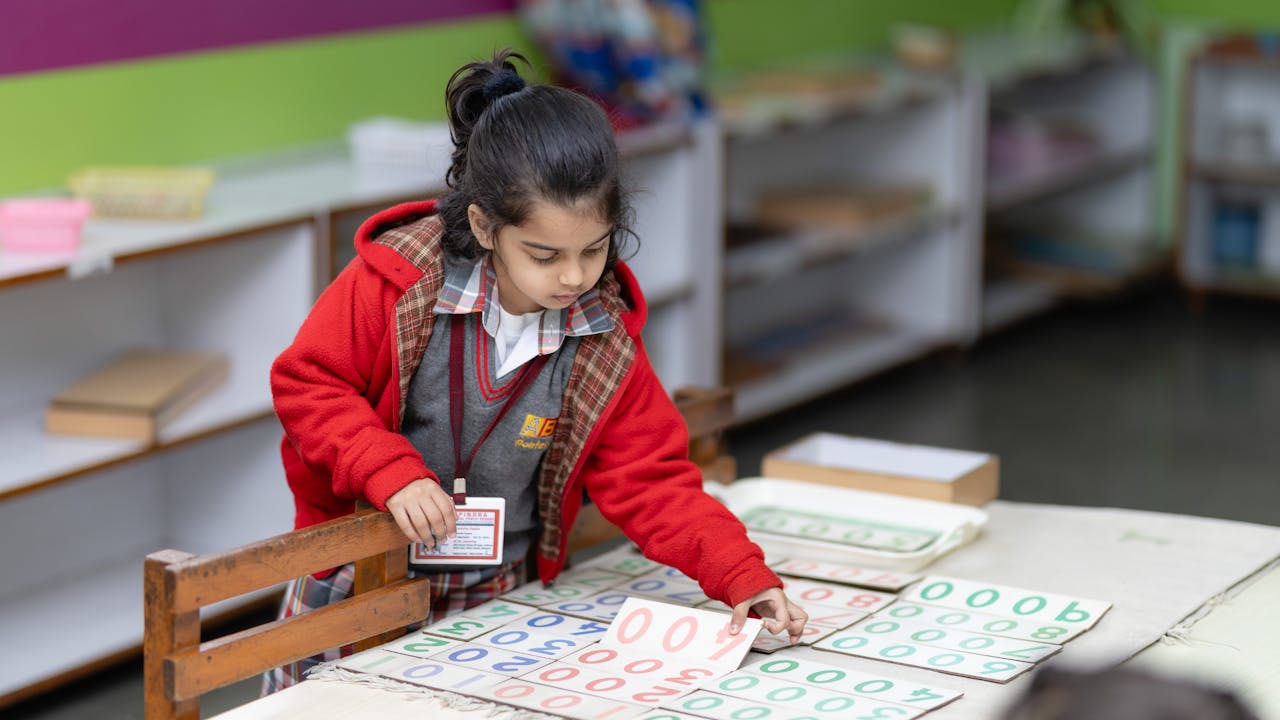
No single principle defines Montessori education. The method is a system, a set of interconnected ideas that support and reinforce each other. Remove one, and the whole thing shifts. Understanding the principles individually and collectively is the key to distinguishing authentic Montessori practice from the many things that borrow the name without the substance.
1. Respect for the child
Every other Montessori principle flows from this one. Respect for the child means treating children as capable, intelligent beings with their own inner life, not as incomplete adults who need to be fixed, filled, or managed. In practice, it means speaking to children honestly, at their level. It means knocking before entering a child's workspace, asking permission before helping, and taking their preferences and interests seriously as data about their development.
Respect is not the same as permissiveness. It means holding children accountable for their behavior in a way that takes their dignity seriously.
2. The child constructs themselves
Montessori described the child as the "forgotten citizen", a human being in the process of self-construction who needs the right conditions, not the right instruction. Development is not something done to a child by an adult. It unfolds from the inside out, driven by the child's own energy and guided by the materials and experiences they encounter.
The adult's job is not to build the child. It is to make sure the conditions for self-construction are in place.
3. The absorbent mind (birth to 6)
Children under six learn by absorbing their environment, not through conscious effort but through direct, effortless exposure. Language, habits, emotional tone, spatial understanding, and the cultural frameworks of their community are taken in without intention. This is why the quality of the early environment matters so much: the child is absorbing all of it. See our complete guide to the Absorbent Mind for a deeper explanation.
4. Sensitive periods
At specific developmental windows, children are biologically prepared to acquire particular skills or types of knowledge with exceptional ease. These are the sensitive periods, windows of heightened receptivity for language, order, movement, small objects, and sensory experience. When these windows are active, learning is effortless. When they close, the same learning requires conscious effort. Montessori education aims to meet children inside these windows rather than ahead of or behind them.
5. The prepared environment
The prepared environment, the Montessori classroom or home setup, is not background. It is an active educational tool. Every detail is intentional: the height of the shelves, the arrangement of materials from simple to complex, the quality and beauty of the objects available to children. The environment is designed so that children can work independently, make mistakes without humiliation, and develop real competence.
6. Intrinsic motivation
Montessori education deliberately avoids external reward systems, gold stars, grades, timed tests, competitive rankings. The work itself is the reward. A child who successfully pours water without spilling, who reads a word for the first time, or who balances all ten cubes of the Pink Tower, experiences something more durable than a sticker: the satisfaction of genuine accomplishment.
This is not idealism. It is developmental pragmatics. External rewards reliably undermine intrinsic motivation, a phenomenon documented extensively in research on Self-Determination Theory. When children learn to work for stars, they stop working when the stars disappear. When they learn to work for the satisfaction of doing, they keep working.
7. Freedom within limits
Freedom is not the absence of limits, it is the space within them. In a Montessori classroom, children have significant freedom: they choose their own work, set their own pace, work where they like, and take the time they need. But every freedom comes with a corresponding responsibility, and the limits are real. Children may not disrupt others' concentration, may not handle materials carelessly, and may not opt out of the community's shared expectations for behavior.
This structure is not a contradiction of Montessori freedom, it is its foundation. True freedom requires internal discipline, and internal discipline is developed by practicing it within a thoughtfully designed structure.
8. Multi-age groupings
Montessori classrooms group children in three-year spans: nido (0–18 months), infant community (18 months–3 years), primary (3–6 years), lower elementary (6–9 years), and upper elementary (9–12 years). This is not administrative convenience, it is educational design. Younger children in a multi-age group learn by watching older peers. Older children consolidate and deepen their understanding by helping younger ones. Leadership, mentorship, and collaboration develop naturally without adult orchestration.
9. The role of the guide
The Montessori teacher, called a guide, directress, or director, is not an instructor in the traditional sense. Their primary roles are: observing children carefully to understand where each is developmentally; preparing and maintaining the environment; and offering individual or small-group lessons when a child is ready for a new material. Minimizing unnecessary intervention is an explicit value. The guide who steps back when a child is successfully working, resisting the urge to praise or redirect, is doing exactly the right thing.
10. Control of error
Authentic Montessori materials are designed with a built-in "control of error", a way for the child to notice independently when something has gone wrong, without needing adult correction. The Cylinder Blocks tell the child they've made a mistake because the cylinder doesn't fit. The Sandpaper Letters tell the child through touch when they're moving in the wrong direction. This design feature is philosophically significant: it means mistakes are discovered, not announced. Failure is a private experience that leads to another attempt, not a public one that leads to shame.
Authenticity matters
The word "Montessori" is not trademarked, which means any school or product can use it regardless of whether it follows these principles. When evaluating a Montessori program, use this list as a checklist. If a school grades students, uses external reward systems, has traditional rows of desks, and mixes ages only by administrative accident, it is not delivering authentic Montessori education, regardless of what it calls itself.