
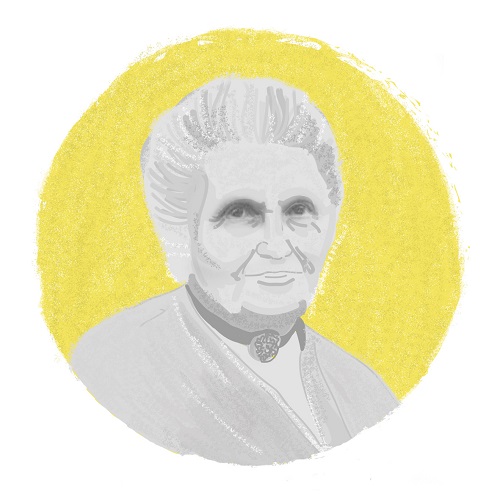
Early life and education
Maria Tecla Artemisia Montessori was born on August 31, 1870, in Chiaravalle, a small town in the Marche region of central Italy. Her father, Alessandro, was a government accountant; her mother, Renilde Stoppani, was an unusually well-educated woman for her time, a piece of her character that she passed emphatically to her daughter.
The family moved to Rome when Maria was five, seeking the educational opportunities the capital offered. From an early age, she was intellectually restless and academically exceptional. She initially set her sights on engineering, an almost unthinkable ambition for an Italian girl of the 1880s, before pivoting to medicine, an ambition only marginally less radical.
Gaining admission to the University of Rome's medical program required fighting institutional resistance at every level. Accounts vary on the precise details, but by 1896 she had graduated with a degree in medicine and surgery, making her among the first women, some say the first, to earn a medical degree in Italy. She was 26.
From medicine to education
Her early medical career took her into Rome's psychiatric clinics, where she worked with children who were then classified as "mentally deficient" and largely warehoused without treatment or education. Montessori was appalled not by the children but by their circumstances. She observed that the children's fundamental problem was not pathological, it was environmental and educational. They were not incapable of learning. They had never been given anything worth learning with.
She began studying the work of two French physicians, Jean Marc Gaspard Itard and Édouard Séguin, who had worked with sensory and cognitive disabilities in the early 19th century. From Séguin's "physiological method", which used carefully designed sensorial materials and structured repetition, Montessori extracted a set of principles that she would eventually transform into a universal pedagogy.
Between 1900 and 1906, she trained teachers, ran a school for children with cognitive disabilities, and developed her first set of educational materials. The results were startling: some of her students scored higher on standardized examinations than typically developing children from mainstream schools. This led her to a question that would drive the rest of her career: if these methods worked so well for children labeled as deficient, what might they do for all children?
The Casa dei Bambini
On January 6, 1907, Montessori opened the Casa dei Bambini, the Children's House, in the San Lorenzo slum district of Rome. The building had recently been renovated, and the developers, recognizing that the children of working-class residents had nowhere to go during the day, offered Montessori a room and a small salary to keep them occupied and off the newly painted staircases.
Her first students were approximately 50 children between the ages of two and a half and seven, largely from impoverished, often illiterate families. She gave them the sensorial materials she had developed for her work with disabled children, cylinders, blocks, geometric shapes, textured surfaces, and left them largely to their own devices, observing carefully.
What she saw confounded every assumption she carried into the room. The children did not need to be cajoled or directed. Given interesting materials and freedom to work with them, they chose to work. They focused for extended periods. They repeated activities spontaneously. They were upset when interrupted. And gradually, without explicit instruction, they began to read, write, and perform arithmetic.
News of the Casa dei Bambini spread rapidly. By 1909, Montessori had written her first major work, Il Metodo della Pedagogia Scientifica (The Montessori Method), which was quickly translated into multiple languages. Schools began opening across Europe and then the United States, where Alexander Graham Bell and others founded the American Montessori Association in 1913, the same year Montessori made her first visit to the country to an audience of thousands.
The middle years: growth and controversy
The 1910s and 1920s were a period of extraordinary growth for Montessori schools worldwide, and of personal complexity for their founder. In 1898, she had given birth to a son, Mario, from a relationship with a fellow physician, Giuseppe Montesano. Because an unmarried Italian woman of her social standing could not raise a child without destroying her professional prospects, Mario was placed with a family in the countryside. He and his mother were not publicly acknowledged as related until Montessori was in her sixties, when Mario, by then a grown man, became her principal collaborator.
Throughout the 1920s and early 1930s, Montessori schools proliferated in Europe, with particularly strong growth in the Netherlands, Spain, and Britain. Then came the political catastrophes of the 1930s. The Fascist governments of Italy and Germany initially praised Montessori education, and then, recognizing that it fundamentally opposed their authoritarian aims, shut down her schools. In 1934, she left Italy permanently. The Nazis burned her books. She was effectively stateless.
India and late career
In 1939, Montessori and Mario traveled to India at the invitation of the Theosophical Society of Adyar. They planned to stay for a few months; they stayed for seven years, largely because World War II made return impossible.
The years in India were intellectually some of Montessori's most productive. She trained over a thousand teachers, developed her elementary curriculum significantly, and wrote several of her most important books, including The Absorbent Mind (1949) and Education for a New World (1946). She was also nominated for the Nobel Peace Prize three times, in 1949, 1950, and 1951, in recognition of her conviction that the right education for children was the only reliable foundation for world peace.
She returned to Europe in 1946, settled in the Netherlands, and continued training teachers and lecturing internationally until the end of her life. She died in Noordwijk aan Zee, the Netherlands, on May 6, 1952, at the age of 81, reportedly in the middle of discussing a trip to Ghana. She had been working until the week before her death.
Legacy
Maria Montessori's legacy is genuinely difficult to overstate. Her core insight, that children are natural learners whose development we can support but not control, has influenced every progressive education movement that followed her. The emphasis on intrinsic motivation, on hands-on learning, on respecting the developmental stage of the child, and on the role of the physical environment in education are all ideas that are now considered basic educational principles, even in contexts that have never heard of Montessori.
Today, there are estimated to be between 20,000 and 22,000 Montessori schools worldwide, with more than 5,000 in the United States alone, ranging from private preschools to public elementary charter schools. Her face appears on the former Italian 1,000 lira note. The AMI (Association Montessori Internationale), which she founded in 1929 with her son Mario, continues to accredit teacher training programs and maintain fidelity to her original work.
Her books remain in print and are read by educators and parents around the world. But perhaps her most enduring legacy is simpler than any of that: in every Montessori classroom, every day, a three-year-old carefully returns a material to its place on the shelf, a five-year-old helps a younger child find the work they're looking for, and somewhere an educator kneels beside a child and waits. That patience, that deep trust in the child's capacity, is Montessori's most important gift.
Key dates
- 1870: Born in Chiaravalle, Italy
- 1896: Graduated with medical degree from University of Rome
- 1907: Opened the first Casa dei Bambini in Rome
- 1909: Published The Montessori Method
- 1913: First US lecture tour
- 1929: Founded the Association Montessori Internationale (AMI)
- 1939–1946: Worked in India during WWII
- 1949: Published The Absorbent Mind
- 1949, 1950, 1951: Nominated for the Nobel Peace Prize
- 1952: Died in Noordwijk, Netherlands, age 81