
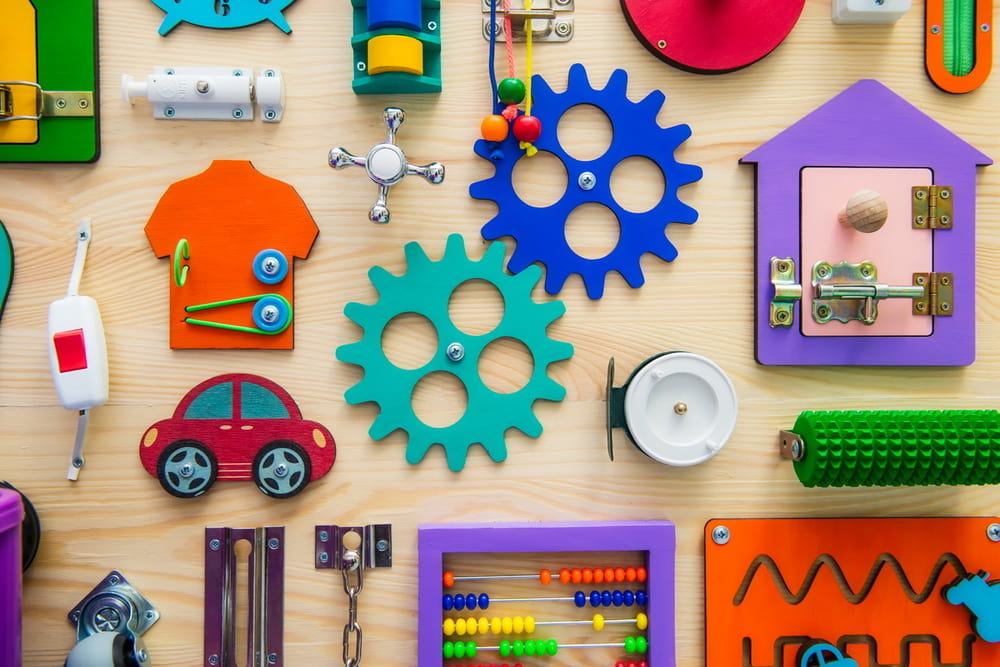
The term busy board is used loosely in the market to describe everything from high-quality hardwood panels with genuine household fasteners to cheap plastic boards covered in brightly colored flaps with cartoon characters underneath. These are not the same thing. A Montessori busy board specifically uses real, functional fasteners that the child will encounter in their actual environment: the same buckle as a car seat, the same latch as a cabinet, the same zipper as a jacket. The connection to real life is what gives the material its value.
What a Montessori busy board actually develops
Fine motor control and coordination
Working a stiff bolt, threading a hook through a latch, or manipulating a small button through a buttonhole all require precise, coordinated movement of the fingers and hands. These are not natural abilities for a toddler. They have to be built through repeated practice. The busy board provides a concentrated environment for that practice, presenting multiple different fastener challenges on a single surface that the child can return to independently, again and again, without needing adult instruction.
The practical consequence of this work is visible and immediate. Children who spend significant time with a busy board typically learn to operate their own clothing fasteners, open cabinet latches, and manage buckles significantly earlier than those who have not. The motor patterns transfer directly.
Problem-solving and persistence
A bolt that is difficult to turn does not turn on the first attempt. A buckle requires a specific sequence of actions before it releases. A carabiner must be twisted and pulled simultaneously. Each of these challenges requires the child to try, assess, adjust, and try again. This iterative problem-solving process is exactly what Montessori materials are designed to encourage. The child encounters the error through the material's resistance, not through a correction from an adult, and must figure out the solution independently.
A well-designed busy board does not reward random activity. It rewards attention. A child who watches what they are doing, adjusts their grip, and tries a different approach will succeed. One who bangs or pulls randomly will not. The material teaches through its own feedback.
Concentration and independent work
One of the qualities Maria Montessori most wanted to cultivate in young children was the ability to concentrate: to give sustained, focused attention to a single task. A good busy board naturally supports this because the child must attend carefully to what they are doing in order to make progress. It is difficult to open a combination padlock while looking elsewhere. Unlike screen-based activities that produce concentration through artificial stimulation, the busy board produces concentration through genuine challenge. This is a meaningfully different kind of attention.
What to look for in a Montessori busy board
Real fasteners, not toy versions
The single most important feature of a Montessori busy board is that its fasteners are real. Not printed, not painted, not simplified. A zipper on a Montessori busy board should be an actual garment zipper. A padlock should be a real padlock with a real key. A bolt and nut should require actual turning in the same way a bolt on furniture or a bicycle would. This is what connects the practice to real-life application. Toy versions of fasteners have different proportions, different resistance, and different mechanics than real ones, and the transfer of skill is weaker.
Appropriate for the child's stage
Not every fastener type is appropriate for every age. A general guide:
- 12 to 18 months: Simple latches, magnetic closures, large sliding bolts, and basic hooks. Fasteners that respond clearly to a single action.
- 18 months to 3 years: Zippers, velcro, buckles, large buttons, and barrel bolts. These require a two-step action and build toward clothing independence.
- 3 to 5 years: Combination locks, padlocks with keys, carabiners, wing nuts, and small snap hooks. These require genuine manual dexterity and sequential thinking.
A busy board with thirty different fasteners covering ages 1 through 6 sounds comprehensive. In practice, it means the youngest child spends the session frustrated by age-inappropriate challenges while the older child ignores the components they mastered two years ago. A more targeted board designed for a specific developmental window is more useful than an everything-included version.
Solid wood construction
The backing board should be solid hardwood or quality plywood, thick enough not to flex under pressure. Fasteners must be securely mounted. A latch that pulls loose when the child applies force is not just useless; it is a hazard. All hardware should be recessed, filed, or covered to prevent sharp edges. Examine the back of the board as well as the front before purchasing. Exposed screws are a warning sign.
Making a busy board at home
A DIY busy board is one of the more manageable Montessori projects for a parent with basic tools. The required materials are:
- A solid wooden board, approximately 16 by 20 inches, sanded smooth
- A selection of real hardware store fasteners: cabinet latch, barrel bolt, hook and eye, door handle, simple padlock, key lock
- A selection of fabric-based fasteners: a zipper from a zipper kit, a button and buttonhole from scrap fabric, a velcro strip, a buckle from a craft supply store
- Screws and mounting hardware appropriate for each fastener
The process is straightforward: layout the fasteners on the board, spacing them far enough apart that a child can operate each one without interfering with its neighbor, then mount each one securely. The child's safety determines all decisions: any fastener with a sharp edge, a small swallowable piece, or a pinching mechanism should be avoided for children under three.
A homemade busy board has the advantage of being fully customizable to your child's current interests and stage, and it costs significantly less than comparable retail versions. A full board built from hardware store components typically costs fifteen to thirty dollars in materials.
How to introduce and present the busy board
In the Montessori approach, a material is not simply given to a child. It is introduced through a demonstration that makes the purpose and the correct technique visible. For a busy board, this means sitting with the child, pointing to one fastener at a time, and demonstrating its operation slowly and clearly. Show the correct grip, the correct direction of movement, and the complete open-and-close cycle. Then invite the child to try.
The first session should focus on one or two fasteners only. Introducing the entire board at once produces overwhelm and random exploration rather than focused practice. As the child masters each fastener, neighboring ones are introduced, building a vocabulary of mechanical actions the child can apply independently.
Once introduced, the busy board works best as an independent activity on the child's shelf, available without adult involvement. Most children will return to it repeatedly, particularly to fasteners that initially presented difficulty. The motivation to master a challenge is natural and requires no reward system.
The busy board and the dressing frames
The Montessori classroom has a specific set of materials dedicated to fastener practice: the Dressing Frames. These are square wooden frames, each mounting a different fastening type on two panels of fabric, allowing the child to practice opening and closing each fastener in the context of clothing. The busy board is not a direct replacement for the Dressing Frames, but it serves a complementary purpose, training the same motor skills through a format that many toddlers find more engaging because it combines multiple challenges on one surface.
Families who can invest in Dressing Frames as well as a busy board will find the two materials reinforce each other. Families who must choose one: the busy board covers more fastener types and is more engaging for most toddlers, while the Dressing Frames more closely simulate the actual experience of dressing and undressing.
The quality test most buyers skip
Before buying or building a busy board, operate every single fastener yourself, with one hand, while someone else applies resistance from the other side. If it takes more force than your child's hands can realistically produce, or if the mechanism binds before completing its full cycle, it is not appropriate for the intended age. A fastener that cannot be operated by the child it is designed for is not a challenge; it is a frustration. Montessori materials are calibrated to be achievable with effort, not impossible without adult help.