
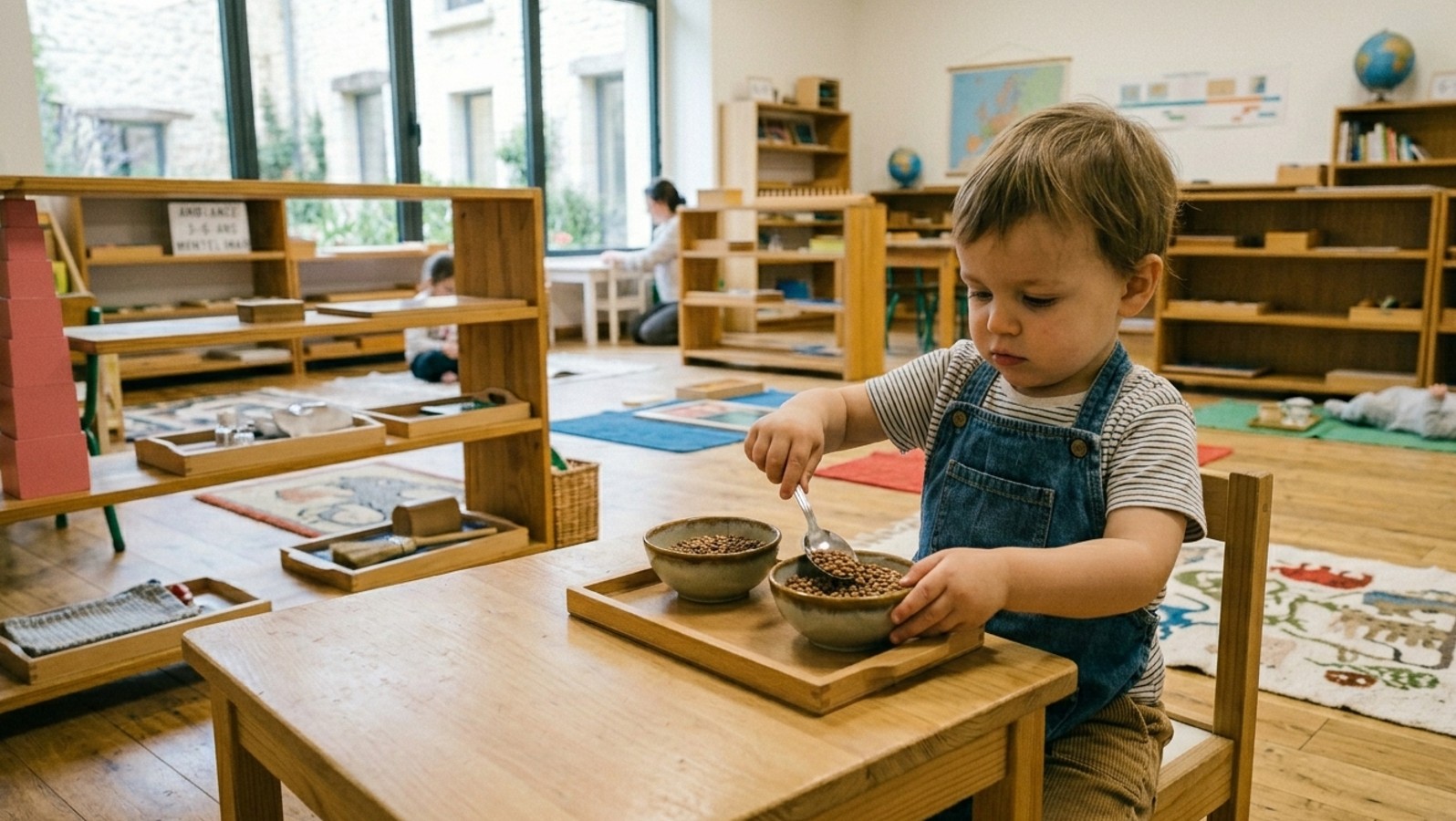
Between ages two and three, children are in a sensitive period for order, for language, for movement, and for social development simultaneously. Montessori activities for this age work best when they respect the child's need for independence, provide clear and consistent structure, and offer real challenge, not just entertainment.
Dressing and self-care
The Montessori dressing frames, a set of wooden frames each featuring a different fastening (buttons, zippers, snaps, laces, Velcro), exist specifically to allow two- and three-year-olds to practice the mechanical skills of dressing without the added complexity of a garment on their own body. A child who has mastered the button frame can button their shirt calmly. A child who has never had the chance to practice in isolation struggles with buttons while also trying to get dressed and not be late.
At home: offer clothing with fasteners the child is ready for, not fasteners that are convenient for you. A two-year-old in elastic-waist pants every day has no opportunity to develop the fine motor skills that buttons require. Let them practice, even when it's slower.
Sorting and matching
At age two, sorting activities shift from simple "put in/take out" to genuine categorical thinking. Activities to try:
- Color sorting: a set of objects in three distinct colors, sorted into matching containers. Start with two colors; add a third when those are mastered.
- Shape sorting boxes: wooden boxes with shaped holes. The child chooses a shape and finds the matching hole, simple, but powerful for spatial reasoning.
- Nature sorting: a collection of natural materials (pebbles, shells, pinecones, acorns) sorted by type onto a simple tray
Early math: number and quantity
The sensitive period for number typically begins in earnest around age two and a half. Montessori introduces number through counting real objects, not abstract symbols. Activities:
- Number rods at home: a simplified version using stacking cubes or duplo blocks in increasing quantities from 1 to 10. Count together each time.
- Counting objects in the environment: "Let's put three apples in the bowl." Three. One, two, three. Not counting to ten as a verbal exercise, counting real things.
- Simple quantity matching: cards with dots (1–5) matched to the corresponding number of small objects
Early language and writing preparation
From age two onward, children in the language sensitive period benefit from increasingly complex vocabulary, exposure to books, and activities that prepare the hand for eventual writing.
- Drawing on textured surfaces: chalk on pavement, finger painting on a smooth surface, tracing with a finger in a tray of sand or salt. All develop the hand-eye coordination and directional awareness that writing requires.
- Metal insets (simplified): tracing around simple geometric shapes develops pencil control in children who aren't yet ready for formal writing
- Classification cards: sets of matching cards (animal/habitat, tool/use) that develop vocabulary, categorization, and sustained attention
Practical life: expanded
By age two, practical life activities can be significantly more complex. Two-year-olds can:
- Set the table with real plates, cups, and silverware for a meal
- Help prepare simple food (tearing lettuce, spreading butter, pouring juice from a child-size pitcher)
- Sweep the floor with a small broom and dustpan
- Polish shoes or silverware with appropriate materials
- Fold washcloths or napkins in half, then in half again
As with Montessori chores at any age, the key is that these are real tasks, not simulations. The child is doing real work that has real consequences and real value to the household. This is not make-believe cleaning, it is cleaning. The dignity of real contribution is part of what makes it so powerful for a two-year-old's developing sense of self.