
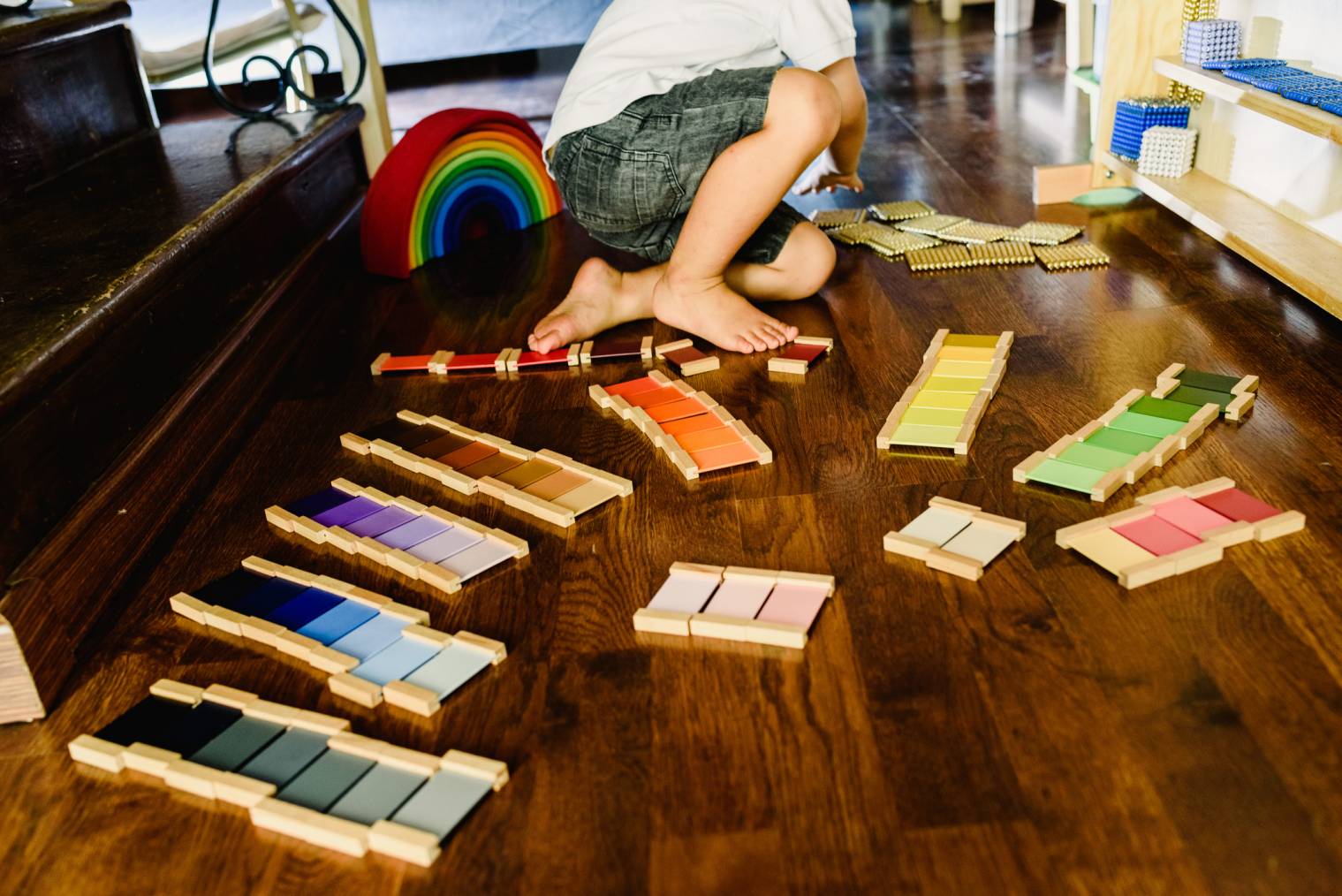
There is a version of Montessori at home that costs almost nothing. Pouring activities use a pitcher from your kitchen and a bowl. Practical life work uses real brooms, real sponges, real tools. Sorting activities use objects you already own. Sensorial work can be built from natural materials collected outside. The perception that Montessori requires expensive equipment is a marketing artifact, not a reflection of the method itself. Maria Montessori developed her approach working with some of the poorest children in Rome. Expense was never the point.
What you actually need to buy
Before spending anything, it helps to be clear about what Montessori materials are genuinely irreplaceable versus what can be substituted or improvised. The honest answer is that very few materials are truly irreplaceable, and most of those can be made at home with a little patience.
Worth buying (start with these if budget allows):
- A set of Sandpaper Letters is difficult to make well at home. The precision of the stroke direction and letter shape matters for building correct motor patterns. Budget sets from reputable sellers on Amazon or Etsy often work fine.
- Sandpaper Numbers for the same reason. Look for fine sandpaper on solid backing, with correctly oriented numerals.
- A Movable Alphabet is time-consuming to make and the consistency of letter size matters. Small sets sold for home use are significantly cheaper than classroom sets and work perfectly well.
- A set of Cylinder Blocks if fine motor work is a priority. These are expensive new but appear frequently secondhand.
Easily substituted:
- The Pink Tower and Brown Stair can be approximated with stacking blocks arranged in graduated sizes.
- Number Rods can be replaced with rods of tape or cut cardboard strips in graduated lengths.
- Sorting activities use buttons, dried beans, pebbles, coins, pasta shapes.
- Pouring work uses pitchers, jugs, funnels, and measuring cups from your kitchen.
- Spooning and transferring work uses spoons, tongs, and tweezers from your kitchen or dollar store.
The best free and low-cost activities
Practical life: the highest-value free category
Practical life activities form the foundation of the Montessori primary curriculum. They cost nothing because they use your home and its real objects. A child who helps set the table, wipes up spills, folds laundry, waters plants, peels vegetables, or sweeps the floor is engaged in genuine Montessori practical life work. The key requirements are: real tools, appropriate size, genuine purpose, and the freedom to complete the task without being corrected mid-process.
A child-sized broom costs around five dollars at most dollar stores. A small wooden dustpan and brush is similar. A sponge cut in half fits a toddler's hand perfectly. A small plastic pitcher for pouring their own water or juice can be repurposed from your kitchen. These are not expensive investments. They are simply objects most families already have or can acquire for nearly nothing.
Sensorial work from natural materials
Many sensorial activities can be built from materials found outside or purchased in bulk cheaply. A collection of ten smooth stones of different sizes, arranged from smallest to largest on a mat, teaches graduated series exactly as the Pink Tower does. A set of fabric swatches in different textures builds tactile discrimination. Seed collections, leaf collections, and shell collections all lend themselves to sorting and classification work. Nature itself is one of the richest Montessori sensorial environments, and it costs nothing.
DIY Montessori materials worth making
Some materials are genuinely worth the time to make yourself:
- Sandpaper Numbers and Letters: Print templates, cut fine sandpaper, adhere to cardstock or thin wood. The cost of materials is under five dollars for the full set if you already have scissors and glue.
- Color tablets: Paint wooden dowel sections or cardboard strips in pairs of the same color. The child matches the pairs, orders them by shade, or sorts by color family.
- Object-to-card matching: Print or cut images from catalogs that match small objects you own. Matching a toy animal to its picture is a classic primary activity that costs nothing if you use images printed from a home printer.
- Geometric shape cards: Print and laminate simple geometric shapes on cards. Use them for matching, naming, and sorting.
- The Movable Alphabet: If you cannot afford a purchased set, printing, laminating, and cutting individual letter cards works at home. It is time-consuming but functional.
Secondhand sources worth knowing
The Montessori secondhand market is larger than most parents realize. Authentic Montessori materials are built to last decades. A Pink Tower made in the 1990s is still a functioning Pink Tower. Families who have moved their children past the primary stage often sell materials they no longer need, and the condition is often excellent.
Where to look:
- Facebook Marketplace: Search your zip code for Montessori materials. Cylinder Blocks, Pink Towers, and complete material sets appear regularly, often at ten to twenty percent of their new price.
- eBay: Particularly good for specific items. Use completed listings to understand what materials actually sell for before bidding.
- Etsy: Many small makers sell budget-friendly Montessori materials. Quality varies. Check reviews carefully and look at images of the actual product, not mockups.
- Local Montessori schools: Schools periodically sell surplus or aging materials. Calling your local school and asking is worth the two-minute phone call.
- Homeschool co-ops: Families who have exited the Montessori stage often sell or donate materials through homeschool networks. Facebook groups for Montessori homeschooling families are a good starting point.
Budget priorities by age
If you have a limited budget, spending based on your child's current developmental stage is more efficient than buying everything at once.
Under 18 months: Nothing needs to be purchased. The infant Montessori environment is built from a floor-level sleeping space, a few simple grasping objects, and a mirror at floor level. A wooden rattle, a fabric ball, and a metal bell cover the grasping curriculum.
18 months to 3 years: A small pitcher for pouring, a few nesting and stacking objects, simple sorting containers, and a child-sized broom cover most of the curriculum. Total cost under twenty dollars if you shop at dollar stores.
3 to 6 years: This is where the investment becomes worthwhile. Sandpaper Letters and Numbers, a Movable Alphabet, and a basic set of math manipulatives (Number Rods or their substitute, counters and number cards) make a significant difference. Spending fifty to one hundred dollars on these specific materials is a genuine educational investment.
6 to 12 years: The Montessori elementary curriculum is largely built on logic, research, and long-form projects. The most valuable investment at this age is access to a good library, not classroom equipment.
What to avoid
The low-cost Montessori market includes a lot of products that use the Montessori name without reflecting the method's principles. Things worth avoiding:
- Flashcard sets labeled Montessori. Flashcards are the opposite of the Montessori sensorial approach.
- Plastic versions of traditionally wooden materials. Plastic is not inherently wrong, but many cheap plastic sets have imprecise gradations that undermine the self-correcting function.
- Digital Montessori apps for children under three. Screen time and Montessori are philosophically incompatible at that age.
- Complete curriculum boxes marketed to parents. These often contain materials the child does not need at their current stage, presented without the pedagogical sequence that makes them useful.
The most cost-effective single investment
If you can spend only twenty to thirty dollars on one Montessori material, spend it on a set of Sandpaper Letters. This one material, used consistently with the three-period lesson, builds phonological awareness, fine motor control, and letter-sound connection simultaneously. It is the most pedagogically dense material available at low cost, and its effect on early literacy is well documented in Montessori research literature.
The principle behind the budget
The most important thing to understand about Montessori spending is that the philosophy does not require any specific product. It requires an environment that supports independence, an adult who knows when to step back, and activities that are genuinely purposeful. A kitchen where a child can help prepare real food is more Montessori than a shelf full of expensive materials the child uses passively.
Maria Montessori worked with children who owned nothing. The method she developed was not a product line. It was a theory of child development expressed through carefully designed experiences. Most of those experiences are available in your home right now, with the objects already there, if you know how to offer them.