
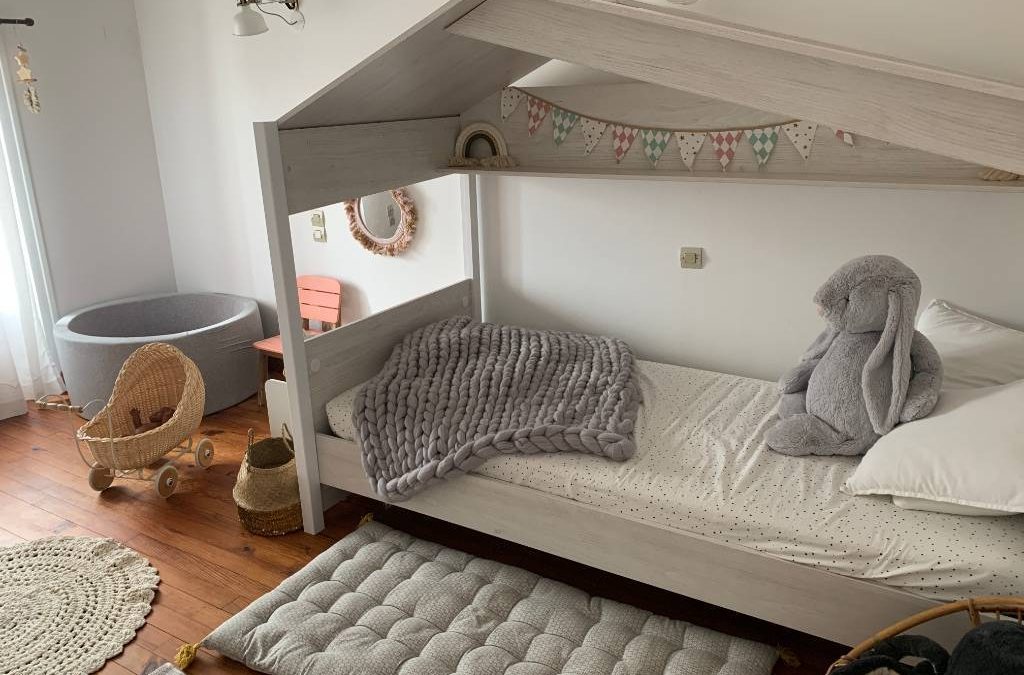
The central design principle of a Montessori bedroom is access. Not access in the sense of making everything available, but access in the sense of making the right things reachable and navigable by the child without adult assistance. A toddler who wakes up in a room where everything is too high to reach, where their clothing is in a drawer they cannot open, and where their toys are in a bin they cannot see into, is a child who starts their day in dependence. A child who can get up, find their clothes, choose a book, and begin their morning independently has started building something else entirely.
The infant bedroom (birth to 12 months)
The Montessori approach to infant sleep centers on floor-level access and freedom of movement. The traditional crib, while safe, limits the infant's ability to move freely and observe their environment. The Montessori alternative is a floor bed, typically a low mattress directly on the floor or a very low platform frame, with the sleeping surface accessible from the floor level.
The infant floor bed allows the baby to roll, push up, and eventually crawl off and onto the mattress independently. It makes the environment navigable from the earliest months. Safety considerations are real: the room must be thoroughly baby-proofed, since the child can exit the sleeping area independently once mobile. Outlet covers, secured furniture, no accessible cords or small objects, and a baby gate at the door are standard precautions.
The rest of the infant Montessori bedroom is minimal. A low mirror at floor level for tummy time and self-observation. A single mobile in the visual field, changed as visual development progresses. A small mat or blanket defining a movement area. A few simple objects for grasping placed in a low basket. Not a nursery full of stimulating toys, but a curated set of objects appropriate to the child's current developmental stage.
The Montessori mobiles are a specific sequence: the Munari mobile first, high contrast and visual, then the Gobbi mobile, introducing color gradation, then three-dimensional hanging objects as the infant begins to bat and grasp. Each mobile is introduced when the child's visual development is ready for it and removed when it no longer produces engagement.
The toddler bedroom (12 months to 3 years)
The toddler Montessori bedroom builds on the infant setup with greater emphasis on independence in routine. The key additions:
The floor bed continues
The floor bed remains appropriate through the toddler years and beyond. Many families transition to a low platform bed at some point, but the principle of floor-level access remains. A toddler who cannot get in and out of bed independently must call for an adult at every nap and bedtime transition. A toddler who can manage this independently is building a skill that matters far beyond the bedroom.
Low accessible storage
Books stored spine-out on a low shelf or in a low basket with covers facing forward are accessible to a toddler who can choose and return them independently. A toy box where everything gets dumped is not. Open shelves at the child's height, with a limited number of items displayed with space between them, allow the child to see what is available, choose deliberately, and replace things when they are done.
Clothing access
A low hook at child height for hanging their own bag, coat, or current outfit is one of the highest-value changes you can make. A small low drawer or open basket with a few clothing options the child can choose from supports dressing independence. The options should be limited and appropriate for the season: two or three shirts, two pairs of pants. This is enough for real choice without the overwhelm of a full dresser.
A defined movement space
A small rug or mat in the center of the room gives the toddler a defined activity space that is theirs. This is not about enforcing where they play, it is about giving the environment a clear structure that supports the child's orientation. In a Montessori classroom, mats define work spaces. At home, a simple rug does the same thing.
The primary bedroom (3 to 6 years)
By age three, a child in a Montessori environment can manage a significant portion of their morning routine independently: getting in and out of bed, choosing and putting on clothing, selecting a book, tidying their space before leaving. The room should be designed to make each of these possible without adult involvement.
The low wardrobe
A low open-front wardrobe or a repurposed low bookshelf with a clothing bar added creates a clothing selection area the child can use completely independently. Hanging clothing at the child's height, folded items on a low shelf, and a shoe rack at floor level cover the full dressing sequence, the same fastening skills often practiced first on dressing frames. When children can dress themselves from start to finish, the morning routine changes for the whole family.
A reading corner
A small comfortable space with good light, accessible bookshelves, and enough quiet to actually read is worth designing intentionally. It does not need to be elaborate: a floor cushion, a small lamp, and a low shelf with twelve to fifteen books at a time, rotated regularly, covers it. Children who read independently from an early age almost universally grew up with reading materials at their own level and their own height.
A small work area
A low table and a chair at the right height, with good light, gives the child a space for drawing, writing, and working with materials. This area works best when it is consistently available and consistently clear of adult items. A space that is half the child's and half the parent's art supplies is not a prepared environment for the child.
What to remove from any Montessori bedroom
The design principle that has the most immediate impact is often subtraction, not addition. Things worth removing or dramatically reducing:
- Excessive toys: A child with twenty toys in view at once is a child who will play deeply with none of them. Rotation is the solution: keep eight to twelve items accessible and store the rest, rotating every two to four weeks as interest changes.
- Screens: Tablets, televisions, and phones in the bedroom interrupt sleep, displace independent play, and create dependency on external stimulation. Removing them from the bedroom is consistent with Montessori principles at every age.
- Inaccessible storage: Any storage the child cannot use independently defeats the purpose of the design. Toy boxes with heavy lids, high shelves, and locked drawers all put the child in a dependent position whenever they want something.
- Visual clutter: Walls covered in bright, competing visual elements create an overstimulating environment. Montessori classrooms are calm, beautiful, and ordered. The bedroom can reflect the same principle with one or two thoughtfully chosen pieces of art at the child's eye level.
The change with the highest return
If you can make only one change to your child's bedroom, lower something. Lower the bed so the child can get in and out independently. Lower one shelf of books so they can reach and return them. Lower one clothing hook so they can hang things themselves. Every item the child can access without your help is a small act of independence. Those accumulate. The return on one physical change that enables daily independent use is higher than any material or activity you can purchase.
The bedroom as an environment, not a space
Montessori called the designed space the prepared environment. The word environment carries more weight than the word room. A room is a physical container. An environment is a context designed to support development. The difference in how you approach it is significant.
A room is designed for its occupant's comfort and aesthetics. An environment is designed for its occupant's activity and growth. When you walk into your child's bedroom and ask not "is this nice?" but "what can my child do here independently?", you are thinking about it as an environment. That shift in question changes what you notice, what you add, and what you take away.
The Montessori bedroom is not a permanent installation. It changes with the child. What served a one-year-old is reorganized for a three-year-old and reorganized again for a six-year-old. The environment is always behind the child's current capacity by a small margin: slightly more than they can do today, achievable with effort. That calibration is what keeps it working.