
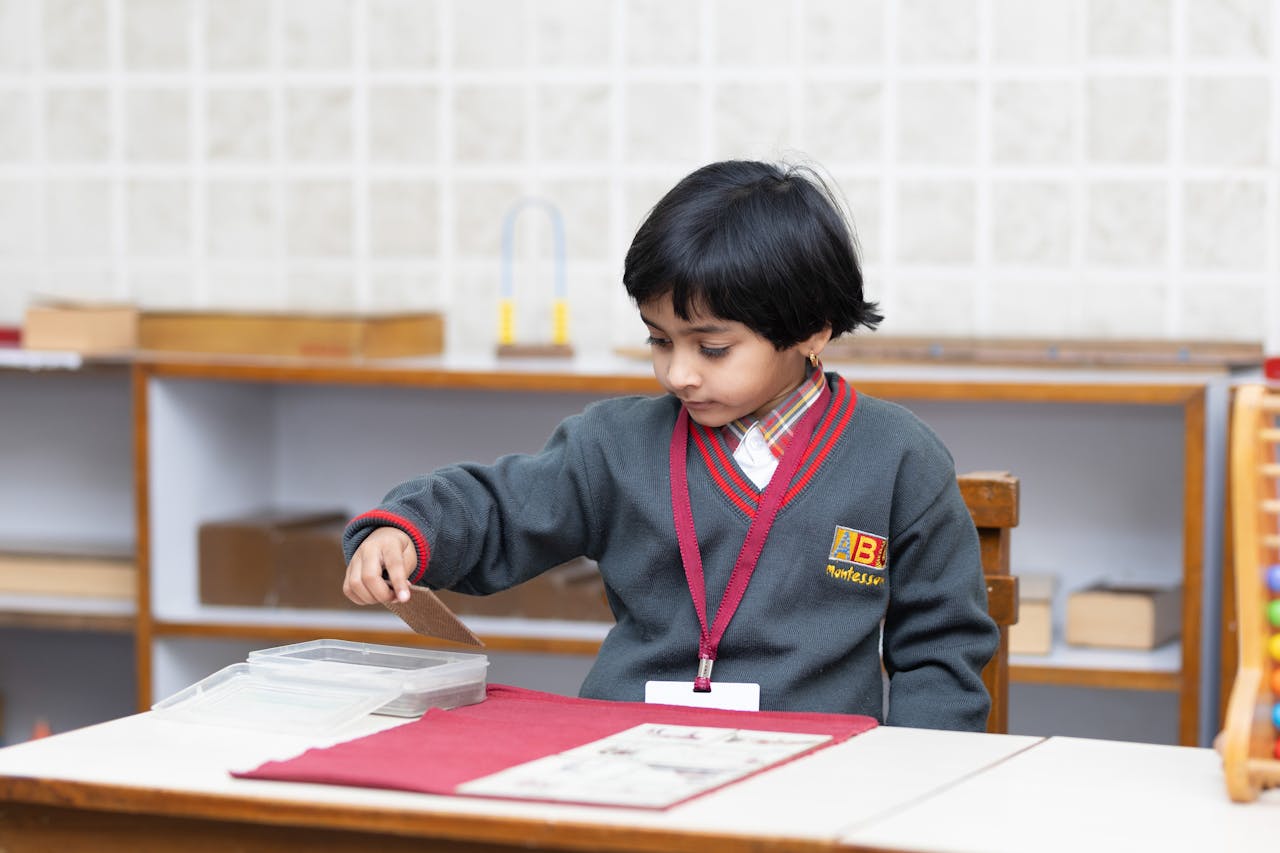
Maria Montessori opened her first Casa dei Bambini, Italian for Children's House, in Rome in 1907, working with children the conventional educational thinking of the time had largely written off. What she observed there, children as young as three concentrating for long stretches on self-chosen work, correcting their own mistakes, and developing real independence, became the foundation for the preschool model used in Montessori classrooms around the world today. For families new to the method, the Children's House can look deceptively simple: a quiet room, low shelves, children moving calmly from one activity to another. Understanding what's actually happening underneath that calm surface changes how you evaluate and support it.
What is Montessori preschool?
Montessori preschool serves children roughly from two and a half to six years old, spanning what Montessori called the first plane of development, a period she believed was defined by the "absorbent mind," an extraordinary, largely unconscious capacity to take in and internalize the surrounding environment. Rather than a curriculum delivered through direct instruction, the Children's House offers a carefully prepared environment: a room stocked with sequenced materials sized and designed for the child, arranged on open, accessible shelves, with a trained adult observing and guiding rather than directing.
This is meaningfully different from both a standard daycare, which is primarily about supervision and care with variable educational content, and a standard academic preschool, which is generally teacher-directed and group-paced. In a Montessori preschool, the child chooses their own work from the available materials, works at their own pace for as long as their concentration lasts, and is rarely, if ever, required to keep pace with a group.
A typical day at Montessori preschool
While details vary by school, most Montessori preschool days follow a recognizable rhythm built around one core feature: the long, uninterrupted work period, known as the work cycle, which typically runs two and a half to three hours each morning.
Children usually arrive and settle into independent work almost immediately, choosing a material from the shelf, carrying it to a table or floor mat, working with it for as long as they like, and returning it to its place when finished. The teacher, or guide, circulates quietly during this period, giving brief individual or small-group lessons on new materials as each child is ready, but otherwise observing rather than directing. A short group gathering, often called circle time, may bookend the work period with songs, a story, or a group activity. Outdoor time, a snack (often prepared by the children themselves as part of practical life), and, for younger or full-day students, a rest period round out the schedule.
| Time block | What's happening |
|---|---|
| 7:30 to 8:30 a.m. | Arrival, greeting, settling into an initial self-chosen activity |
| 8:30 to 11:00 a.m. | The main work cycle: independent work with materials, interspersed with brief individual or small-group lessons from the guide |
| 11:00 to 11:30 a.m. | Outdoor play or gross motor movement |
| 11:30 to 11:50 a.m. | Closing circle: songs, a story, or a group activity |
| 11:50 a.m. to 12:00 p.m. | Snack preparation and dismissal (half-day programs) or transition to lunch (full-day programs) |
| 12:00 to 1:00 p.m. (full day) | Lunch, often with practical life tasks like serving and cleaning up |
| 1:00 to 2:30 p.m. (full day) | Rest or quiet time for younger children; a shorter afternoon work cycle for older ones |
| 2:30 to 3:30 p.m. (full day) | Afternoon enrichment (art, music, outdoor time) and dismissal |
Exact times shift from school to school, and some schools run a shorter or longer morning work cycle depending on their schedule, but the underlying structure, a long uninterrupted work block anchoring the morning, framed by consistent arrival and closing routines, is close to universal across authentic Montessori preschools. For a fuller hour-by-hour picture across both preschool and elementary, see a day in a Montessori school.
The four curriculum areas
The Children's House environment is organized into distinct curriculum areas, each with its own sequence of materials.
Practical life
Practical life activities, pouring, spooning, buttoning, sweeping, food preparation, are often the first area a new child gravitates toward, because they closely mirror real household tasks the child has already observed adults doing. Beyond building fine motor control, practical life work develops concentration, order, and independence, the foundation the rest of the curriculum builds on.
Sensorial
Sensorial materials, including the classic Pink Tower, Brown Stair, and Cylinder Blocks, refine the child's ability to perceive and classify sensory qualities: size, weight, texture, color, sound. These materials sharpen the senses through isolated, controlled comparison and lay the perceptual groundwork for the more abstract math and language work that follows.
Language
Language work moves from spoken vocabulary enrichment through phonetic awareness (supported by materials like Sandpaper Letters) to composing words and simple sentences with the Movable Alphabet, often well before a child can physically write by hand. Many Montessori children begin reading and writing between ages four and five, not because of pressure to accelerate, but because the sequence of materials builds the underlying skills gradually and concretely.
Math
Montessori math work makes abstract number concepts physical and countable, most famously through the Golden Beads, which let a child physically handle units, tens, hundreds, and thousands before ever encountering the concepts symbolically on paper. By the time a Montessori child moves into elementary work with numbers on a page, they typically have years of concrete, hands-on experience with exactly what those numbers represent.
Culture
A fifth area, broadly called culture, introduces geography, botany, zoology, basic science, art, and music, generally through hands-on materials like puzzle maps, real specimens, and simple experiments rather than textbooks. Culture work in the primary years is intentionally broad and exploratory, planting seeds of interest that the elementary "cosmic education" curriculum later builds into deeper, more structured study.
Why mixed ages, 3 to 6
Montessori preschool classrooms deliberately mix children across the full 3-to-6 age span rather than grouping by single birth year, and this is a core design choice, not a scheduling convenience. Younger children benefit from constantly observing older children working at a more advanced level, absorbing vocabulary, behavior, and skills well before they are formally taught. Older children consolidate and deepen their own understanding by explaining or demonstrating work to younger classmates, a well-documented way of solidifying learning. The three-year span also means a child generally stays with the same teacher and many of the same classmates across multiple years, offering a stability and sense of belonging that a single-grade classroom, with a full turnover of teacher and peers every year, does not provide in the same way. For more on the developmental thinking behind this age range, see Montessori for 3 to 6 years.
How it differs from standard preschool or daycare
The most visible differences are the materials and the long work period, but the deeper difference is in the adult's role. A conventional preschool teacher typically leads the group through planned activities on a fixed schedule. A Montessori guide observes each child individually, tracks their progress through the material sequence, and intervenes with a brief, targeted lesson only when a child is developmentally ready for it. The result is a classroom that looks, and is, far less centrally directed, with the child rather than the teacher setting the pace of most of the day.
What to expect the first weeks
New Montessori families are sometimes surprised that the first few weeks can look less polished than the calm, orderly classroom they saw on a tour. A child new to the environment, especially one coming from a more conventional daycare, often needs time to learn how to choose work independently and sustain concentration without constant adult direction, skills the classroom is specifically designed to build but that don't appear instantly. It's normal for a new child to wander between materials without settling for the first several weeks, and normal for a guide to give extra individual attention during this adjustment period. Most children settle into genuine, sustained independent work within the first month or two; a longer adjustment isn't a sign that Montessori isn't working, only that the underlying skills take real time to develop.
Concentration is the goal, not compliance
A Montessori guide isn't trying to get a new child to sit still and follow instructions quickly. The actual goal, what Maria Montessori called normalization, is a child who chooses meaningful work and sustains real concentration on it, a process that unfolds gradually and looks different for every child. If your child's early weeks look less orderly than you expected, that's normal, not a sign of a problem.