
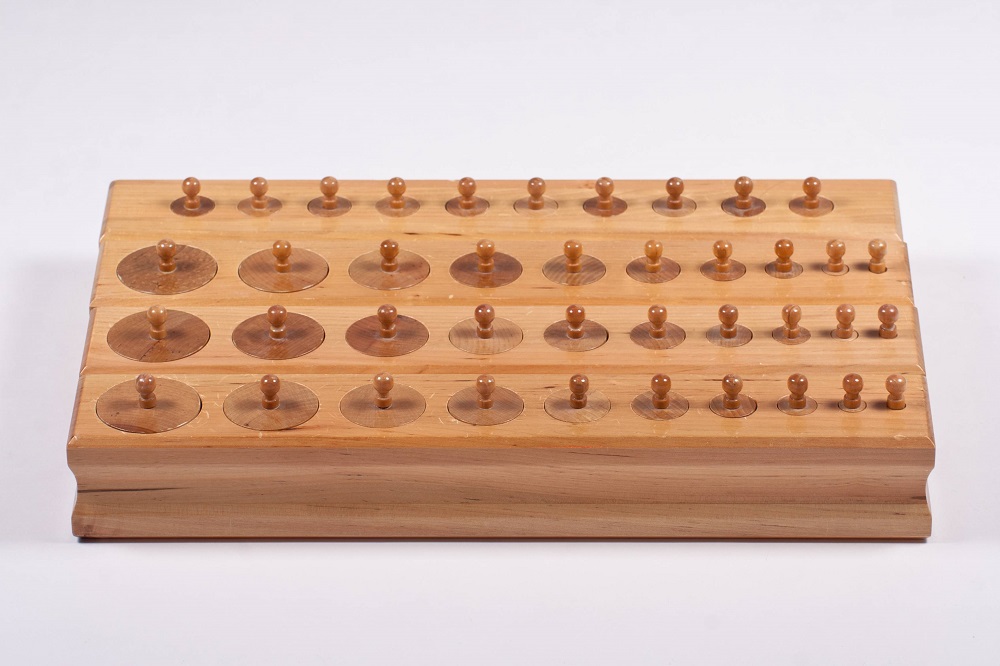
Every classroom material Maria Montessori designed had a purpose that went beyond what it appeared to do on the surface. The Cylinder Blocks are a perfect example of this. A child who spends thirty minutes fitting cylinders into sockets is not simply doing a puzzle. They are training their visual perception, developing their three-finger pincer grip, building their capacity for self-correction, and practicing the kind of sustained concentration that transfers directly to reading and mathematics. This is what Montessori called indirect preparation: the material does more than it shows.
What the Cylinder Blocks are
The Cylinder Blocks consist of four solid rectangular wooden blocks, each containing ten cylindrical sockets and ten matching wooden cylinders fitted with small knobs on top. The four blocks are traditionally labeled Block 1 through Block 4, and each one varies along a different dimension:
- Block 1: Cylinders vary in both height and diameter simultaneously. The tallest cylinder is also the widest; the shortest is the narrowest. The gradation is consistent and clear.
- Block 2: Cylinders vary in diameter only, remaining the same height. This is the most subtle block and often the most challenging for young children.
- Block 3: Cylinders vary in height only, all having the same diameter. The sockets look nearly identical until you study them carefully.
- Block 4: Cylinders vary inversely: the tallest is the narrowest, the shortest is the widest. This reversal catches children who have learned to rely on a single cue.
Each block is self-correcting. If a cylinder is placed in the wrong socket, the error becomes apparent either because the cylinder sinks too deep, sits too high, or wobbles. The child does not need an adult to tell them they made a mistake. The material tells them directly.
The age range and how to introduce them
The Cylinder Blocks are typically introduced in the Montessori primary classroom between ages two and a half and three, though some children show readiness earlier. The key indicator is not age but whether the child can focus on a three-step sequence: take the cylinder out, examine it, replace it correctly. If a child is still at the stage of dumping everything out and walking away, the material is not yet the right fit.
The classic Montessori presentation for Block 1 goes like this. The guide places the block on a low table or a mat on the floor. They remove each cylinder using the three-finger pincer grip, thumb and two fingers on the knob, and lay the cylinders in a mixed row in front of the block. Without speaking excessively, they then pick up one cylinder, look at it, look at the sockets, and place it in its correct socket. The process is slow, deliberate, and purposeful. After demonstrating for one or two cycles, the guide invites the child to try.
The grip used to handle the cylinders is not incidental. The three-finger pincer grip is exactly the grip used to hold a pencil. Montessori designed this deliberately. A child who has spent months using this grip with Cylinder Blocks has already trained the hand that will one day write.
What skills the Cylinder Blocks build
Visual discrimination
Fitting a cylinder into the correct socket requires the child to compare dimensions with their eyes before they act. Over hundreds of repetitions across months, this trains the ability to perceive subtle differences in size, proportion, and space. This is the same perceptual skill that allows a child to distinguish between similar-looking letters like b and d, or between numbers like 6 and 9. The Cylinder Blocks lay the neurological groundwork for this without ever involving a letter or number.
Fine motor control
Grasping a cylinder by its small knob and placing it into a tight-fitting socket requires precise motor control. The child must judge how much force to use, how to orient the cylinder, and when to release. This is significantly more demanding than typical toy play, and the concentration it requires is exactly what Montessori was cultivating. Fine motor control built through this kind of work transfers to scissors, pencils, and any tool that requires coordinated grip and release.
Concentration and the work cycle
Maria Montessori observed that children who had worked deeply with materials like the Cylinder Blocks entered a state she described as a normalized work cycle: a period of focused engagement that, once established, became the child's natural way of approaching a task. A child who can sit with Block 2 for twenty uninterrupted minutes, removing, mixing, and replacing all ten cylinders repeatedly, has developed a quality of attention that no worksheet can build.
Self-correction without adult intervention
The self-correcting nature of the material is one of its most important features. When a child places a cylinder incorrectly, they discover the error through the material itself, not through a teacher's correction. This is not a small thing. A child who learns to detect and correct their own errors develops an internal standard for accuracy that is far more powerful than dependence on external feedback. It also removes the emotional charge of being corrected. The material is simply telling them something. There is nothing personal about it.
Extending the work: combinations and variations
Once a child has worked comfortably with each block individually, the Cylinder Blocks offer a natural extension that dramatically increases the challenge. Two, three, or all four blocks can be combined. The child removes all cylinders from all blocks into a single mixed pile, then sorts and replaces every cylinder into its correct position across multiple blocks simultaneously.
This combination work requires the child to hold more information in working memory, make finer comparisons across a larger set, and manage a significantly more complex task. Many children find this extension deeply absorbing, precisely because it matches their growing capacity for challenge. A child who can complete the four-block combination without error is demonstrating a level of visual and motor discrimination that is genuinely impressive.
Another natural extension is blindfolded work. The child uses touch alone to fit each cylinder. This shifts the exercise from visual to tactile discrimination and builds a different kind of perceptual awareness. It also tends to be enormously satisfying for children who are ready for it, because the success feels earned in a way that visual work no longer challenges them.
The Cylinder Blocks at home
For families practicing Montessori at home, the Cylinder Blocks are one of the highest-value materials to invest in. They are durable, lasting decades if treated with care. They require no preparation or cleanup beyond replacing the cylinders, making them genuinely independent work for the child. And because the four blocks offer escalating challenge, a single set serves a child from age two and a half through five or six, a longer useful lifespan than most materials.
At home, the material works best presented on a low shelf in the prepared environment, alongside a small mat the child can use to define their workspace. Present one block at a time. Wait until the child has truly mastered a block before introducing the next. The temptation to rush through all four quickly should be resisted: the value is in the repetition, not in the novelty.
Choosing a set: what to look for
The Cylinder Blocks are a material where quality matters. The cylinders must fit their sockets precisely. Too loose, and the self-correcting function breaks down. Too tight, and young children cannot manage them without frustration. The wood should be solid hardwood, not MDF or pine, and the finish should be smooth without any splinters or rough edges around the knobs. The knobs themselves should be the right size for small fingers, large enough to grip securely but small enough to require the three-finger hold rather than a full-fist grasp.
The gradient across each block must be mathematically accurate. Inconsistent gradation is a common issue with cheaper sets and defeats the purpose of the material entirely. Before purchasing, it is worth checking whether the manufacturer has published their tolerances or whether the set is certified by an AMI- or AMS-affiliated body.
If budget is a constraint, start with Block 1. It offers the most visible gradation and is the most accessible entry point for young children. The remaining blocks can be added over time as interest and ability develop.
The detail most parents miss
The knob on each cylinder is not just a handle. Its size is calibrated to require exactly the three-finger grip that Maria Montessori wanted the child to use. If your child is using a full-hand grab instead, the knob is either too large, or the child needs a gentle demonstration of the correct grip. This is worth paying attention to, because the indirect preparation for writing depends entirely on how the hand is being used, not just on whether the cylinder goes in the right socket.
Where the Cylinder Blocks fit in the sensorial sequence
In the Montessori classroom, the Cylinder Blocks are typically among the first sensorial materials introduced because their self-correcting nature makes them accessible to children who are still developing their ability to work independently. They precede the Pink Tower and Brown Stair in many presentations, though the exact sequence varies by school and guide.
What the Cylinder Blocks share with the Pink Tower and Brown Stair is the concept of graduated series. Montessori believed that exposing children to the mathematical concept of regular, predictable gradation through concrete, tactile experience was the first step in building a mathematical mind. Long before a child encounters a number line or a ruler, they have internalized through their hands and eyes what it means for something to become systematically larger or smaller, wider or narrower, taller or shorter. This embodied understanding is the foundation everything else builds on.