
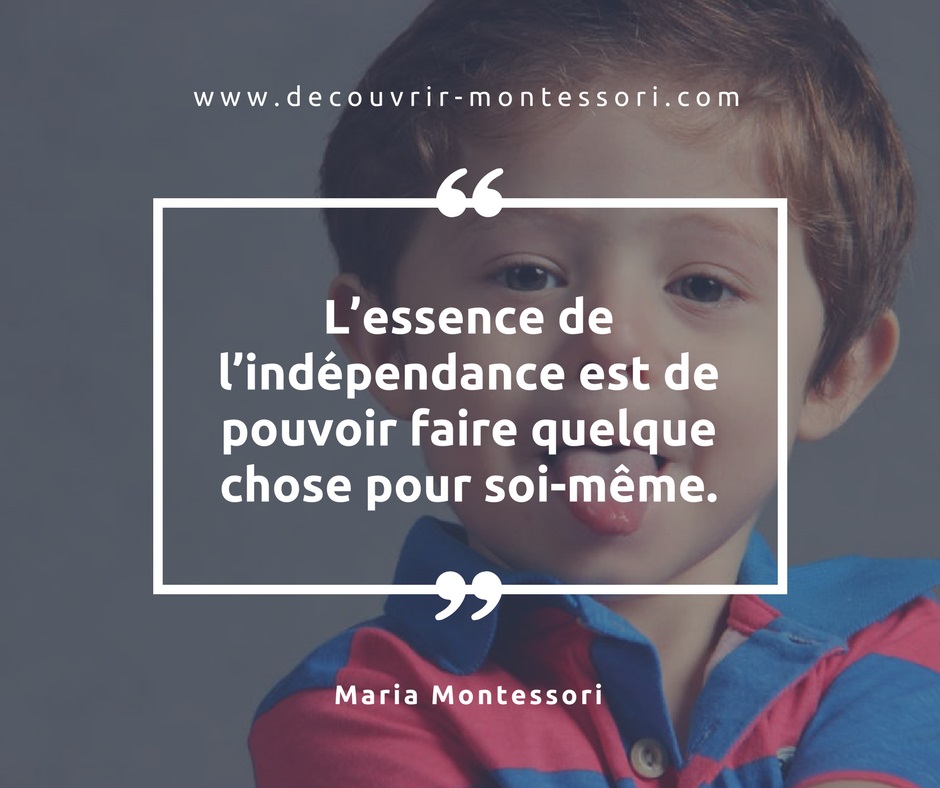
"Help me do it myself." This is the phrase Maria Montessori used to capture what she believed children were asking from the adults around them. Not "do it for me." Not "tell me how." But "help me so that I can do it." The distinction is everything. An adult who does the work for the child removes the opportunity to develop competence. An adult who sets up the conditions in which the child can succeed, and then steps back, creates competence. The Montessori method is, at its core, a disciplined practice of the second kind of help.
What Montessori means by independence
In ordinary usage, independence often means self-sufficiency: not needing others. Montessori's sense of independence is different and more nuanced. It means the capacity for self-direction: the ability to initiate action, choose work, sustain effort, and complete tasks because of an internal drive rather than external direction or reward.
A child who does what they are told when told, who needs constant adult guidance to move from one task to the next, who cannot make decisions without adult approval: this child is obedient, not independent. Obedience trained by external pressure is useful in certain contexts, but it does not develop the internal resources that sustain a person through difficulty, novelty, and challenge over a lifetime. Independence in the Montessori sense does.
Maria Montessori observed that when children were given the conditions for genuine independence, their behavior changed. They became calmer, more focused, more cooperative, more joyful. She called this normalization: the return to the natural state of the healthy child when the conditions for independence are met. The concept of normalization is built around the belief that children's deepest drive is to do, to act, to build competence, and that a child who cannot exercise this drive becomes frustrated, attention-seeking, or passive.
Independence from birth
The Montessori approach to independence begins at birth. An infant who is placed on a firm floor surface on their back is already being supported in free, unassisted movement. Propping, bouncing seats, and containing devices limit the infant's ability to discover and refine their own movement repertoire. The Montessori infant environment removes these limitations wherever safety allows.
The infant who rolls over by themselves has done something. The infant who is rolled over by an adult has had something done to them. This distinction seems trivial. It is not. The infant building their movement competence through their own effort is building something that transfers: the experience of "I tried, I struggled, and I succeeded."
Toddler independence: the age of "I do it"
Between eighteen months and three years, often labeled the terrible twos, the drive for independence reaches its most visible and most challenging expression. A toddler who insists on putting on their own shoes, however long it takes and however badly they are put on, is doing something developmentally essential. An adult who takes over because it is faster is prioritizing the adult's schedule over the child's development.
The practical tools for supporting toddler independence, and the earliest chores appropriate for this age, are largely environmental:
- Clothing that the child can put on independently: elastic waistbands, large arm openings, velcro rather than laces for early stages
- A low hook for the child's own coat and bag
- A step stool that makes the bathroom sink genuinely accessible
- Real child-sized tools for household participation: a small broom, a sponge, a dustpan
- A shelf of activities the child can access, use, and return without adult help
The environment is what makes independence possible. Good intentions without environmental preparation produce frustration, not competence.
Primary-age independence (3 to 6 years)
By age three, a child in a well-prepared Montessori environment can manage a significant portion of their daily routine independently: dressing, breakfast preparation, selecting and completing activities, tidying their space. This is not a low bar. It is the natural result of three years of environmental support for independence.
At this stage, independence extends into learning: choosing work from the shelf, managing the full cycle of an activity from selection to completion to restoration, deciding what to work on and for how long. The Montessori guide's role is not to manage this process but to observe it, to introduce new materials at the right moment, and to provide guidance when the child is genuinely stuck rather than merely challenged.
The three-to-six classroom offers independence in social dimensions as well. Children resolve conflicts with each other, with guidance but without constant adult intervention. They care for younger children in the multi-age environment. They take on classroom responsibilities: watering plants, preparing snack, caring for animals. Each responsibility is a genuine exercise of competence that belongs to the child, not to the adult.
Elementary independence (6 to 12 years)
In the elementary Montessori classroom, independence takes on an intellectual character. Children conduct research on topics of their choosing, manage long-term projects, track their own progress, and take genuine responsibility for what they learn and how deeply they pursue it. The elementary guide's role shifts further from instructor to consultant: available for help, for resources, for discussion, but not directing the child's intellectual life from the front of the room.
At this stage, independence also develops in the social dimension: children negotiate, collaborate, work through disagreements, and take responsibility for the quality of their work in relation to others who are depending on them. The social independence of the elementary years builds the capacity for genuine cooperation and accountability that adult work requires.
The hardest part: the adult's role
The most consistent obstacle to developing independence in children is not a lack of good intentions but the difficulty adults have in watching a child struggle without stepping in. A child who is working on something hard, who is frustrated but still trying, is in the optimal learning state. An adult who steps in to relieve the frustration removes the learning experience at the moment it would have the highest return.
This does not mean abandoning children to impossible tasks. It means calibrating help carefully: enough environmental preparation that the challenge is achievable, enough adult availability that the child knows help is there if genuinely needed, and enough restraint that the child's own effort produces the result rather than the adult's.
The phrase that is most useful is: "What do you think you should do?" Rather than providing the answer, this returns the problem to the child. It signals that you believe they have the resources to figure it out. Most of the time, they do. When they truly do not, the help that follows is received differently than help offered preemptively, because the child has already had the experience of trying.
The long-term measure of Montessori independence
Several longitudinal studies of Montessori-educated children have found differences in adult outcomes that trace back to the independence built in their early years: higher ratings of executive function, stronger internal motivation, greater satisfaction in their work, and better self-regulation under stress. These are not small differences. They represent a meaningfully different relationship with effort, challenge, and the self as an agent in the world. The daily investment in supporting a child's independence, tedious as it sometimes is, pays compound interest over a lifetime.