
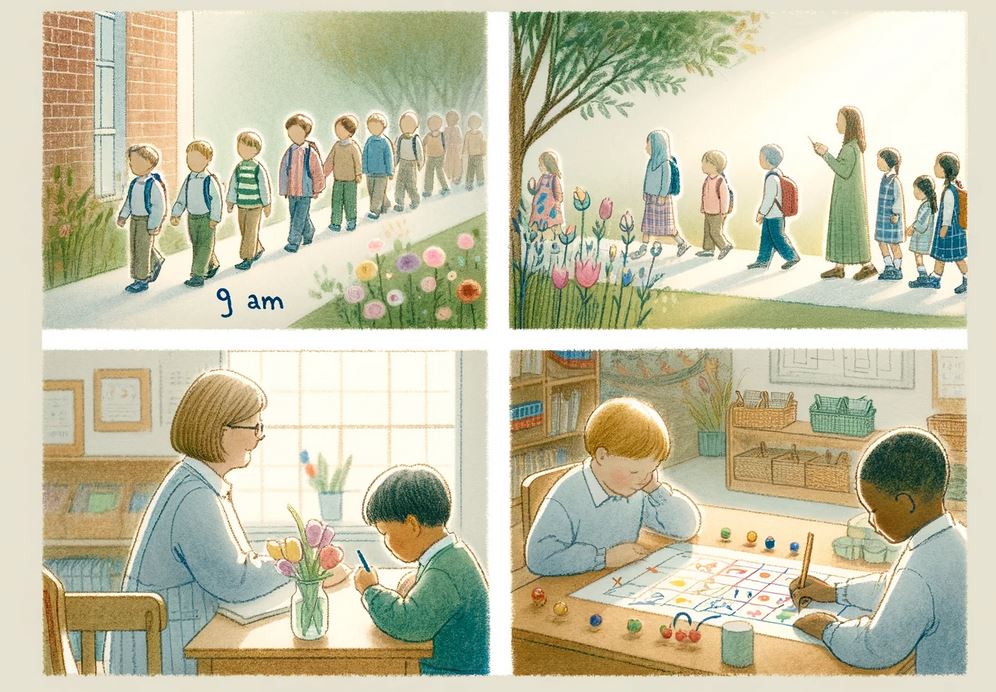
No two Montessori classrooms run on an identical clock, timing depends on the age group, the school, and even the season, but the underlying structure is remarkably consistent from one authentic Montessori environment to the next. The day below reflects a typical primary (ages 3-6) or elementary (ages 6-12) classroom. Infant and toddler programs, and the last hour or two of a full-day elementary schedule, look somewhat different and are noted where relevant.
A Sample Schedule at a Glance
Exact times shift from school to school, but the block structure below is a realistic composite of a full-day Montessori program, and it's worth scanning before reading the detail on each block that follows.
| Time | Primary Classroom (3-6) | Elementary Classroom (6-12) |
|---|---|---|
| 7:30 - 9:00 | Staggered arrival, independent choice of first activity | Staggered arrival, independent choice of first activity |
| 9:00 - 11:30 | Uninterrupted work cycle; individual and small-group lessons woven in | Uninterrupted work cycle; individual and small-group lessons woven in |
| Throughout the morning | Flowing snack table, available whenever a child is hungry | Flowing snack table or a single shared snack, depending on the school |
| 11:30 - 12:15 | Outdoor time and movement | Outdoor time and movement |
| 12:15 - 1:00 | Lunch (full-day programs); many half-day programs dismiss around this time | Lunch |
| 1:00 - 2:30 | Rest or quiet activity time (age-dependent); shorter second work period for older primary children | Second work cycle: group research, cosmic-education follow-up, art, music, or a "going out" trip |
| 2:30 - 3:00 | Closing circle and staggered dismissal | Closing circle and staggered dismissal |
Half-day programs, common for younger primary children, typically end at or before the midday outdoor block and skip the afternoon rows entirely. What follows walks through each block in more depth.
Arrival and the Start of the Day
Montessori mornings tend to open gradually rather than all at once. Children arrive over a staggered window, often 7:30 to 9:00, greet their guide individually at the door, put away their own bag and coat, and move directly into the classroom to choose their first activity. There is rarely a whole-group opening routine at this stage. Instead, the classroom itself is "prepared", every material has a fixed place on an open shelf, so a child who arrives at 7:45 can start meaningful, independent work immediately rather than waiting for a 9:00 bell. This staggered start is also what allows the long work cycle that follows to actually be long: there is no lost time waiting for the last student to arrive before anything can begin.
The Three-Hour Work Cycle
The heart of the Montessori morning is the uninterrupted work cycle, typically two and a half to three hours, during which children choose their own activities from the shelves, work at their own pace, and are not interrupted by scheduled transitions, group announcements, or a rotating bell schedule. A child might spend forty minutes at a single sensorial material, mastering it through repetition, or move through four or five short activities in the same period. Both are normal. What matters to a Montessori guide is not how much ground a child covers in a morning but whether the child is engaged in "deep work", the sustained, self-chosen concentration Montessori called normalization, which she considered essential to healthy development at every age.
During the work cycle, the guide is rarely standing at the front of the room. Most of the guide's time is spent circulating, observing which child is ready for a new presentation, and giving individual or small-group lessons quietly at a table or floor mat while the rest of the class continues working independently around them. Assistants, where present, support with practical needs (a spill, a child new to a material, keeping the shelves in order) so the guide's attention stays free for teaching and observation.
Individual and Small-Group Lessons
Lessons in a Montessori classroom are almost never delivered to the whole class at once, and they are almost never lectures. A guide will bring one child, or two or three children working on the same concept, to a table or mat and demonstrate a material with minimal, precise language, then step back and let the child work with it independently, sometimes for days, before the next related lesson is introduced. In elementary classrooms this is where the Great Lessons and cosmic-education work typically begin: a guide opens a topic with a short, often dramatic presentation, and small groups then run with the research questions it raises for the rest of the week.
Snack Time and Practical Life
Rather than a single scheduled snack break for the whole class, many Montessori primary classrooms run a "flowing" snack table: a small, prepared station where one or two children at a time can independently pour a drink, cut fruit, and clean up after themselves whenever they are hungry during the work cycle, rather than at one fixed moment for everyone. This is itself a practical life activity, not a break from learning, it builds independence, fine motor coordination, and self-regulation the same way any other material does. Some schools, particularly full-day elementary programs, do run a single shared snack or lunch period instead, especially once children are older and the group has begun to value shared social time more than solitary choice.
Outdoor Time and Movement
Outdoor time is a deliberate part of the schedule, not an afterthought squeezed in if time allows. Younger children typically get one dedicated outdoor period, often after the main work cycle ends around midday, involving both free movement and, in many schools, outdoor practical life or gardening work. Movement matters enormously in Montessori's model of development: young children build coordination, balance, and body awareness through large-muscle movement in the same deliberate way they build fine motor skill through tabletop materials, so outdoor time is treated as developmental work, not simply a chance to burn off energy.
The Elementary Afternoon: Research and Going Out
Full-day elementary programs (age 6 and up) typically add a second work block in the afternoon, often used for longer group research projects, art, music, foreign language, or a "going out" trip: a small group leaving the classroom, with adult supervision but child-led planning, to pursue a specific research need in the wider community. Afternoons tend to be somewhat more social and project-based than the more individually paced morning work cycle, reflecting the elementary-age child's growing interest in peer collaboration.
Closing Circle and Dismissal
Most Montessori classrooms end the day with a brief group gathering, sometimes called closing circle, where children may share something they worked on, hear a story, sing, or simply review the plan for the following day. This is often the only true whole-group moment in the entire day outside of the opening greeting. Dismissal, like arrival, tends to be staggered and individual rather than a single mass exit, giving each child (and each parent) a brief personal moment with the guide at pickup.
What a good tour should actually show you
If you are visiting a school and the entire class is doing the same worksheet at the same time when you walk in, that is worth asking about directly. It does not automatically mean the school is inauthentic, some moments of the day are legitimately whole-group, but the bulk of a well-run Montessori morning should show children at different activities, at different paces, with the guide working one-on-one or in small groups rather than addressing the room. Ask to observe during the mid-morning work cycle specifically, not just at drop-off or during a scheduled group lesson, since that stretch is where the method is most visible.