
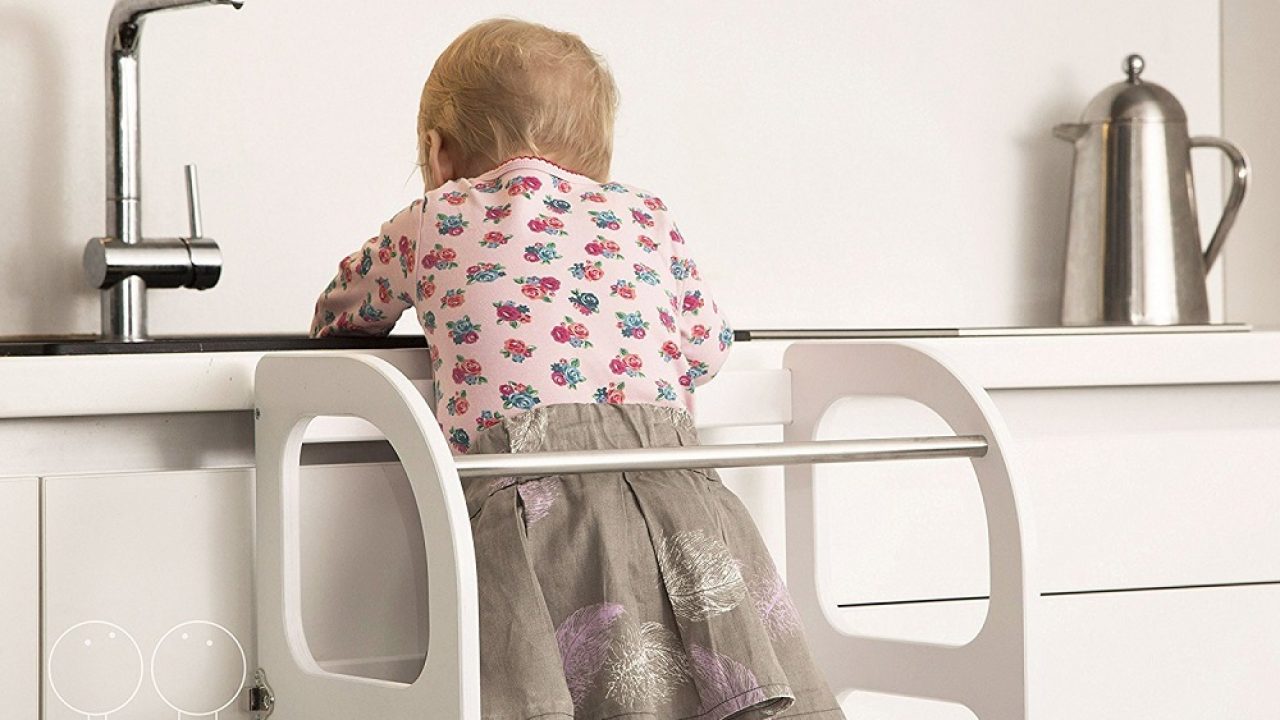
A learning tower is a raised, enclosed platform on four legs, typically with an adjustable step height and guard rails on three or four sides, built so a toddler can stand at adult counter height without an adult holding or lifting them the entire time. The child climbs in independently (once old enough to do so safely), stands at a stable, enclosed platform, and can see, reach, and participate in whatever is happening at the counter: washing vegetables, stirring batter, pouring, or simply watching closely at eye level with the activity instead of from a chair pulled up nearby or from the floor.
Not an original Montessori material, and why that's fine
It is worth being direct about this: the learning tower does not appear anywhere in Maria Montessori's original body of designed materials, and no legitimate source claims otherwise. It was developed much later, as part of the broader modern movement of parents and companies adapting Montessori principles for home use in ways Montessori herself never specifically addressed, since she was writing primarily about the prepared classroom environment, not the family kitchen.
What makes the learning tower a reasonable fit for a Montessori-inspired home anyway is that it serves a principle Montessori was explicit about: the young child's deep need to participate in the real work of the household, not a simplified or pretend version of it, at a scale and height that makes genuine participation physically possible. That principle underlies the entire practical life curriculum, and a learning tower is simply one modern tool for extending it to the kitchen counter specifically. If you're building out a Montessori-style kitchen space more broadly, see our complete guide to a Montessori kitchen for kids, which covers low shelving, child-sized tools, and other adaptations alongside the tower itself.
Safety considerations, taken seriously
A learning tower puts a young child at counter height, next to hot surfaces, sharp tools, and appliances, which means the safety questions deserve more weight than a typical toy purchase. A few points matter regardless of which tower a family chooses or builds:
- Never leave a child unattended in a learning tower. Every reputable manufacturer states this explicitly, and it holds regardless of how sturdy the tower is. The tower changes what a child can reach; it does not change what is safe for them to touch unsupervised.
- Check the base and rails for stability. A wide, stable base and enclosed sides that prevent a child from leaning far out or climbing over the top are the features that most reduce tipping risk. Towers with a narrow footprint or open sides carry meaningfully more risk.
- Set the platform so the top rail sits above the child's waist, not at chest height or below. Most adjustable towers have multiple height settings for exactly this reason, and the correct setting changes as the child grows.
- Keep hot surfaces, knives, and hot liquids out of reach even when the child is safely in the tower. Counter height access means new things become reachable that weren't before; a stovetop or hot pan at counter level is a real hazard once a toddler can stand right next to it.
- Inspect hardware periodically, since screws, bolts, and locking mechanisms loosen with regular use, especially on wooden towers that get moved between the kitchen and storage.
When to introduce one
There is no single correct age, and readiness matters more than a birthday. Most sources point to somewhere between twelve and eighteen months as the point when many toddlers have the standing balance and confidence to use a learning tower safely, but the more useful markers are behavioral rather than calendar-based: can the child stand unsupported for a sustained period, cruise or walk confidently, and follow a basic safety instruction like "hands on the rail"? A child who is still unsteady on their feet, or who does not yet reliably respond to a simple verbal boundary, is not yet ready regardless of age in months.
This readiness-based approach, watching the individual child rather than following a fixed age, is consistent with how Montessori practical life work is introduced generally: a new tool or activity is offered when the child shows the physical and attentional readiness for it, not on a predetermined schedule. See our guide to Montessori practical life activities for how this readiness principle applies across the whole practical life curriculum, not just kitchen work.
Learning tower safety checklist
- ✓ Child can stand unsupported for several minutes and cruises or walks with confidence
- ✓ Child reliably follows one simple verbal safety instruction, such as "hands on the rail"
- ✓ Tower has a wide, stable base on all four sides, not a narrow or top-heavy footprint
- ✓ Guard rails enclose at least three sides, with no gap wide enough for a child to climb through or lean far out of
- ✓ Platform height is adjustable, and the top rail sits above the child's waist at the current setting
- ✓ Hardware (screws, bolts, locking pins) has been checked and tightened recently
- ✓ Hot surfaces, knives, and hot liquids are kept off the section of counter closest to the tower
- ✓ An adult is present and attentive the entire time the child is in the tower, including while getting in and out
DIY versus buying
Families approach the learning tower in roughly three ways. Some buy a purpose-built commercial tower, typically an adjustable wooden model with guard rails on three or four sides, generally in the range of $100 to $300 depending on the brand, wood type, and adjustability. Some build one themselves from plans widely available online, using basic woodworking skills and standard lumber, at meaningfully lower material cost but requiring careful attention to the same stability and rail-height principles a commercial tower is built to. And some use a simpler alternative for a shorter window of time: a sturdy step stool with a rail attachment, or a two-step stool placed against a wall so the child cannot fall backward, though these generally offer less side-to-side stability and enclosure than a purpose-built tower.
Whichever route a family takes, the safety features described above (a wide stable base, adequate side enclosure, and correct platform height) matter more than whether the tower was purchased or built, and matter more than the tower's appearance or finish.
How it fits Montessori practical life philosophy
Practical life activities, real household tasks scaled to a child's size and ability, are foundational to Montessori education because they give a young child genuine, meaningful work rather than an activity invented purely to entertain or occupy them. A toddler who pours their own water, washes a real dish, or helps prepare a real meal is doing something that matters to the household, not a simulation of adult work. This builds independence, fine motor coordination, concentration, and a felt sense of belonging and contribution that pretend versions of the same activities do not provide nearly as well.
The kitchen is one of the richest environments for this kind of work, and it is also one of the environments where a young child's short stature is most limiting: counters, sinks, and stovetops are built for adults. A learning tower removes that specific physical barrier without requiring the family to lower their entire kitchen to toddler height, which is why it has become such a common recommendation in Montessori-at-home circles even though it postdates Montessori's own writing by many decades.
The tower is a tool, not the point
It's worth remembering that the learning tower itself teaches nothing. What matters is what the child does once they're safely at counter height: real pouring, real washing, real stirring, with real consequences and real contribution to a shared task. A family that buys an expensive tower and then only uses it to let the child watch, rather than participate, has bought the accessory without the practical life philosophy behind it. The tower is worth the investment specifically because of what it makes possible, not for its own sake.