
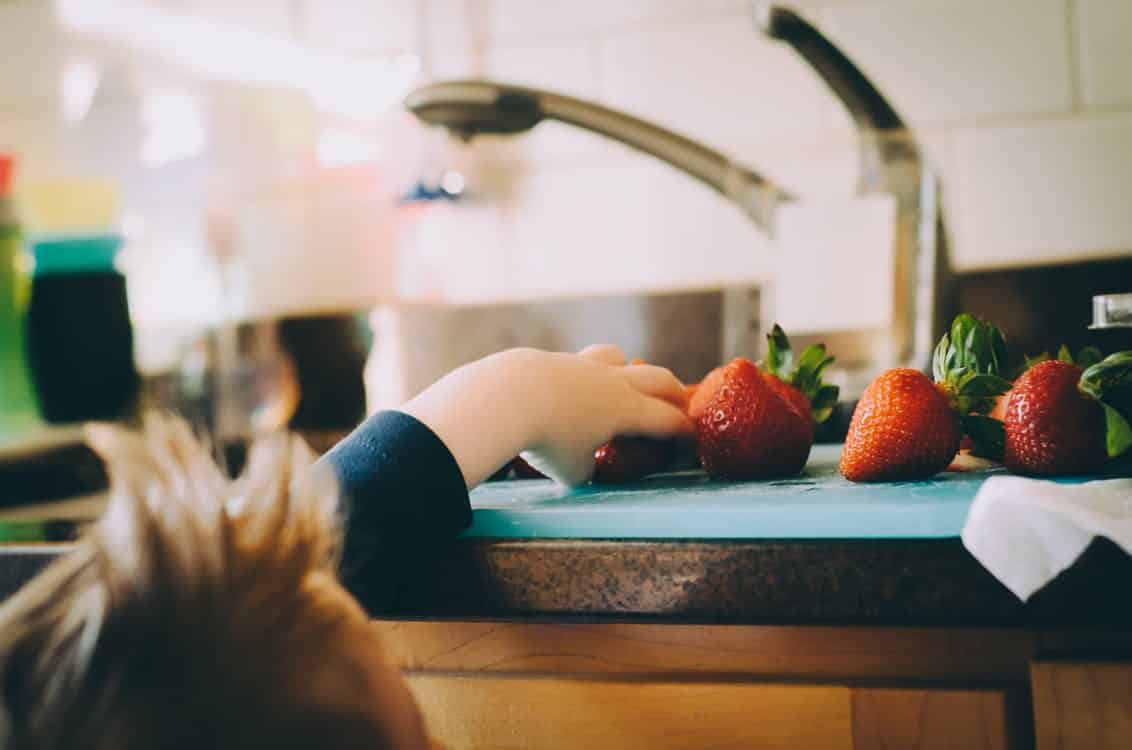
Maria Montessori placed practical life activities, which are the real activities of daily living, at the center of her primary curriculum. Cooking, preparing food, setting the table, washing dishes: these were not supplementary activities or enrichment. They were the core. The skills they build, concentration, fine motor control, sequencing, independence, sensory awareness, are the same skills that later show up in reading, mathematics, and executive function. The kitchen is not a break from learning. In Montessori, it is one of the most important places it happens.
Why real cooking beats play kitchens
Play kitchens are popular, and they are not without value. Imaginative play with a toy kitchen supports language development, social skills, and creative thinking. But Montessori kitchen work is not imaginative play. It is real work with real materials, and the distinction matters.
When a child pours real water from a real pitcher into a real glass, the consequence of inaccurate pouring is immediate and real: water on the table. They clean it up. When a child uses a real child-safe knife to cut a real banana, the feedback is physical and meaningful. When they finish and there is real food on a real plate, the satisfaction is earned. None of this is available in play kitchen work. The motivation that comes from real work, the sense of genuine competence, cannot be manufactured by a toy.
This is not an argument against play kitchens, which have their place among the best Montessori toys by age. It is an argument for giving the child access to the real kitchen alongside whatever imaginative play they do with a toy one.
The Montessori kitchen setup
The observation tower or learning tower
The most practical addition for a family implementing a Montessori kitchen is a learning tower: a sturdy wooden platform that raises the child to counter height while keeping them safely enclosed. This gives children from around eighteen months access to the workspace adults use. They can stand at the counter, observe food preparation, and participate in activities that require the counter surface, all without being held.
A learning tower is a genuine investment and typically costs between one hundred and two hundred dollars for a quality version. Families who are comfortable with woodworking can build one from plans available widely online for significantly less. A step stool can serve temporarily for older toddlers who are steady on their feet, though it provides less security than a tower.
The child's kitchen corner
A designated area at the child's height, accessible without adult involvement, is the heart of the Montessori kitchen setup. This does not require a renovation. It requires:
- A low shelf or the bottom shelf of an existing cabinet dedicated to the child's kitchen materials
- A small pitcher or water bottle the child can pour from independently
- A small plate and cup they can access, use, and clean up without help
- A tray or cutting board for snack preparation
- A child-safe knife (a butter knife or a dedicated child's knife with a rounded tip) on a tray
The child's materials should be stored consistently in the same place. When a toddler knows exactly where their pitcher is, exactly where their cup is, and exactly how to get their own water, they use that independence without prompting. When these things are in different places each day, the cognitive load of locating them before using them eliminates the independence benefit.
The snack station
A snack station is a low accessible area where the child can prepare their own simple snacks without adult involvement. The setup typically includes a small cutting board, a child-safe knife, a plate, and a selection of appropriate foods: a banana, a few crackers, a small container of cheese, apple slices (pre-cut for younger children, left whole for older ones who cut them independently). The child selects, prepares, eats, and cleans up without needing to involve an adult unless they choose to.
For families where meal schedules are strict, the snack station can be set up for a defined period, then cleared. For families with more flexible timing, it can be available throughout the day. The key is that it is the child's area, with materials that belong to them and that they are responsible for.
Kitchen activities by age
12 to 18 months
At this age, the kitchen contribution is primarily sensory and observational. Activities that work well include washing vegetables under a gentle stream of water (set up at the child's height with a low basin), tearing lettuce leaves, putting berries into a bowl, and stirring ingredients already in a bowl. The emphasis is on participation, not precision. The eighteen-month-old who stirs too vigorously is learning. The adult who takes the spoon back because they are stirring the wrong way has just removed the lesson.
18 months to 3 years
Pouring is the classic Montessori activity for this age group: pouring water from a small pitcher, pouring dry ingredients like oats or rice from a measuring cup, pouring juice. Spreading is another key activity: spreading soft butter or cream cheese on bread or crackers using a child-safe knife. Peeling begins now: bananas, hard-boiled eggs, clementines. Whisking, stirring, and mixing work develops arm strength and coordination. All of these activities use real food and real tools, scaled to the child's size and ability.
3 to 6 years
By age three, children in a Montessori environment are ready for the full sequence of simple meal preparation. Cutting soft foods with a child's knife (bananas, strawberries, soft cheese, cooked vegetables) is achievable and genuinely exciting for children this age. Measuring ingredients with measuring cups and spoons builds early math understanding while doing real work. Making a simple salad, preparing toast, assembling a sandwich: these are complete cooking sequences the child can manage with appropriate tools and a clear setup.
Washing dishes, setting and clearing the table, and wiping surfaces are chores as important as food preparation. The complete kitchen cycle, prepare, eat, clean up, belongs to the child as much as the cooking does.
6 to 12 years
Children in the elementary years who have built a kitchen foundation can learn to cook real meals with minimal supervision. Reading a recipe, following a sequence, managing a stovetop safely with guidance: these are appropriate elementary kitchen challenges. The goal at this age is not just independence in snack preparation but genuine cooking competence. A ten-year-old who can prepare a simple dinner has a life skill that will serve them for decades.
Tools worth having
The child's kitchen toolkit does not need to be extensive:
- A child's knife: look for a sharp (not blunt) blade with a rounded tip, sized for a child's hand. Blunt knives are more dangerous than sharp ones because they require more force, increasing the risk of slipping.
- A small cutting board dedicated to the child's use, stored in their area
- A small pitcher with a handle proportioned for small hands, holds 8 to 12 ounces
- A handheld egg beater or small whisk for mixing
- Child-sized measuring cups and spoons
- A small apron the child can put on and take off independently
The cleanup is part of the activity
In a Montessori kitchen, the cleanup is not a separate chore that happens after the activity. It is the final step of the activity. A child who prepares a snack and then wipes up any spills, puts their dishes in the sink, and replaces their materials is doing the complete cycle. A child who prepares a snack and then leaves everything for a parent to clean up has only done half the work. From the beginning, the expectation should be set clearly: you prepare, you eat, you clean up. This is not perfectionism. It is respect for the shared space.
Managing the mess
Montessori kitchen work produces messes. Water gets spilled. Crackers get crumbled. Ingredients fall on the floor. This is expected and acceptable. The response that supports development is to have a small mop or sponge available at child height so the child can clean up their own mess, not to hover over the activity to prevent spills, and not to take over the cleanup when a spill happens. A child who learns to clean up their own kitchen mess has learned something far more valuable than how to prepare a snack.