
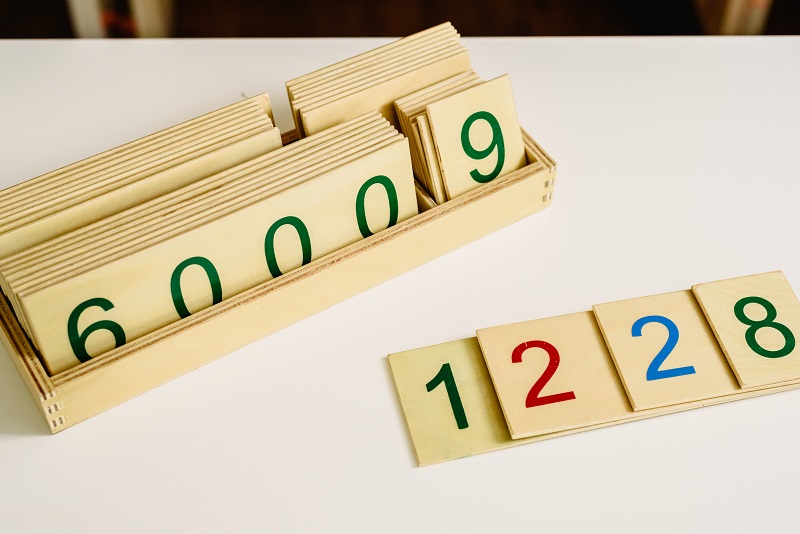
In mainstream early childhood education, numbers are typically introduced visually: flash cards, worksheets, counting books. The symbol comes first, and the child is expected to connect it to a quantity through repetition and correction. Montessori reverses this sequence entirely. Before any numeral is introduced, the child spends weeks or months with concrete counting materials that give them a genuine, physical sense of what quantities feel like. Only then, when the concept of number is already solid, does the symbol arrive. And when it does, it arrives through touch.
What Sandpaper Numbers are
Sandpaper Numbers are a set of ten boards, one for each digit from 0 to 9, each made of smooth wood with the numeral cut from sandpaper and adhered to its surface. The sandpaper texture stands out clearly against the smooth board, allowing the child to feel the boundary of the numeral as they trace it. The boards are typically color-coded to match other Montessori math materials: blue for even numbers, red for odd numbers, or sometimes green and blue depending on the school's curriculum sequence.
The dimensions of the boards matter. Each numeral is large enough for the child to trace with two fingers, the index finger and the middle finger together, in a fluid stroke that follows the natural writing path. The numeral 5, for instance, is traced starting at the top right, arcing to the left, curving down and around, then adding the flat top. This is the same stroke a child will use when writing a 5 with a pencil. The Sandpaper Numbers teach the motor pattern, not just the visual shape.
Where they fit in the Montessori math sequence
The Sandpaper Numbers are typically introduced after the child has worked with the Number Rods and the Number Cards, which together establish the concept that numerals correspond to specific quantities. The Number Rods give the child a concrete, physical experience of the quantities 1 through 10. By the time the Sandpaper Numbers arrive, the child already knows what four things feel like, what seven looks like, and what the difference between two and eight means in their hands and body. The symbol is the last step, not the first.
This sequence reflects one of Montessori's core insights about how children learn: abstract symbols should follow concrete experience, never precede it. A child who traces the numeral 7 already knows what seven objects feel like from work with the Number Rods. The Sandpaper Number is simply the code for something they already understand. This is a fundamentally different cognitive experience than introducing the symbol first and hoping the abstraction follows.
The three-period lesson
Sandpaper Numbers are introduced using the classic Montessori three-period lesson, the same structure used with the Sandpaper Letters and other naming materials.
Period 1 (Naming): The guide holds up the board, traces the numeral with two fingers, and says the name clearly: "This is three." They invite the child to trace and say the name. This is repeated for two or three numerals at a time, never more.
Period 2 (Recognizing): The boards are placed on the table. The guide says "Can you show me four?" or "Put your finger on two." The child points or traces without naming. This is the critical consolidation period where the name anchors to the symbol.
Period 3 (Remembering): The guide points to a board and asks, "What is this?" The child names it independently. If they cannot, the guide returns to Period 1 without any indication that the child has failed. There is no correction in the conventional sense, only a patient return to the beginning.
Only two or three numerals are introduced per session. This deliberate limitation is not about underestimating the child. It reflects the understanding that consolidating two things deeply is more valuable than exposing the child to ten things superficially. The Sandpaper Numbers are worked with repeatedly over days and weeks, not introduced in a single sitting.
The role of the tactile experience
Why sandpaper? The rough texture is not decorative. When the child's fingertips move across the sandpaper, several things happen simultaneously. The tactile receptors in the fingertips send information about the numeral's shape to the brain. The proprioceptive system in the muscles records the path of the movement. The visual system sees the shape. The auditory system hears the name. Four sensory channels receive the same information at the same time.
Research in neuroscience has consistently shown that multi-sensory encoding creates stronger, more durable memory traces than single-channel encoding. A child who has traced a 6 one hundred times has a motor memory of that shape that persists even when visual memory fails. This is why children who have worked extensively with Sandpaper Numbers rarely reverse 6 and 9 when writing, a reversal that is extremely common in children who learned numerals only visually.
Making sandpaper numbers at home
For families practicing Montessori at home, Sandpaper Numbers are one of the most manageable materials to make yourself if budget is a concern. The requirements are:
- Smooth wooden or thick cardboard backing, approximately 4 by 6 inches per card
- Fine-grit sandpaper (not too rough, the texture should be pleasant rather than abrasive)
- A printed template of each numeral in the correct size and stroke direction
- Non-toxic adhesive to affix the cut sandpaper to the backing
The most important thing when making them at home is ensuring that the stroke direction is correct. Numerals should be traced in the direction a child will eventually write them, not in whichever direction looks correct from the outside. Printing a motor-path guide for each numeral before cutting is worth the extra step.
If purchasing, look for sets where the sandpaper is fine enough to be pleasant to the touch, where the backing is solid enough not to flex when traced, and where the numerals are large enough for proper two-finger tracing. Sets where the numeral is painted on rather than textured defeat the entire purpose of the material.
Connecting Sandpaper Numbers to quantity
One of the most important extensions with Sandpaper Numbers is pairing them with concrete quantity materials. Once the child can identify the numerals independently, the guide introduces the concept of matching: taking the Sandpaper Number 7 and placing 7 objects beside it. Buttons, stones, small wooden discs, or counting chips all work. This pairing activity reinforces the connection between symbol and quantity that the earlier Number Rod work established.
Later, when the child encounters the Spindle Boxes, the Teen Boards, the Golden Beads, and ultimately written arithmetic, the foundation laid by the Sandpaper Numbers remains. Every written numeral is, at its root, a shape the child has traced hundreds of times. The abstract is anchored in the physical. That anchor does not fade.
Signs of readiness
A child is ready for Sandpaper Numbers when they:
- Can count objects accurately up to at least 5, touching each object as they count
- Have worked with the Number Rods and can match rods to their quantities with confidence
- Can focus on a seated table activity for five to ten minutes without distraction
- Show interest in symbols, letters, or numbers in their environment
The age range for readiness is wide. Some children are ready at three and a half. Others are not ready until four and a half or five. Neither is a concern. What matters is that the sequence is followed and the concrete foundation is genuinely solid before the symbol is introduced.
The stroke direction matters more than anything else
When presenting Sandpaper Numbers, always trace in the correct motor direction: the same direction the child will use when writing. For 1, straight down. For 2, arc right from the top, curve around and down, then sweep left. For 8, two loops connected at the center. If the child is tracing in reverse, gently reposition their fingers and guide the correct direction without comment. The motor memory being built here is the exact memory they will use with a pencil. Encoding the wrong path with hundreds of repetitions is counterproductive and hard to undo.
The bigger picture: numeral literacy as a foundation
In a culture that introduces writing and numbers earlier and earlier, the Montessori approach can seem slow. A four-year-old who has spent two months with Sandpaper Numbers and still has not written a single numeral on paper might seem behind a peer who is completing number worksheets. The comparison is misleading. The child doing Sandpaper Number work is building a multisensory, embodied knowledge of numeral shapes and their connection to quantities. They are also building concentration, fine motor control, and an internal standard for precision, none of which appear on a worksheet.
When this child does begin to write numerals, typically using the Metal Insets and later pencil work, the motor pattern is already there. The hand already knows where to go. What looks slow at four produces something that looks effortless at five.