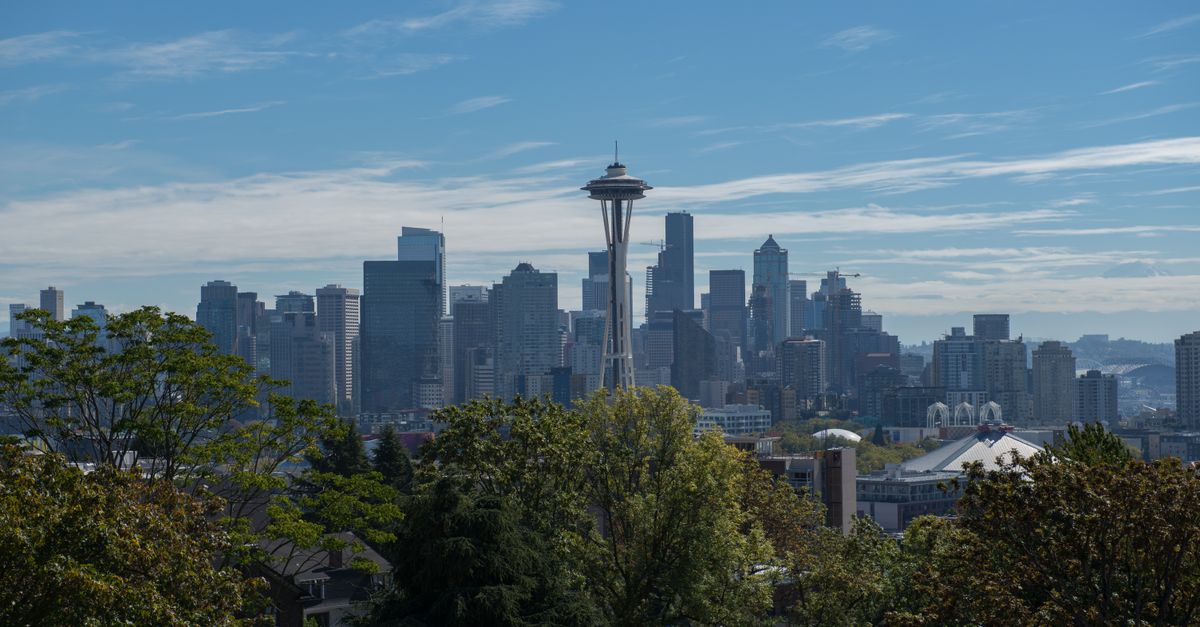
Seattle's economy, anchored by major technology employers headquartered in and around the metro, has produced high wages alongside some of the highest housing costs in the country, a combination that shapes school choice here as much as anywhere in this guide. Unlike Houston or Dallas, Seattle Public Schools does not currently operate a large, dedicated Montessori magnet program under its own name, which means most Seattle families access Montessori education through the private market, or by looking to public options further out in the wider Puget Sound region.
Quick Facts: Montessori in Seattle
| What to Know | In Seattle |
|---|---|
| Notable public options | None run directly by Seattle Public Schools; Geiger Montessori School operates as a public, tuition-free option within Tacoma Public Schools, about 30 minutes south |
| Typical private tuition | Washington statewide average around $15,674/year (2026); elite non-Montessori independents in Seattle can charge well over $50,000 for upper grades |
| AMI/AMS training locally | Montessori Education Institute of the Pacific Northwest (MEIPN), an AMS-affiliated, MACTE-accredited program rooted in a Seattle University teacher-training course dating to 1973 |
| Distinctive local factor | No SPS-run Montessori magnet within city limits; a wet season (roughly October-April) shapes daily outdoor practical life more than temperature ever does |
The Montessori Landscape in Seattle
Montessori education in Seattle proper is concentrated in independent, tuition-based schools rather than in a district-run public program, which is a real point of contrast with several other cities covered in this guide. Some of these private schools have deep roots in the region: Northwest Montessori School, for instance, has served Seattle-area families for more than five decades and holds accreditation from the Association Montessori Internationale (AMI). That kind of longevity is a genuine asset for families, since a school that has operated continuously for decades has typically weathered multiple economic cycles and leadership transitions without abandoning its Montessori fidelity, which is worth more than any single year's marketing.
Seattle does have a genuine local teacher-training pathway, even without a public magnet system: the Montessori Education Institute of the Pacific Northwest (MEIPN) traces its roots to a Seattle University Montessori teacher-education program that began in 1973, itself building on a 1962 visit by E.M. Standing, a close associate of Maria Montessori. MEIPN is AMS-affiliated and MACTE-accredited, offering coursework from Infant/Toddler through Elementary II, which means the region has trained a meaningful share of its own Montessori guides for half a century, even though most of that training has fed the private sector rather than a public one.
Public Montessori access in the wider Puget Sound region does exist, but it currently sits mainly outside Seattle Public Schools' own boundaries. Geiger Montessori School, for example, operates as a public Montessori option within Tacoma Public Schools, roughly a half-hour drive south of downtown Seattle depending on traffic. Families living in Seattle proper who want a tuition-free public Montessori option should not assume that one exists inside SPS; confirm current district offerings directly, since public program availability shifts over time and is not something a general guide can track in real time.
Climate and Outdoor Life for Seattle Montessori Families
Seattle's marine west coast climate is mild by national standards, rarely reaching extreme heat or extreme cold, but it is genuinely wet: a rainy season stretching roughly from October through April brings frequent, often light, persistent rainfall, while July through September is typically dry and sunny. That pattern changes how Montessori practical-life and outdoor work run here compared with hotter, drier metros. Rather than avoiding a season of extreme heat, Seattle-area schools generally plan around consistent, unglamorous rain gear, covered outdoor spaces, and mud-tolerant practical-life activities for most of the school year, with the dry summer stretch offering the most conventionally ideal outdoor conditions. A school's covered outdoor space and its policy on outdoor time in light rain are worth asking about directly, since in Seattle they matter far more often than a policy on extreme heat would.
Public Montessori Options Near Seattle
As noted above, Seattle Public Schools itself does not currently run a dedicated, large-scale Montessori magnet program comparable to what districts like Houston ISD or Dallas ISD operate. Families should verify this directly with SPS, since district program offerings can change. In the broader region, Geiger Montessori School within Tacoma Public Schools is a genuine public, tuition-free Montessori option, though it sits within a different district's boundaries and enrollment rules, which typically means either living within that district or applying through any inter-district or open-enrollment process the district allows. Always confirm current boundary and enrollment rules directly with the district in question before assuming eligibility.
Private Montessori Schools in Seattle
Independent Montessori schools are the primary path to a Montessori education within Seattle city limits, with established options including Northwest Montessori School (AMI-accredited) and other long-running private schools across neighborhoods like Capitol Hill, Ballard, and West Seattle, alongside a further set of options in nearby Eastside communities such as Bellevue and Redmond. As always, confirm a specific school's actual AMI or AMS accreditation directly rather than relying on the name, and ask how long the school has operated under its current leadership, since program quality and fidelity can shift meaningfully after a change in ownership or administration.
What Tuition Typically Looks Like Here
Washington State's average private-school tuition runs higher than many of the other states covered in this guide, a reflection of the Seattle metro's high overall cost of living. Elite independent (non-Montessori) schools in the city can charge tuition well above the state average for upper grades, and while standalone Montessori schools typically price below that top tier, families should expect Seattle-area Montessori tuition to run at or above the national average for private Montessori education rather than below it. Because Seattle Public Schools does not currently offer a large tuition-free Montessori magnet option within city limits, most Seattle families budgeting for Montessori should plan around private-school costs as the default scenario rather than the exception. See our full guide to Montessori school cost for a broader breakdown by program type and age group.
How to Find an Accredited School Near You
Given how much of Seattle's Montessori landscape runs through private schools, verifying real accreditation is an especially important step before enrolling or paying a deposit. Start with the official locators: the AMI/USA school locator, the American Montessori Society (AMS) school locator, and the National Center for Montessori in the Public Sector (NCMPS) for any public Montessori programs in the wider region. Our guide on how to find a Montessori school covers the visit and evaluation process in detail, and our comparison of AMI vs. AMS explains what each accreditation actually requires.
Don't assume a public magnet option exists here
Unlike several other cities in this guide, Seattle Public Schools does not currently run a large district-wide Montessori magnet program of its own, and the nearest genuine public option may sit in a neighboring district with entirely different boundary and enrollment rules. Confirm this directly with both SPS and any neighboring district before building your school-choice plan around an assumption of tuition-free public Montessori within city limits.