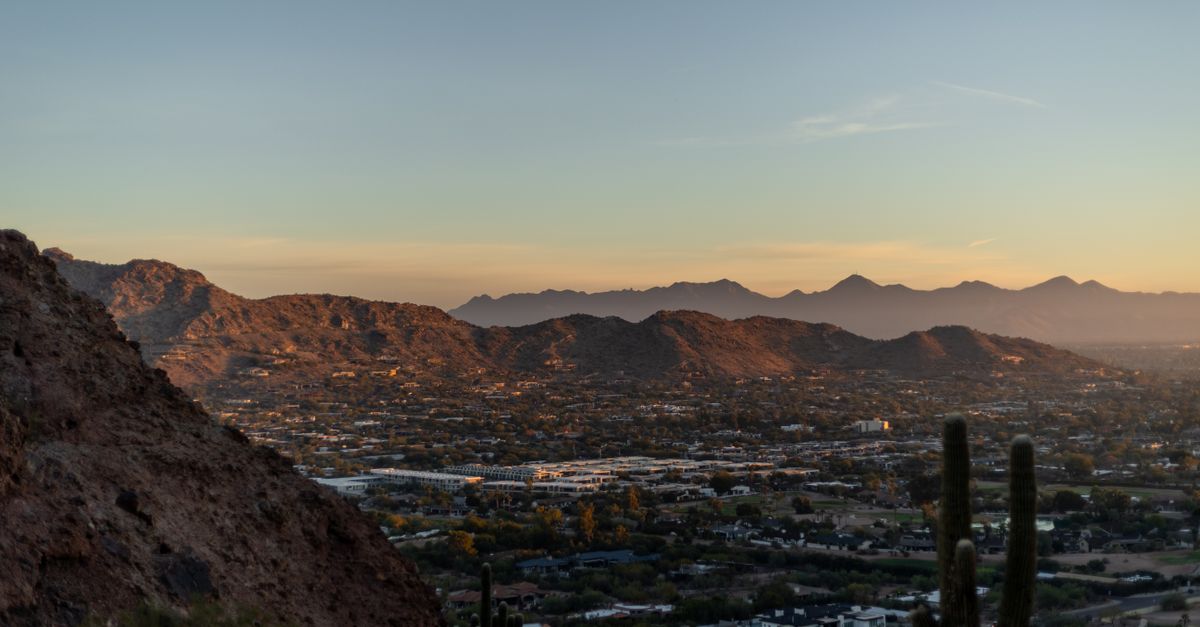
Metro Phoenix, often called the Valley of the Sun, is one of the fastest-growing large metro areas in the United States, spreading across Maricopa County through Scottsdale, Tempe, Chandler, Gilbert, Mesa, and Glendale. Two state-level policies shape the Montessori landscape here more than in most metros: Arizona's long-standing, expansive charter school law, which has produced an unusually high number of tuition-free public Montessori charter campuses, and the state's Empowerment Scholarship Account (ESA) program, which now allows nearly any K-12 student to direct public funds toward private-school tuition, including Montessori tuition. Together, they mean Phoenix families often have more accessible Montessori options, at more price points, than families in states without either policy.
Quick Facts: Montessori in Phoenix
| What to Know | In Metro Phoenix |
|---|---|
| Notable public options | Keystone Montessori Charter School (grades 1-9, chartered 1999), Villa Montessori's Phoenix campus (K-8), and Montessori Day Public Schools Chartered - Mountainside (K-8); all tuition-free public charters |
| Typical private tuition | Arizona statewide average around $12,100/year (2026), among the lowest of any metro covered in this guide |
| AMI/AMS training locally | SIMS (Southwest Institute of Montessori Studies), an AMI center in Mesa, and AMTEP (Arizona Montessori Teacher Education Program), an AMS pathway |
| Distinctive local factor | Arizona's ESA program lets many families direct public funds toward private Montessori tuition; June-September heat of 100-115°F pushes outdoor work to early morning or indoors |
The Montessori Landscape in Phoenix
Arizona has one of the oldest and most expansive charter school laws in the country, dating back to 1994, and Montessori education has been one of the direct beneficiaries. Several charter schools operating specifically as Montessori campuses have existed in the Phoenix area for decades, which is unusual: in most states, an authentic, fully implemented Montessori program at no cost to families is limited to a handful of magnet seats in one urban district. In greater Phoenix, it has instead grown into a small but genuine sector of its own.
At the same time, Arizona's ESA expansion, which opened eligibility to nearly all K-12 students starting in the 2022-23 school year, has reshaped the private Montessori market. Some private schools have kept tuition roughly flat to remain accessible to ESA-funded families, while independent reporting has also found that a number of Arizona private schools raised tuition after the program expanded. Neither pattern is universal, so it is worth asking any specific private Montessori school directly, and recently, about its tuition trend and whether it accepts ESA funds.
Climate and Outdoor Life for Phoenix Montessori Families
Phoenix's desert climate is one of the most extreme in the country for a major US metro, and it genuinely shapes how Montessori practical-life and outdoor work are scheduled here. Roughly October through April brings mild days, low humidity, and abundant sunshine, ideal conditions for outdoor practical life, gardening, and movement work, and many Phoenix-area schools lean heavily into that stretch. June through September is a different story: daytime highs regularly exceed 100°F and frequently pass 110°F, which pushes outdoor work to early morning or indoors entirely, and utility costs for keeping classrooms cool climb accordingly. A Montessori classroom's outdoor environment matters a great deal in Phoenix, and it is worth asking specifically how a school handles the four-to-five-month stretch of extreme heat, not just whether it has an outdoor space at all.
Public Montessori Options in the Phoenix Area
Metro Phoenix has a genuinely notable cluster of public charter schools running Montessori programs, more than most US metros of comparable size. Keystone Montessori Charter School, chartered in 1999 and recognized by AMI/USA, serves grades 1 through 9. Villa Montessori's Phoenix campus operates as a K-8 charter school. Montessori Day Public Schools Chartered, which includes its Mountainside campus, is another established K-8 charter option in the area. All operate as free public charter schools, meaning no tuition, though charter schools typically have enrollment caps and may use lotteries when demand exceeds available seats.
Because Arizona charter law allows schools to be authorized independently of a specific home district, families anywhere in the Phoenix metro can generally apply to any of these campuses, not only families who live in a particular attendance zone. Seats and waitlists change year to year, so confirm current enrollment status directly with each school.
Private Montessori Schools in Phoenix
Phoenix and its suburbs also support a range of independent, tuition-based Montessori schools, including some, like Villa Montessori School, that have operated in the Valley for decades alongside their charter counterparts. If a school participates in Arizona's ESA program, ask how that interacts with its published tuition and whether ESA funds cover the full cost or only a portion of it, since that answer varies school to school.
A Growing Training Hub in Mesa
Downtown Mesa, part of the greater Phoenix metro, is home to the Southwest Institute of Montessori Studies (SIMS), an AMI-affiliated training center offering Early Childhood and Elementary coursework, including a roughly 1,300-hour elementary preparation track. The Arizona Montessori Teacher Education Program (AMTEP) offers a parallel AMS-affiliated pathway. Between the two, Phoenix has a genuine local pipeline for both major Montessori credentialing traditions, which is worth knowing when you ask a specific charter or private school where its lead teachers actually trained.
What Tuition Typically Looks Like Here
Arizona's average private-school tuition is notably lower than in many other large states, running in the low five figures per year overall, with elementary tuition typically somewhat lower than that average and high school tuition somewhat higher. That statewide average sits well below the private-tuition averages reported in Texas, Colorado, or Washington metros, though individual Montessori schools in affluent Phoenix-area suburbs like Scottsdale and Paradise Valley can run above the state average. Arizona's ESA program can offset some or all of tuition for eligible families, but eligibility rules, funding amounts, and required paperwork change periodically, so confirm current details directly with the Arizona Department of Education and with the specific school. For a broader comparison of what Montessori education costs across different delivery models, see our guide to Montessori school cost.
How to Find an Accredited School Near You
With so many charter, ESA-funded, and fully private options in one metro, verifying actual accreditation matters even more in Phoenix than in a market with fewer choices. Start with the official locators: the AMI/USA school locator, the American Montessori Society (AMS) school locator, and the National Center for Montessori in the Public Sector (NCMPS) for public program information. Read our step-by-step guide on how to find a Montessori school, and our comparison of AMI vs. AMS to understand what each accreditation actually verifies before you commit to an application or a lottery entry.
Before you apply: confirm the funding path
- ✓ Ask directly whether the school is a tuition-free public charter, an ESA-funded private school, or fully private, since the name alone won't tell you
- ✓ If ESA-funded, ask what portion of tuition the account covers this year and what paperwork the state currently requires
- ✓ Verify the school's actual AMI or AMS accreditation directly, rather than assuming from its name or marketing
- ✓ Ask how outdoor practical-life work and gardening are handled during the June-September heat
- ✓ For charter schools, confirm this year's enrollment cap and whether a lottery is currently active
Tuition trends have gone both ways since Arizona's ESA expansion
Since Arizona opened its ESA program to nearly all K-12 students, reporting has found a mixed picture: some private schools have kept tuition roughly flat specifically to stay accessible to ESA-funded families, while other analyses have found a number of Arizona private schools raised tuition after the expansion. Ask any specific school directly how its published tuition has moved over the past few years, not just what it costs today.