
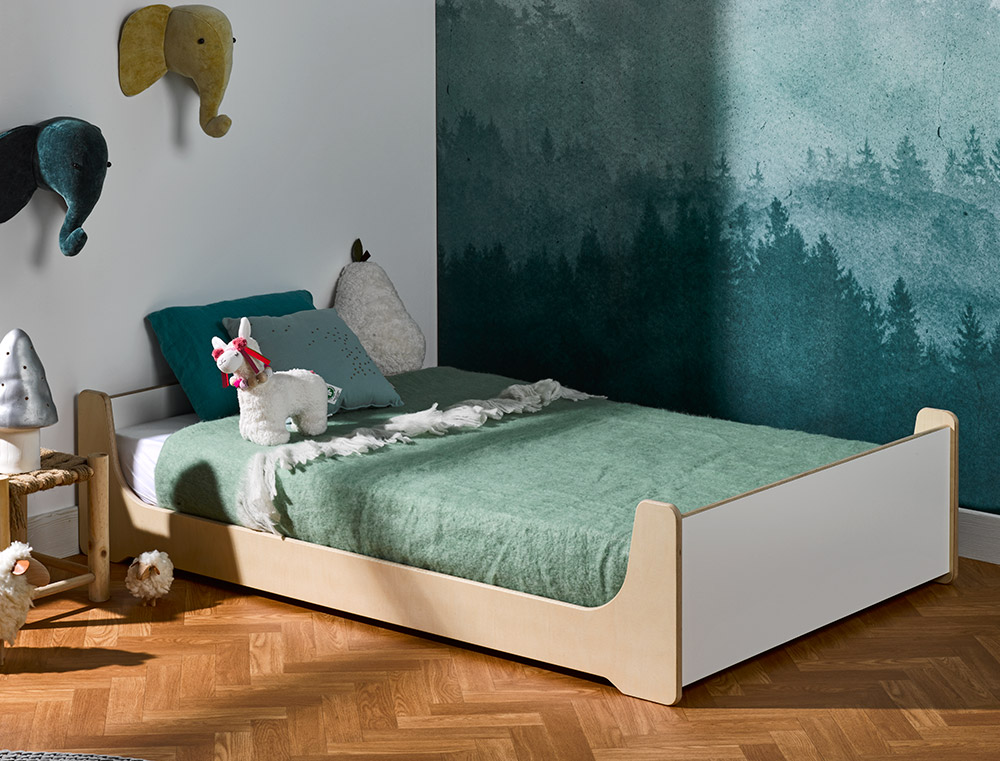
In conventional infant sleep setups, the crib places the baby in an enclosed space they cannot enter or exit independently. They wake and must wait for an adult to retrieve them. They want to move and cannot. They want to see their room and cannot. The floor bed challenges this by positioning the infant at floor level on a mattress without rails, within a carefully prepared room. The child can see their environment, move within it, and eventually, explore it on their own terms.
The principle behind it
Maria Montessori wrote extensively about the importance of movement in infant development. She observed that movement and intelligence are inseparable in the young child: the mind develops through the body's exploration of the physical world, not through passive observation of a ceiling or the bars of a crib. Confining a child's movement during the periods when they are most developmentally driven to move is, in Montessori's view, a form of deprivation.
The floor bed is not primarily about sleep. It is about what happens when the child is awake and alert in their sleep space. A newborn placed on a floor mattress can track their environment with their eyes from the first days. A two-month-old on a floor mattress can push up during tummy time and see the whole room. A five-month-old who wakes before their parent can explore the room safely. An eight-month-old can pull to standing on the low edge of the mattress and practice walking along it. None of these are possible in a crib, and for Montessori, this early freedom of movement is where independence begins, not something introduced later at the toddler stage.
Safety
The floor bed works only in a room that has been thoroughly prepared for safety. This is not optional. A floor-level sleep space without a prepared room is not Montessori; it is simply unsafe.
The Montessori infant room:
- Is fully babyproofed: all electrical outlets covered, all cords secured or removed, all furniture that could tip anchored to the wall
- Has no small objects anywhere the child can reach, including under furniture
- Has no window cords or blind strings within reach
- Has a firm, flat mattress on the floor: a standard crib mattress or a firm toddler mattress works well. Soft mattresses, pillows, and loose bedding are not used with infants.
- Is temperature-appropriate: a child who can move freely at night needs a room that is consistently comfortable, as they cannot pull up a blanket that has shifted
- Has a low mirror affixed safely to the wall at floor level
- Has a single, age-appropriate activity in the child's reachable space when they are awake and alert: during the newborn period, a Munari or Octahedron mobile above the mattress; later, a single grasping toy within arm's reach
The room should be visually simple. Not stark, but not overstimulating. Natural materials, soft colors, and a small number of carefully chosen objects.
From birth through toddlerhood
| Age | What the floor bed enables | What the room setup supports |
|---|---|---|
| Birth to 2 months | Visual tracking of the environment, tummy time on a firm surface | Munari mobile above the mattress, mirror at eye level |
| 2 to 4 months | Arm and leg movement, reaching, visual scanning of the room | Octahedron or Gobbi mobile, grasping ring within reach |
| 4 to 7 months | Rolling, pushing up, early reaching for objects beyond arm's length | Cleared floor space for rolling, one or two grasping objects |
| 7 to 10 months | Crawling, pulling to stand on the mattress edge, exploring the room | Low shelves with one or two objects, low mirror for standing |
| 10 to 18 months | Walking along furniture, exploring independently after waking | Low shelf with a few books and simple activities, child-safe room |
| 18 months onwards | Full independent entry and exit, self-settling, independent morning exploration | Toddler-level environment: low hooks, accessible clothes, low bookshelf |
The most common objections
"Won't they fall out of bed?"
There is no edge to fall from. The mattress is flush with the floor. A child who rolls off the mattress during sleep rolls onto the floor, which is exactly as soft as the floor normally is. This is rarely a problem in practice and resolves completely as soon as the child can crawl, at which point they simply crawl back onto the mattress.
"Won't they wander the house at night?"
The Montessori approach to this is simple: a baby gate on the room's door keeps the child safely in their prepared space. The room itself is the safe environment. The house beyond it is not prepared for an unsupervised toddler at 3am, and no one is suggesting otherwise. The gate is the limit. Within the room, the child has freedom.
"We live in a cold climate and the floor is cold."
A thick mattress provides substantial insulation from a cold floor. For very cold climates, a rug under the mattress adds another layer. The child's room should be maintained at a consistent sleeping temperature regardless of sleep setup. Sleeping bags designed for infants and toddlers, which wrap the body without loose fabric, are compatible with a floor bed setup and eliminate the blanket problem entirely.
"Our pediatrician says it isn't safe."
The safe sleep guidelines from pediatric health organizations (back sleeping, firm mattress, no loose bedding, no soft objects in the sleep space) are fully compatible with the Montessori floor bed, provided the room has been properly prepared. The concern about unsafe sleep environments is about soft surfaces, suffocation hazards, and parental co-sleeping without preparation. A firm floor mattress in a babyproofed room addresses all of these. If you have specific concerns, discuss the particular setup with your pediatrician, not just the concept.
The transition away
Most Montessori-influenced families keep the floor bed through toddlerhood, sometimes into the early primary years. The transition to a low platform bed or traditional bed happens when the child is ready, which usually means when they are sleeping consistently through the night and no longer need the floor-level accessibility for motor development purposes. There is no fixed age. Some families keep the floor mattress as the child's sleeping surface indefinitely; others transition at 18 months; others at three or four years. The child's needs and preferences, not a developmental timetable, guide the decision.
The floor bed is one element of a larger Montessori bedroom design. The complete bedroom guide covers how to set up the full room by age: storage, clothing access, reading area, and movement space, as well as how the bedroom setup connects to a morning routine the child can manage independently from the moment they wake up.
The floor bed and the infant mobiles
The Montessori mobile sequence (Munari, Octahedron, Gobbi, Dancers) is designed to be used with an infant who is lying on their back with free visual access to the space above them. A crib with high sides limits this visual field. A floor mattress with the mobile hung above at the correct height (8 to 12 inches above the infant's face) provides exactly the visual engagement the mobiles are designed to create. The two elements of the Montessori infant environment work together.