
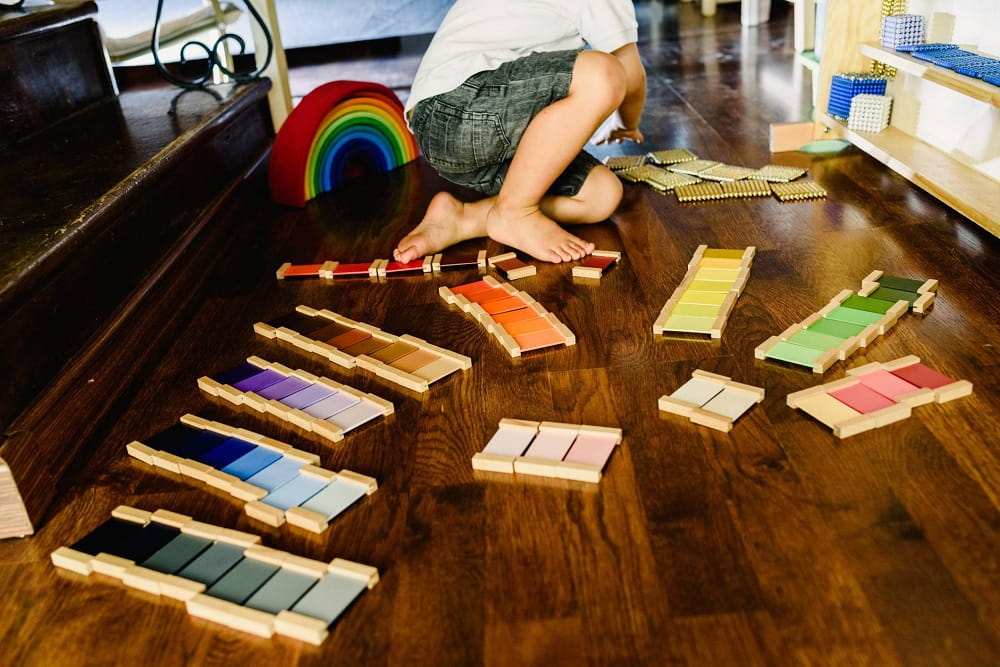
In a Montessori classroom, every material is introduced through a presentation: a careful, mostly silent demonstration by the guide that shows the child what the material is, how it is used, and what the activity's natural cycle looks like from beginning to end. The child observes, then tries. The guide steps back. This structure is not a teaching method in the conventional sense. It is a way of making the activity accessible without creating dependence. Understanding how to do this at home is the key to making Montessori work outside the classroom.
Before the presentation: preparation
Choose the right moment
Montessori presentations work when the child is calm, rested, and not already engaged in something else. They do not work when the child is hungry, tired, mid-tantrum, or about to leave the house. A child who is introduced to a new activity while distracted or dysregulated will not absorb the presentation, will not engage with the material independently afterward, and may develop a negative association with it.
The best moment for a new presentation is often in the morning, after a light snack, when the child is alert but not yet deeply engaged in their own activity. Five to ten minutes of calm is all that is needed, but that five to ten minutes matters.
Prepare the material completely
Every element of the activity should be ready before you invite the child. The tray should be complete. The materials should be in their starting position. Nothing should need to be fetched mid-presentation. A presentation interrupted by "wait, let me go get the other bowl" breaks the child's attention and disrupts the coherence of the demonstration.
Practice yourself first
For activities with a specific technique, try the activity yourself before presenting it to the child. Work through it slowly, identifying where the technique requires particular attention, where the most interesting challenge is, and where errors are likely to happen. A presentation is much smoother when the adult is familiar with the material's natural sequence and rhythm.
The presentation itself
Invite, don't instruct
The presentation begins with an invitation: "I'd like to show you something." Not "Come here and pay attention" or "Let me teach you how to do this." The tone is important. The child should feel they are being offered something interesting, not subjected to a lesson.
Sit beside the child, not across from them. This positions the demonstration so the child sees the materials from the same angle they will use when working independently. Sitting across from the child means the activity appears reversed from their perspective, which can cause confusion when they try to reproduce what they saw.
Use minimal language
One of the most consistent mistakes parents make when presenting Montessori activities is talking too much. The purpose of the presentation is to let the action speak. The child is watching the movement, registering the technique, and building a motor memory of the sequence. Continuous verbal explanation competes with this visual and kinesthetic processing.
Name key objects when you introduce them. Describe a key action when precision matters. Otherwise, let the demonstration proceed in near silence. "This is the spooning activity. This is the spoon. Watch." Then spoon. Let the activity demonstrate itself.
Move slowly and deliberately
Presentations are done significantly more slowly than the adult would normally perform the activity. Not artificially slow, but deliberately and purposefully slow. Each action is completed before the next begins. The spoon goes into the bowl, lifts the material, moves to the receiving bowl, deposits it, and returns, each as a distinct, visible movement. The child's eyes track this. The motor pattern is being encoded through observation. Speed prevents encoding.
Complete the full cycle
Every Montessori presentation includes the complete cycle: beginning, middle, and the return to starting position. A spooning activity is presented from the first spoonful through the last, then the materials are returned to their original position on the tray, ready for the next user. This teaches the child not just the activity but the full sequence including cleanup and restoration, which is part of the work, not a separate chore.
After the demonstration: inviting the child
After completing the demonstration, invite the child to try: "Would you like to try?" If they want to, let them begin without further instruction. Resist the urge to comment, correct, or guide as they work. The child is figuring out the technique through their own hands. This process is the learning. An adult who explains what the child is doing wrong, who reaches over to straighten something, or who takes the spoon to show them again, interrupts the process.
If the child makes an error that the material will correct by itself, let the material do that work. A spooning activity where the material spills will show the child what happened. They can clean it up and try again. If the error suggests a fundamental misunderstanding of the technique that will prevent any success, a gentle, brief re-demonstration of that specific step is appropriate, without comment and without judgment.
The three-period lesson for naming activities
For activities that involve learning names, whether the names of the parts of a flower, the names of numerals, or the names of colors, the three-period lesson is the specific Montessori presentation structure:
Period 1 (Naming): "This is red. This is blue." Each object is introduced by name, with a concrete demonstration. Two or three items maximum in a single session.
Period 2 (Recognition): "Can you show me red?" The child identifies the named object without needing to produce the name themselves. This is the consolidation period. It can span multiple sessions before moving to Period 3.
Period 3 (Recall): "What is this?" The child produces the name independently. Move to Period 3 only when Period 2 is fully secure. If the child cannot recall in Period 3, return to Period 1 without any sign of frustration or disappointment.
Handling errors without correction
Montessori materials, especially the sensorial activities, are designed to be self-correcting wherever possible. The Cylinder Blocks tell the child when a cylinder is wrong. The Pink Tower shows instability when built incorrectly. The matching materials do not match when wrong. The role of the adult is to trust this process, not to add an additional layer of verbal correction on top of it.
When a material is not self-correcting and the child has made a significant error, the technique is to wait and observe. If the child notices the error themselves and self-corrects, this is ideal. If they continue without noticing, a gentle distraction can be used: briefly draw their attention to something else, then return to the activity from the beginning when they are ready. This resets the work without framing the error as a failure.
What is never appropriate in Montessori is pointing at an error and saying "no, that's wrong" or "not like that." The child's relationship to the activity should remain positive and self-directed. An adult correction that carries any emotional charge disrupts this relationship.
When to step back completely
The goal of every presentation is that it becomes unnecessary, a direct expression of Montessori's own call to help me do it myself. A child who has been introduced to an activity correctly, who has had the chance to try it with the adult nearby, and who has engaged with it successfully, no longer needs the adult present for that activity. They own it. They can access it, do it, and return it independently.
This is the measure of a successful Montessori presentation: the child's independence with the material afterward. Not whether they did it correctly the first time, not whether they used the technique exactly as demonstrated, but whether they can engage with it, find their own rhythm with it, and feel competent working with it on their own.
The most important thing to practice
The single most valuable skill to develop as a Montessori parent is the ability to watch without intervening. Sit beside your child as they work. Resist every impulse to help, correct, or guide. Watch what they are actually doing rather than what you expected them to do. The child who works independently, makes their own mistakes, and finds their own solutions is building something far more durable than any skill a parent can scaffold them through. Your most active role in a Montessori activity, after the presentation, is to do nothing.