
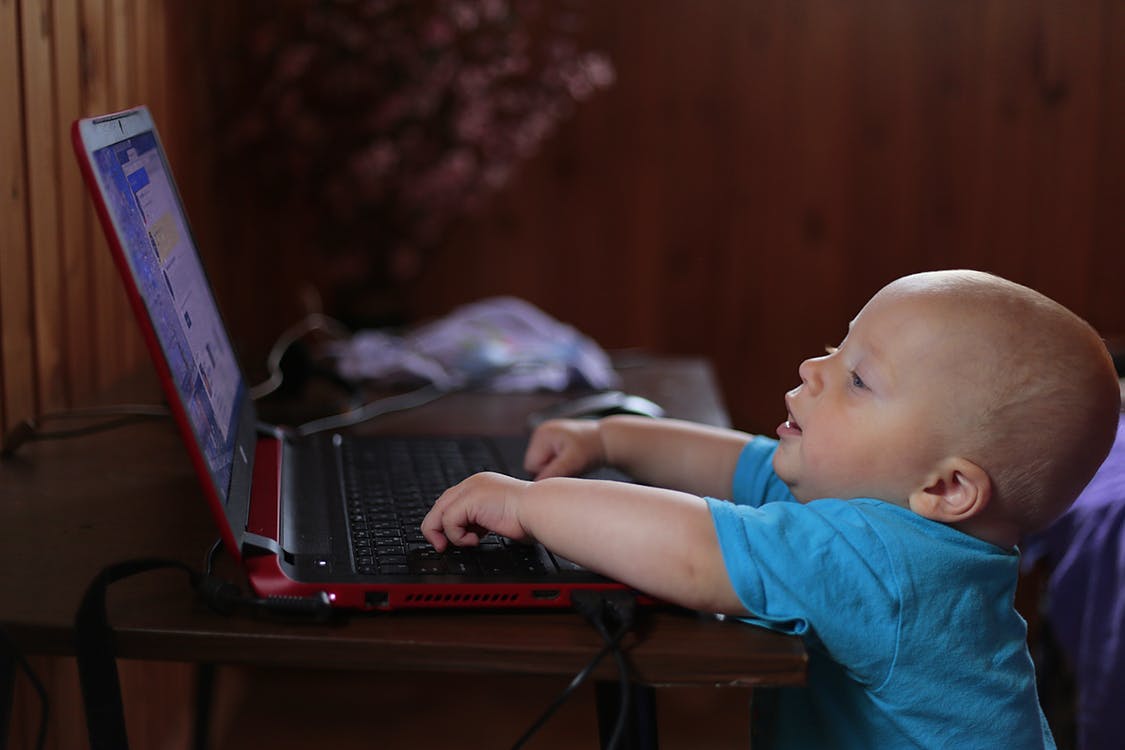
Screens are the default entertainment and educational tool in most American households with young children. Tablets, smartphones, streaming services, and educational apps are marketed aggressively as early learning tools, and many parents use them as exactly that. The Montessori perspective cuts against this trend not because Montessori was anti-technology, but because Montessori had a highly specific theory of what the child's first years require. That theory is directly incompatible with what screens provide.
Why Montessori sets limits on screens for young children
The absorbent mind and real-world experience
Montessori's most important concept for understanding early childhood is the absorbent mind: the idea that children from birth to six absorb their environment effortlessly and completely, building their entire mental model of the world from direct physical and sensory experience. Language is absorbed from real conversations. Mathematical understanding is built from handling real objects. Social skills develop through real interactions with real people. The sense of cause and effect comes from real actions with real consequences.
A screen does not provide any of these. A screen provides a simulation of experience. Images, sounds, and sequences that represent the world rather than being the world. For an adult, this distinction matters less because the adult already has an established mental model of reality onto which screen content can be mapped. For a child building that model from scratch, the simulation is a poor substitute for the real thing, and can actually interfere with the development of real-world understanding.
The sensitive periods and what screens displace
Montessori identified specific sensitive periods in early childhood: windows of heightened neurological receptivity during which the child is primed to develop specific skills. The sensitive period for language peaks between eighteen months and four years. For movement, it spans birth through five. For small details and sensory refinement, between eighteen months and three years. These windows close. A child who spends the sensitive period for language development primarily watching screens is not building language through the mechanism that makes that window powerful: real, contingent, face-to-face human interaction.
Research from developmental linguistics supports this strongly. Studies comparing language acquisition in children with high screen exposure versus high conversational exposure consistently find that screens, even interactive ones, do not produce the language development that conversation does. The screen talks at the child. The caregiver talks with the child. The child's brain responds to the difference.
The concentration problem
One of the things Montessori most valued, and most carefully cultivated, was the child's capacity for deep concentration: sustained, self-directed attention to a single activity. This capacity is built through practice with materials that require real attention and offer real feedback. It is undermined by exposure to environments designed to maximize stimulus switching, which is exactly what most screen content for young children is designed to do.
High-frequency cuts, loud sound effects, rapid movement, and constant novelty keep a child's attention through external stimulation, not through internal engagement. A child who has been conditioned to expect this level of stimulus will find real-world activities, which do not compete for attention but invite it, understimulating and difficult to settle into. This is a meaningful problem for classroom-based learning, which depends on precisely the kind of internal attention that screens train away.
The Montessori guidelines
Montessori schools and the broader Montessori community generally follow these guidelines:
- Under 3 years: No screen time. This aligns with American Academy of Pediatrics guidelines, which also recommend against screens other than video chatting for children under 18 to 24 months. Montessori extends this to three years based on the theory of the absorbent mind and the critical nature of this developmental window.
- 3 to 6 years: Minimal and intentional. If screens are used, they should be viewed with a parent, the content should be slow-paced and non-commercial, and the session should be brief, thirty minutes or less. Screens should not be in the bedroom or used as background noise.
- 6 to 12 years: Increasingly appropriate for educational use when chosen intentionally. Still not recommended as passive background entertainment. Quality and purpose matter more than quantity at this stage.
What to offer instead
The most common objection to reducing screen time is not disagreement with the principle but uncertainty about what to replace it with. The answer, in a Montessori framework, is a prepared environment that offers genuine alternatives:
- An accessible shelf with materials the child can engage with independently, rotated regularly to maintain interest
- Access to the kitchen for practical life work: pouring, preparing snacks, helping with real household tasks
- Outdoor access: a yard, a park, or any of the outdoor activities where movement, exploration, and sensory engagement are possible
- A reading corner with books accessible at child height, changed regularly
- Art materials in a defined space the child can access independently
- Time that is genuinely unstructured: no screens, no organized activities, just the child with time and their environment
Unstructured time is particularly undervalued. A child who has learned to manage boredom creatively, to find their own engagement, to invent their own activities, has developed something screens systematically prevent: the ability to generate their own interest. This is a capacity that matters far beyond childhood.
The parent's screen use
Research consistently shows that parental screen use, particularly parental smartphone use in the presence of young children, has a measurable negative effect on early language development, parent-child interaction quality, and children's social development. A Montessori household that limits children's screen time while parents are frequently on their phones has missed an important part of the equation.
This is not a guilt trip. It is a recognition that the screen environment includes the screens adults use, not just the ones given to children. Children in the sensitive period for language development need real, contingent, responsive conversation. Every moment an adult is looking at a phone while a child is present is a moment that conversation did not happen.
Navigating the real world: family, school, culture
Montessori families do not live in isolation. Children have cousins who play video games, friends who watch certain shows, grandparents who use the iPad as a babysitting tool. The Montessori approach to screens does not require social isolation or conflict over every screen encounter. It requires a clear home baseline and flexibility about what happens elsewhere.
A child who has a solid home environment with rich alternatives to screens, clear household expectations, and parents who model limited screen use, is reasonably well insulated against occasional screen exposure elsewhere. The goal is not to prevent every contact with screens. It is to ensure that screens are not the default mode in the child's home environment during the years when that environment matters most for development.
The replacement that matters most
When families reduce screen time, the replacement that has the most documented developmental impact is not a structured activity or a specific Montessori material. It is conversation. Real, back-and-forth, adult-child conversation about whatever the child is interested in, with responses that follow the child's lead rather than directing the topic. Twenty minutes of genuine conversation per day does more for language development, cognitive growth, and emotional security than any app, any program, or any educational screen content available. It is also free, always available, and requires no equipment.
Screens in Montessori elementary education
For children in the elementary years, ages six to twelve, the Montessori position on screens is more nuanced. Technology becomes a legitimate tool for research, writing, and specific projects. The concern shifts from developmental harm to healthy habits: using technology purposefully rather than passively, choosing content rather than consuming whatever appears next, and maintaining the capacity for deep, offline engagement that the primary years should have built.
An elementary child who learned to concentrate through years of Montessori work with materials is better equipped to use technology purposefully than one who has been using screens from infancy. The six-year gap in managed screen exposure is not a deprivation. It is the foundation for a more skillful relationship with technology in the years that follow.